


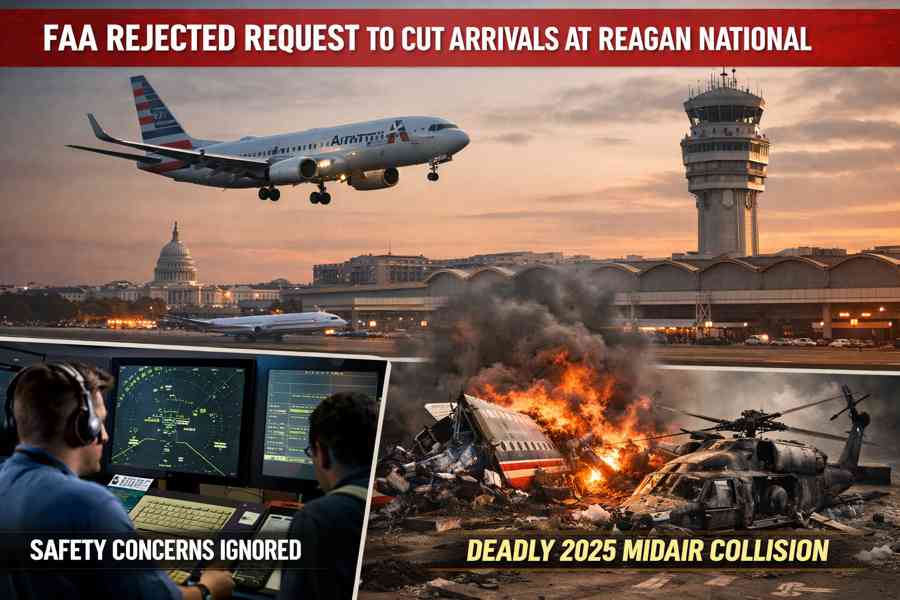
WASHINGTON, D.C.—Federal Aviation Administration officials declined a safety-driven request from air traffic controllers to reduce flight arrivals at Ronald Reagan Washington National Airport, months before a fatal 2025 midair collision involving an American Airlines passenger jet and a U.S. Army Black Hawk helicopter, according to internal records released by the National Transportation Safety Board.
The documents show controllers sought to lower peak-hour arrival demand on the airport’s primary runway from 36 flights per hour to 32, citing increasing congestion and difficulty maintaining required separation standards in one of the country’s most constrained airspaces. The request, submitted May 9, 2023, originated from controllers at the Potomac Consolidated Terminal Radar Approach Control facility in Warrenton, Virginia, which manages arrivals into Reagan National, the primary airport serving the nation’s capital.
The internal records provide a new window into how operational strain at Reagan National was flagged internally before the crash that killed 67 people and intensified scrutiny of traffic volume, staffing pressures, and the complexity of mixing commercial aircraft with frequent military helicopter activity near Washington.
Controllers Raised Safety Concerns Over Separation and Workload
Controllers at PCT TRACON warned FAA leadership that increasing congestion at Reagan National was creating unsafe operating conditions, particularly during peak arrival periods. Their request focused on reducing the hourly arrival rate on the airport’s primary runway from 36 to 32 aircraft, a change intended to improve spacing between aircraft and reduce controller workload during high-volume windows.
According to internal FAA correspondence cited in the NTSB records, the controllers raised concerns about an inability to consistently maintain the required four miles of separation between arriving aircraft. They said the limitation was making it more difficult to manage traffic flows safely into Reagan’s tightly constrained airspace, where arrival paths are limited and traffic density can spike quickly.
Controllers told investigators that an FAA official serving at the time as Washington district general manager declined to forward the request up the agency’s management chain. The PCT TRACON team never received a formal written response and was instead verbally informed that the request would not proceed.
The NTSB records indicate the request was framed as a safety measure, not a capacity-driven adjustment, as controllers sought a manageable arrival rate that would allow them to maintain separation standards more consistently during peak conditions.
Internal Records Point to Political Sensitivity at Reagan National
Investigators found that concerns over political repercussions played a role in the decision-making around reducing arrivals at Reagan National, which is heavily used by members of Congress traveling between Washington and their home districts.
At the same time controllers were raising concerns, Congress was advancing legislation to expand airline slot allocations at the airport—an issue with high visibility for airlines, lawmakers, and business travelers who rely on frequent service.
Internal NTSB documents released in June quote controllers as being told the issue was “too political” to advance.
The same records suggest FAA leadership was wary of opposition from House and Senate members who depended on frequent service at the airport, underscoring the tension between operational safety margins and external pressure to maintain or expand capacity.
Collision in January 2025 Killed 67 People
In January 2025, American Airlines Flight 5342, operating into Reagan National, collided midair with an Army UH-60 Black Hawk during the final approach to runway 33.
The crash killed all 64 passengers and crew aboard the jet and three crew members on the helicopter, making it one of the deadliest U.S. aviation accidents in recent years.
Investigators have focused on the crowded and complex operating environment around Reagan National, where commercial traffic shares nearby corridors with military and government helicopter operations.
Post-Crash Arrival Caps Were Lowered, Then Partially Restored
Following the accident, arrivals at Reagan National were temporarily reduced to 28 flights per hour, according to The Washington Post. That cap has since increased to about 30 arrivals per hour, and officials familiar with the investigation say the reduction is not permanent.
Before the crash, arrival rates sometimes exceeded planned limits, reaching as high as 50 aircraft per hour during peak periods. NTSB records indicate that such congestion forced controllers to rely on continual mitigation strategies, including last-minute runway changes intended to keep traffic moving safely.
One common measure involved diverting aircraft to runway 33, a shorter and less frequently used runway requiring a more complex approach path.
Runway Change and Helicopter Activity Under Scrutiny
NTSB records show Flight 5342 was reassigned to runway 33 moments before the collision, placing it directly over the helicopter’s operating corridor.
In the final 90 seconds before impact, the controller responsible for the airspace was managing 12 aircraft, including five helicopters—an indication of the layered complexity controllers faced during peak activity.
Investigators also found the Black Hawk was flying above its permitted altitude and had disabled its ADS-B system, limiting its visibility to other aircraft. The combination of altitude deviation, reduced aircraft visibility, and high traffic volume has become central to the investigation’s assessment of risk factors in the airspace.
New Restrictions and More NTSB Recommendations Expected
Transportation Secretary Sean Duffy announced permanent restrictions on certain helicopter routes near Reagan shortly before the first anniversary of the crash.
Additional safety recommendations are expected when the NTSB votes on its final report, which will likely address airspace design, arrival-rate management, and the integration of military aircraft operations near high-density commercial airports.
Bottom Line
The FAA’s refusal to advance a controller request to reduce arrivals at Reagan National highlights unresolved tensions between safety margins and political pressure—an issue now at the center of the NTSB’s examination of how congestion and complexity contributed to the fatal 2025 collision.
