


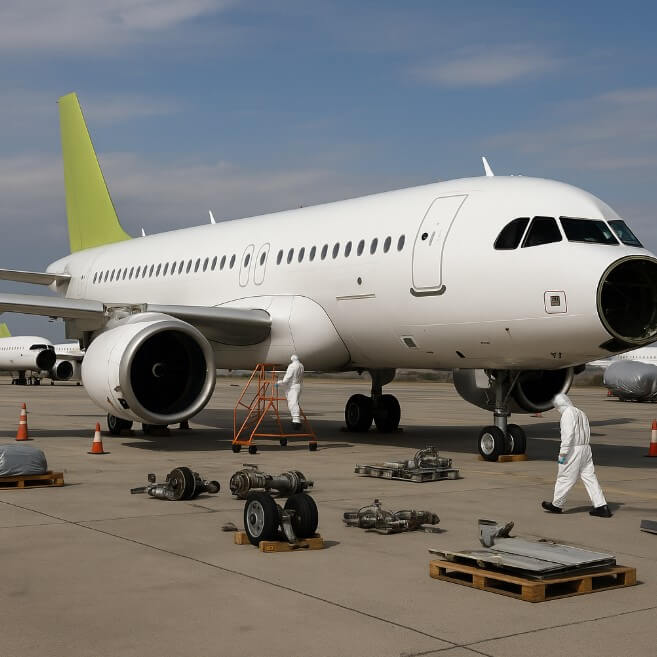
VALENCIA, Spain — At Castellon Airport, a quiet outpost on Spain’s Mediterranean coast, a striking scene captures a growing paradox in global aviation. Rows of nearly new Airbus A320neo and A321neo jets sit parked under the sun, while teams in protective suits carefully remove their engines and other valuable components. These aircraft, designed for decades of efficient service, are now being dismantled after only a few years in operation.
The reason: a crippling shortage of Pratt & Whitney geared turbofan (GTF) engines that has upended airline operations worldwide. Despite strong demand for air travel and new aircraft, many carriers have been forced to ground planes or turn to unconventional measures—such as scrapping nearly new jets—to keep their fleets running.
A Global Bottleneck
The GTF shortage has created an unusual economic reality where the engines powering modern Airbus jets are worth more than the aircraft themselves. “High-demand powerplants are rented as spares for up to $200,000 per month per engine,” reports The Economic Times, underscoring how valuable these components have become in the secondary market.
According to aviation data provider Cirium, roughly one-third of the GTF-powered Airbus fleet is currently grounded or in storage—compared with just 4% of aircraft equipped with competitor engines. The shortage worsened after Pratt & Whitney discovered defects in the powdered metal used in engine manufacturing, prompting extensive inspections and repair backlogs.
The cascading effect has left airlines struggling to maintain schedules, forcing them to extend the service lives of older aircraft or part out newer ones to source components. The result is a patchwork fleet management strategy driven more by necessity than by design.
Dismantling Modern Aircraft
At Castellon, the dismantling process is both methodical and surreal. Technicians remove avionics, landing gear, and flight-control systems while leaving the empty nacelles of missing engines on the wings. The salvaged engines are then stored under protective covers to preserve their resale or lease value.
Many of the jets being stripped down were never meant for such an early demise. Some A321neos being dismantled had entered service as recently as six years ago. These aircraft were built to deliver long-term fuel savings and reduced emissions, not to serve as spare-parts donors.
“Despite being among the most advanced narrow-body jets in operation, their engines have become a limiting factor rather than a technological advantage,” said one industry source familiar with the matter.
Financial and Operational Ripples
The economic logic behind parting out nearly new aircraft lies in the imbalance between supply and demand for serviceable engines. With repairs taking months and production lines stretched thin, airlines and lessors have found that selling or leasing engines individually can yield higher returns than keeping planes idle.
The practice has sparked debate across the industry. International Air Transport Association (IATA) Director General Willie Walsh described the situation as a “systemic challenge in aircraft supply chains,” noting that the shortages expose weaknesses in how modern aviation assets are managed.
Aviation financiers, however, see opportunity in the disruption. Specialized firms such as eCube and Willis Lease Finance are profiting by acquiring and dismantling jets to sell engines and components into a red-hot aftermarket. The resulting trade has created multi-million-dollar returns while airlines await long-delayed engine replacements.
The Broader Implications
Analysts attribute the crisis to a combination of factors: complex manufacturing processes, over-optimization for fuel efficiency at the expense of durability, and production slowdowns in the wake of the COVID-19 pandemic. Rising oil prices during the development phase of the GTF engines also drove engineering decisions that have proven difficult to sustain in mass production.
For now, Castellon Airport has become a symbol of the industry’s struggle to balance innovation with reliability. The sight of gleaming, almost-new airframes being cannibalized for parts encapsulates a global challenge that extends from airline hangars to financial institutions and suppliers.
A Market Turned Upside Down
What was once a straightforward equation—newer aircraft mean higher value—has been inverted. Engines alone are fetching prices and lease rates that defy traditional aircraft economics. Until manufacturers resolve production and maintenance bottlenecks, this trend is likely to persist.
Castellon’s transformation into a makeshift aircraft graveyard highlights the unintended consequences of technological advancement and supply chain fragility. Modern jets, once symbols of progress and efficiency, are now testaments to the limits of a tightly wound global production system.
As the aviation industry waits for the engine crisis to ease, the message is clear: even the most advanced machines are only as valuable as the parts that keep them flying.
