


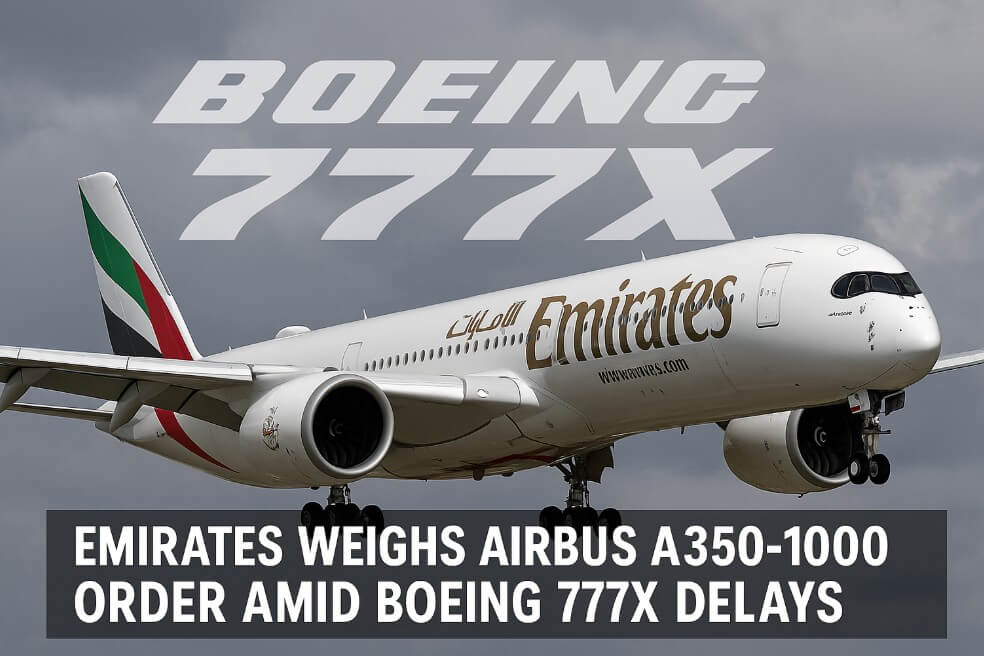
DUBAI — Emirates Airline is considering a major pivot in its long-term fleet strategy, potentially ordering up to 30 Airbus A350-1000 jets as persistent delays in Boeing’s 777X program disrupt the carrier’s growth and fleet replacement plans. The move could mark a significant break from Emirates’ traditional loyalty to Boeing and signal a pragmatic shift toward operational flexibility.
According to industry sources familiar with the negotiations, Emirates’ interest in the A350-1000 represents a calculated response to the 777X certification setbacks that have dragged on for years. The airline, headquartered at Dubai International Airport (DXB), has already begun receiving its first Airbus A350-900s — the smaller variant of the same family — and is now weighing whether to expand that commitment to include the larger, longer-range A350-1000.
A final announcement could come as early as this week’s Dubai Airshow, a venue historically used by Gulf carriers to unveil multibillion-dollar aircraft deals.
Strategic Diversification After Delays
Emirates, the world’s largest international airline by passenger kilometers, built its global reputation on a streamlined widebody fleet composed solely of the Airbus A380 and Boeing 777. But the retirement of the A380 production line and the repeated postponements of Boeing’s 777X entry into service — now expected no earlier than 2027 — have forced the airline to reconsider its long-standing two-type strategy.
In recent years, Emirates confirmed orders for the Airbus A350-900 and the Boeing 787 Dreamliner as part of a diversification effort aimed at maintaining growth. The potential addition of the A350-1000 would deepen that diversification, adding capacity and flexibility to its long-haul operations.
Industry analysts say the possible order underscores a growing trend among major airlines: adapting fleet plans to evolving market conditions and manufacturing delays rather than brand loyalty.
Engine Concerns That Stalled Earlier Orders
The A350-1000’s potential entry into Emirates’ fleet would also represent a striking reversal in tone from the airline’s leadership, which has been openly critical of the aircraft’s Rolls-Royce Trent XWB-97 engines.
Emirates President Tim Clark has not hidden his skepticism in the past, at one point describing the A350-1000’s engines as “defective,” citing “short maintenance intervals and reduced performance in high-temperature environments typical of the Middle East.” His concerns have long centered on durability issues tied to sand ingestion — a key operational challenge for Gulf-based carriers.
Those reservations contributed to Emirates’ decision to steer clear of the A350-1000 during earlier procurement cycles. However, both Qatar Airways and Etihad Airways currently operate the aircraft, lending credibility to reports that performance limitations are manageable, if not fully resolved.
Rolls-Royce, meanwhile, is working to address those issues. The British engine maker has been conducting extensive testing designed to improve sand-ingestion resilience and overall reliability in desert climates. While “the results are promising,” industry observers caution that the improvements have yet to be validated at full operational scale.
Pressure From Boeing’s Persistent Delays
The primary driver behind Emirates’ reconsideration, however, remains Boeing’s troubled 777X program. Emirates holds the largest order book for the next-generation Boeing jet — 205 aircraft in total — but the program’s repeated delays have disrupted the airline’s fleet renewal schedule.
Originally slated to enter service in 2020, the 777X’s certification timeline has slipped multiple times amid regulatory scrutiny and production challenges. Current projections suggest 2027 as the earliest realistic delivery date. Each delay has intensified pressure on Emirates to secure widebody capacity to meet future demand and maintain its global network.
“The 777X delays have created a planning gap,” said one industry analyst familiar with the airline’s fleet strategy. “Emirates can’t afford to wait indefinitely, and the A350-1000, while not perfect, is available and proven in service with other carriers.”
A Broader Reflection of Industry Headwinds
If confirmed, the A350-1000 order would complement Emirates’ growing A350-900 fleet and serve as a hedge against supply disruptions from any single manufacturer. It would also signal a broader reality facing airlines worldwide: the shrinking pool of viable long-haul aircraft choices amid long production backlogs and technical challenges.
For Emirates, the deal would demonstrate a pragmatic approach — prioritizing availability and reliability over earlier objections. It would also align with the airline’s broader strategy of maintaining flexibility in a volatile post-pandemic aviation market.
While the A350-1000 may not have been Emirates’ preferred aircraft in past years, it now appears to offer the right balance of performance, efficiency, and immediate availability to sustain the airline’s global ambitions.
The aviation industry will be watching closely as the Dubai Airshow unfolds. For Emirates, a formal announcement could mark both a strategic shift and a sign of the times — where practicality, not preference, dictates the future of fleet planning.
