


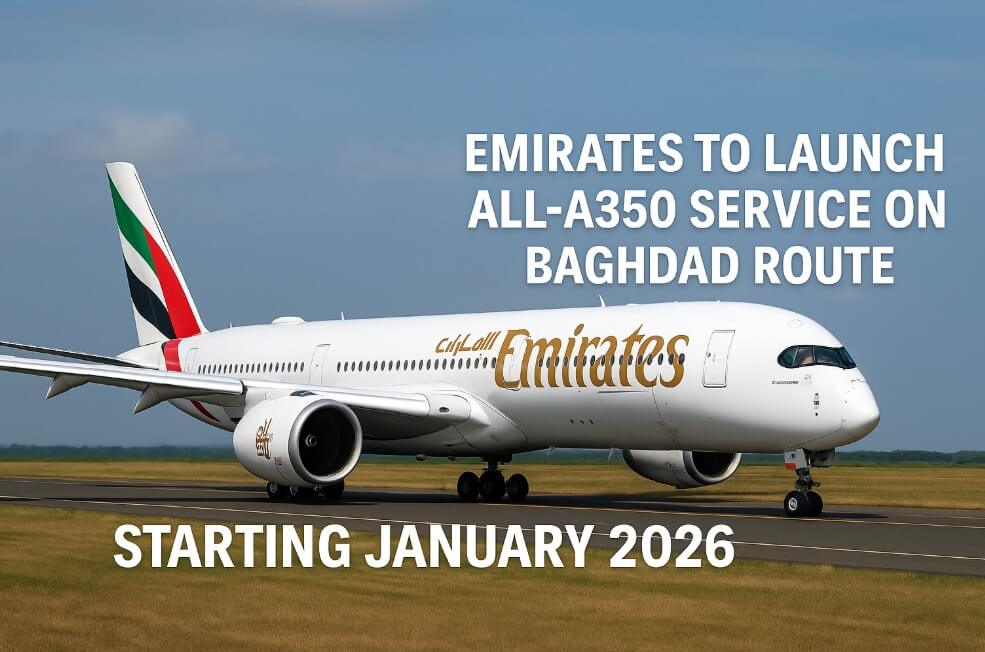
Emirates Commits to Full A350 Schedule
Emirates Airline will transition all flights between Dubai (DXB) and Baghdad (BGW) to the Airbus A350 beginning January 1, 2026, marking a significant upgrade to one of its most strategically important regional routes. The shift replaces a mixed-fleet operation with a fully standardized aircraft type, aiming to deliver greater comfort, reliability, and service consistency as demand for premium travel to Iraq increases.
The carrier currently operates a combination of A350s and Boeing 777s on the route, with the 777 covering four weekly rotations. Under the new schedule, all seven weekly flights—operating as EK 943 and EK 944—will use the A350. Emirates said this change “brings a uniform aircraft type on the route and introduces the airline’s newest cabins to every service.”
Modern Cabin Features Across All Classes
The A350 has already begun appearing on the Baghdad schedule through earlier deployment on flights EK 941 and EK 942. Beginning next year, the aircraft will fully replace the Boeing 777.
Emirates is positioning the A350 as a long-term enhancement to passenger experience. The aircraft includes a three-class layout with:
-
32 Business Class lie-flat seats in a 1-2-1 configuration
-
21 Premium Economy seats in a 2-3-2 layout
-
259 Economy seats in a 3-3-3 configuration
The airline says the new design improves cabin circulation thanks to wider aisles and quieter interiors. It also features the latest update to Emirates’ ice entertainment platform, offering “a sharper display and a broader content library.” Improved lighting systems and advanced noise control are expected to provide better rest on daytime and evening services alike.
Consistent Service for a Growing Market
Emirates describes the switch to an all-A350 operation as a key step in building service predictability and strengthening regional connectivity. “The uniform A350 deployment allows the airline to offer predictable service standards on every departure to and from Baghdad,” the carrier said.
The improved consistency is expected to support rising demand in Iraq for premium travel and reliable connections through Dubai to Europe, Asia, and the Americas. The move underscores Emirates’ long-standing commitment to the Iraqi market, where the airline has made periodic capacity and product adjustments over the past decade.
A350 Role in Strategic Growth and Sustainability
Beyond cabin upgrades, the A350 aligns with Emirates’ broader operational goals. The aircraft type is known for strong fuel efficiency and reduced environmental impact—factors that fit the airline’s long-term modernization strategy. Emirates noted that the A350 “fits strategic growth plans by offering fuel efficiency, improved environmental performance, and a cabin design suited for both regional and long-haul travel.”
With additional A350s expected to join the fleet in coming years, the Baghdad route is among the first in the region to benefit from full deployment of the model.
Baghdad’s Cultural Appeal Highlighted
The airline’s announcement also provided an in-depth look at Baghdad as a destination, emphasizing its historical weight and diverse attractions. Travelers arriving at Baghdad International Airport (BGW) enter a city shaped by multiple civilizations and centuries of cultural evolution. The release highlighted museums, shrines, riverside spaces, and historic neighborhoods as central to the city’s appeal, noting that Baghdad “offers a rare chance to experience layered history, sacred landmarks, and a strong artistic identity.”
Key sites include:
-
The Iraq Museum, home to Sumerian, Assyrian, Babylonian, and Abbasid artifacts
-
Mutanabbi Street and Shorja Bazaar in Old Baghdad
-
Al Mustansiriya Madrasa and the Abbasid Palace
-
The Kadhimayn Shrine and the nearby Arch of Ctesiphon
The guidance also emphasized traveler tips: reviewing advisories, using trusted transportation, dressing modestly, and keeping photography within permitted areas.
Strengthening Connectivity Through Dubai
With the A350 transition, Emirates expects smoother connections from Baghdad into its global network, particularly for long-haul journeys. The move strengthens the carrier’s role as a connector for travelers across the Middle East, Europe, Africa, Asia, and the Americas.
“Emirates positions the shift as a continued investment in passenger comfort and regional stability,” the announcement concluded.
