


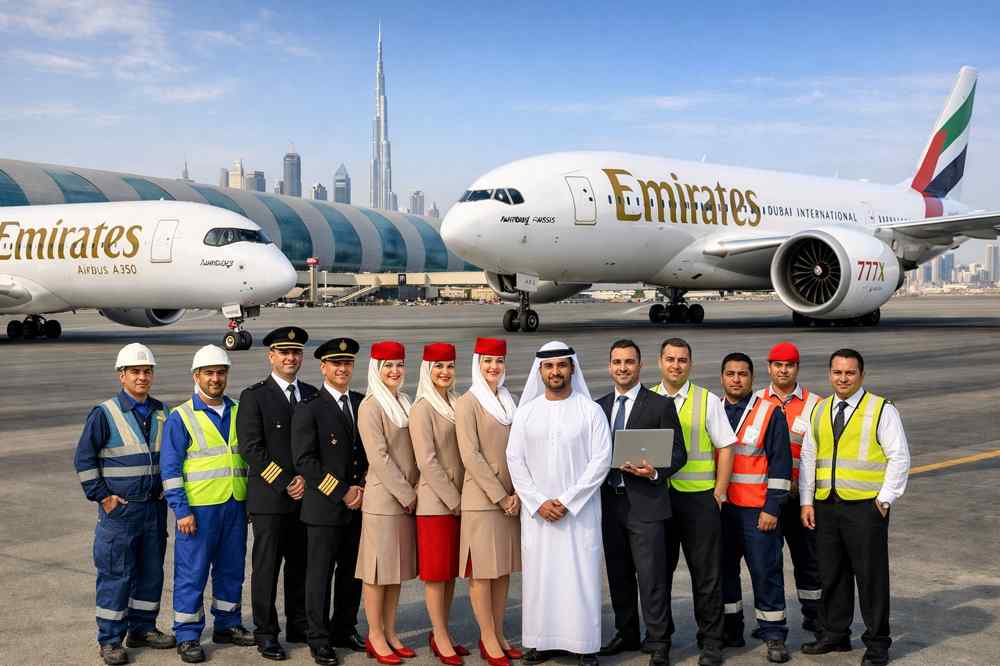
Dubai-based Emirates Airline plans to recruit nearly 20,000 new operational employees over the next five years, a significant workforce expansion aligned with aircraft deliveries and steady growth across its global route network. The hiring initiative underscores the carrier’s confidence in sustained demand and its long-term strategy centered on Dubai as a global aviation hub.
The recruitment plan, announced during a media roundtable at the airline’s headquarters, reflects Emirates’ preparation for a decade of expansion supported by new aircraft entering service and increased frequencies on existing routes. The airline’s leadership emphasized that hiring will be paced to delivery schedules rather than short-term market volatility.
Workforce Growth Anchored in Dubai
Emirates’ growth plans remain anchored at Dubai International Airport, where the airline continues to consolidate operations as it scales capacity. As new aircraft join the fleet and the network expands geographically, additional staff will be deployed to support both new destinations and higher frequencies on established routes.
The airline confirmed that hiring will be continuous, with workforce planning closely aligned to the timing of aircraft deliveries. This approach is designed to ensure operational readiness while maintaining service consistency across the network.
Operational Roles Take Priority
The recruitment drive is focused squarely on operational roles. Emirates said the 20,000 figure applies strictly to positions including cabin crew, pilots, engineers, technicians, and airport services staff. These roles are considered critical to sustaining safe and reliable operations as capacity grows.
Beyond operational hiring, the airline expects to add staff in information technology and administrative functions, though those roles are not included in the stated total. Emirates continues to attract applicants from both within the United Arab Emirates and international markets, reinforcing its status as a global employer.
While the airline operates extensive in-house training programs to support recruitment, internal capacity alone does not meet overall workforce requirements. As a result, external hiring will remain a central pillar of the expansion strategy.
Expanding Opportunities for Emirati Nationals
Emirates is also scaling dedicated programs aimed at increasing the participation of Emirati nationals across key business functions. These initiatives span engineering, cabin crew, IT, and management roles and are designed to build long-term local talent pipelines.
Current intake capacity allows for approximately 120 Emirati recruits per year across cabin crew and engineering programs. The airline plans to gradually increase this number by expanding training infrastructure. Graduate pathways are also available in IT and management, with participants deployed across the global network in both operational and leadership roles.
Talent Availability and Recruitment Conditions
Despite industry-wide challenges in sourcing skilled aviation professionals—particularly pilots—Emirates said it has not faced significant constraints. The airline attributes this resilience to Dubai’s appeal as a global employment destination.
The city’s long-term economic stability, competitive lifestyle standards, and multicultural environment continue to draw skilled professionals willing to relocate. These factors have helped reduce recruitment resistance seen in other markets and supported Emirates’ ability to staff its expanding operations.
Aircraft Deliveries Drive Hiring Momentum
The recruitment strategy is directly linked to Emirates’ aircraft delivery pipeline. The airline expects to receive 17 Airbus A350 aircraft within the current calendar year, supporting both network expansion and frequency increases.
Looking further ahead, deliveries of the Boeing 777X are scheduled to begin in 2027. Emirates confirmed that no Boeing aircraft deliveries are planned for the current year, making the A350 the primary driver of near-term capacity growth.
Separately, the airline said it will launch an additional hiring drive tied to a planned aircraft seat manufacturing unit in Dubai, a joint venture with Safran.
Network Demand Remains Resilient
Emirates reported that demand across its network remains stable, even as some European carriers have scaled back Middle East operations due to regional tensions. The airline continues to operate 100 percent of its published schedule, relying on standard contingency measures.
To date, Emirates said it has not observed any material disruptions or demand shifts, reinforcing management’s confidence in the carrier’s long-term growth outlook as it scales its workforce through the end of the decade.
