


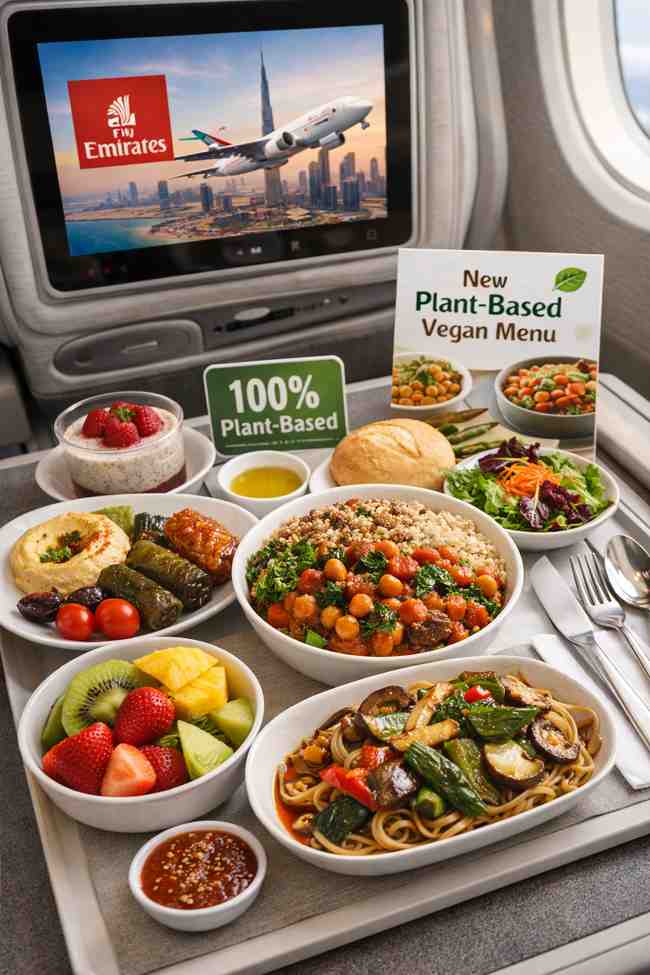
Emirates is overhauling its vegan inflight dining strategy, moving away from imitation meat and egg substitutes and toward whole, minimally processed plant-based ingredients. The Dubai-based airline says the change reflects a long-term commitment to more authentic and nutritionally grounded food options, as demand for vegan meals continues to rise across its global network.
The move marks a clear reversal from Emirates’ earlier experimentation with engineered plant proteins designed to replicate animal products. While the airline has expanded its vegan offerings significantly in recent years, it acknowledged that vegan meals are still not routinely included in its standard onboard menu, meaning many passengers must request them in advance.
A New Direction for Emirates’ Vegan Menu
Emirates said its updated plant-based concept focuses on natural ingredients such as legumes, grains, nuts, seeds, and seasonal vegetables. Rather than attempting to reproduce the taste and texture of meat, the airline is emphasizing dishes built around the inherent flavors and textures of whole plant foods.
The airline views this approach as better suited for inflight dining, where balance, digestibility, and presentation play a major role in passenger satisfaction. Emirates also described the transition as a return to authenticity in its inflight meal design, particularly for travelers seeking lighter, more wholesome options on long-haul flights.
Emirates Executive: No More Mimicking Meat
Doxis Bekris, Vice President of Food and Beverage Design at Emirates, confirmed the airline’s decision to step away from imitation proteins in its vegan meal development.
“Doxis Bekris, Vice President of Food and Beverage Design at Emirates, confirmed that the airline no longer intends to mimic meat in its vegan offerings.”
“He stated that ultra processed protein alternatives do not align with the airline’s long-term food philosophy.”
According to Emirates, the focus is now on using whole ingredients as the foundation of each dish. Bekris noted that legumes, grains, nuts, seeds, and vegetables are being selected for their natural texture, flavor depth, and nutritional value, without reliance on engineered substitutes. He also said the approach gives chefs more freedom to create meals that feel culturally authentic rather than heavily manufactured.
Drawing Inspiration From Traditional Plant-Forward Cuisines
To support the shift, Emirates is leaning into culinary traditions that already have a long history of plant-forward cooking. The airline said its chefs are drawing from Mediterranean mezze, Levantine grain salads, Asian noodle bowls, and African vegetable-based stews.
Emirates believes these cuisines naturally deliver a balance of taste, nutrition, and presentation—qualities the airline says are especially important in an inflight environment. It also considers these styles of dishes more practical for onboard service than meals designed to imitate meat textures.
A Sharp Contrast With Early 2025 Testing
The change comes after Emirates promoted a very different vegan development strategy at the start of 2025. At that time, the airline’s chefs were experimenting with innovative plant-based products at the Emirates Flight Catering Concept Development Kitchen.
During that earlier phase, Emirates featured plant-based proteins supplied by California-based Beyond Meat, including burgers, mince, sausages, and meatballs designed to look, taste, and feel like conventional meat. The airline also tested a lookalike solid egg substitute as part of its vegan program.
Emirates has since decided that replacing animal protein with engineered alternatives does not match its current culinary goals, prompting the shift toward whole-food ingredients.
Scale of the Menu and Rollout Timeline
Emirates currently operates 488 vegan recipes across 140 global destinations, representing a 60 percent increase in vegan dishes over the past two years. The airline said that due to the size and complexity of its existing menu rotation, the transition to the new whole-food-focused concept will take time.
Emirates estimates the rollout will begin in early 2027, signaling a phased implementation rather than an immediate system-wide change.
The timing of the announcement coincides with the airline marking Veganuary, though Emirates emphasized that passenger interest in vegan meals extends far beyond January.
Vegan Meal Demand Continues to Climb
In 2025, Emirates served more than 500,000 vegan meals, which is 100,000 more than in 2024. The airline expects continued growth in the coming years, driven not only by vegan travelers but also by passengers looking for meals that feel lighter and easier to digest.
Emirates said many non-vegan passengers choose vegan options for a more wholesome inflight dining experience, particularly on ultra-long-haul routes where comfort and digestion can become key factors.
Top Routes for Vegan Meal Pre-Orders
London is the number one destination for vegan meal pre-orders, supported by Emirates’ extensive daily flight schedule to the United Kingdom. Other leading destinations include Sydney, Bangkok, Melbourne, and Frankfurt.
Additional high-demand markets for vegan meals include Manchester, Mumbai, Bali, and Singapore, reflecting broad international interest across Europe, Asia, and Australia.
Pre-Order Rules Still Apply for Most Passengers
Despite rising demand, Emirates said vegan meals are not routinely included in its standard onboard menu. Passengers are generally required to pre-order vegan meals at least 24 hours before departure.
The airline noted that the only exception applies to select high-demand routes, where vegan dishes may be offered as part of the regular meal service.
As Emirates continues expanding its plant-based recipe catalog, the airline’s pivot toward whole foods signals a longer-term effort to align vegan dining with its broader inflight culinary identity—one that prioritizes simplicity, cultural authenticity, and natural ingredients over engineered substitutes.
