


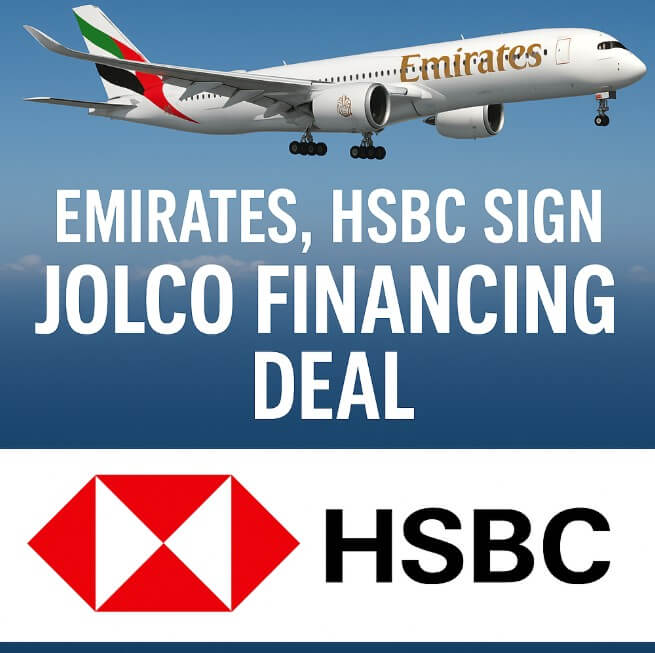
DUBAI — Emirates Airline has secured a major financing package for its new Airbus A350-900 aircraft through HSBC, marking the carrier’s return to the Japanese Operating Lease with Call Option (JOLCO) market after a six-year hiatus. The deal covers five of six aircraft in the current tranche, with financing for the final jet expected to close soon.
The transaction reinforces Emirates’ strategy of diversifying its funding sources while maintaining financial flexibility as it continues a multibillion-dollar fleet renewal program. It also underscores the enduring relationship between Emirates and HSBC—one that dates back more than four decades.
A Milestone Partnership
The JOLCO arrangement was commemorated in Dubai with a meeting between Sheikh Ahmed bin Saeed Al Maktoum, Chairman and Chief Executive of Emirates Airline and Group, and Georges Elhedery, Group CEO of HSBC Holdings Plc. The event highlighted the two institutions’ longstanding collaboration on aircraft financing and capital-market innovation.
HSBC first supported Emirates’ acquisition of its inaugural aircraft in the 1980s, establishing a relationship that has grown in both scale and complexity alongside the airline’s rapid global expansion. Today, the partnership continues to play a pivotal role in helping Emirates access competitive financing and structure transactions that meet international investor demand.
Mohamed Al Marzooqi, CEO of HSBC Bank Middle East Limited, said the renewed cooperation reflects “mutual confidence in the strength and future of the UAE’s aviation sector.” As the bank nears its 80th anniversary in the Emirates, he added, the collaboration demonstrates HSBC’s ongoing commitment to “connecting major national carriers with global capital markets, enabling continued investment in aviation infrastructure and innovation.”
Financing the A350 Fleet
For Emirates, the deal provides a cost-efficient funding solution for its newest fleet addition, the Airbus A350-900, which entered service with the carrier in November 2024. The aircraft features advanced aerodynamics, lightweight composite materials, and next-generation Rolls-Royce Trent XWB engines that deliver roughly 25% lower fuel burn and CO₂ emissions compared with older wide-body models.
The A350’s range and fuel efficiency make it well suited to Emirates’ medium- and long-haul routes, enhancing network flexibility while reducing environmental impact. The new type will support operations from Dubai International Airport (DXB) and complement the airline’s existing fleet of Boeing 777s and Airbus A380s.
Emirates has identified the A350 as a cornerstone of its next-generation fleet strategy, balancing sustainability goals with passenger comfort and operational reliability. The aircraft’s cabin layout—tailored to Emirates’ high service standards—will also enable the airline to optimize capacity across new and existing destinations.
Expanding Global Financing Reach
Industry analysts note that Emirates’ return to the JOLCO market comes amid growing investor appetite for structured aviation leases that combine asset security with long-term yield potential. JOLCOs, a financing instrument pioneered in Japan, allow investors to lease aircraft to airlines while retaining a call option, providing tax and accounting advantages for both sides.
Emirates’ decision to pursue JOLCO financing underscores its ability to tap diverse funding channels even amid volatile interest-rate environments. The transaction also builds on a legacy of innovative capital-market activity between Emirates and HSBC, including the aviation industry’s first Export Credit Agency–guaranteed Sukuk, which at the time was the largest ECA-backed debt capital markets deal.
Strengthening a Leadership Position
For Emirates, the new financing demonstrates a disciplined approach to balance-sheet management while reinforcing its global leadership in fleet modernization. The deal not only supports the carrier’s long-term sustainability objectives but also signals confidence in the continued recovery and expansion of international air travel.
The A350-900’s introduction will enable Emirates to open new markets and strengthen existing routes with more efficient aircraft, maintaining its competitive edge across a rapidly evolving global aviation landscape.
Industry observers see the collaboration as a model of how Gulf carriers and global financial institutions can work together to advance sustainable growth. With a fleet renewal program that includes more than 200 new aircraft on order, Emirates is expected to continue leveraging structured financing to maintain its position among the world’s most financially resilient airlines.
As the airline’s partnership with HSBC approaches its fifth decade, the two organizations appear poised to deepen their cooperation. This latest transaction—combining financial innovation, sustainability, and strategic foresight—marks another chapter in a relationship that has helped shape both the modern aviation financing market and Dubai’s role as a global aviation hub.
