


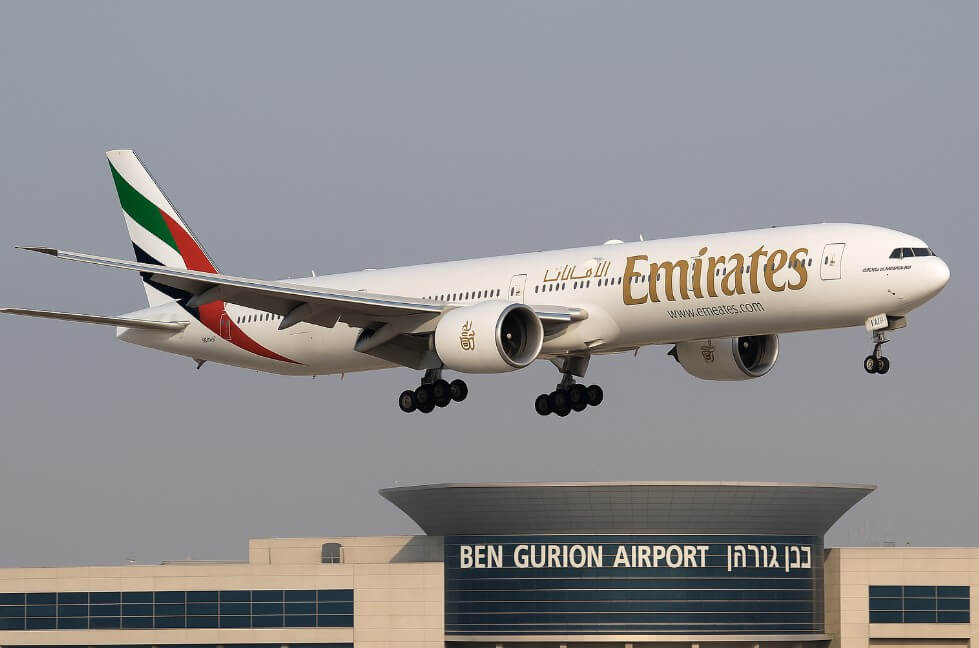
Emirates Airline has formally withdrawn all scheduled service to Tel Aviv, marking one of the most significant pullbacks by a major global carrier from Israel’s aviation market as the region continues to face heightened geopolitical instability. The Dubai-based airline, one of the world’s largest international operators, had previously paused flights during the broad industry suspensions of 2023 but had maintained a long-term plan to reinstate service in 2026. That strategy has now been shelved.
The move, confirmed after all Dubai–Tel Aviv flights disappeared from future schedules last week, underscores the prolonged downturn in international airline activity to Israel. A wave of global carriers—including American Airlines, Turkish Airlines, Virgin Atlantic, Korean Air, and Cathay Pacific—halted Tel Aviv operations in 2023. Emirates, which had initially suspended flights alongside its peers, has now taken the further step of removing the route from its long-range plans entirely.
Emirates entered Israel in June 2022 with a daily Boeing 777-300ER rotation between Dubai International Airport and Ben Gurion Airport. Rapid demand growth helped the carrier ramp up to three daily frequencies by 2023, capitalizing on strong point-to-point traffic and Dubai’s role as a connecting hub to Australia, Southeast Asia, and the Indian Ocean. More than 300,000 Israelis visited the UAE in the two years after pandemic restrictions lifted—a surge that contributed to Emirates’ initial high-capacity strategy on the route.
The airline had most recently targeted April 2026 for a restart using a Boeing 777-200LR in a two-class configuration. Cirium flight-schedule data continued to show the future operation until last week, when the flights were removed, first spotted by aviation outlet SimpleFlying.
While Emirates exits the market, its sister carrier flydubai is increasing its presence. The low-cost airline, which launched Tel Aviv service in 2020 with two daily flights, has steadily grown capacity in line with strengthened UAE-Israel diplomatic ties. By late 2023, flydubai reached eight daily flights, and current schedules indicate up to ten daily rotations—its highest level since launching the route. The airline currently deploys a mix of Boeing 737-800, 737 MAX 8, and 737 MAX 9 aircraft, with plans to operate only the 737-800 and MAX 8 beginning April 2026.
Cirium data shows flydubai has scheduled 33.7 percent more flights this year than in 2024 and over 50 percent more than in 2023, a notable expansion at a time when many international operators continue to avoid Israeli airspace. Overall flight activity in Israel remains down 11.8 percent year over year, reflecting ongoing security concerns and periodic airspace restrictions.
Some carriers are weighing a return. American Airlines has announced intentions to resume New York–Tel Aviv service in March 2026 and is evaluating a potential Los Angeles nonstop after recent talks with Israeli officials. Meanwhile, Turkish Airlines and Pegasus—once among the largest foreign operators at Ben Gurion—surrendered their Tel Aviv slots earlier this year. Turkish Airlines had historically maintained a dominant presence, with flights from Istanbul, Antalya, and Sabiha Gokcen that, at times, reached sixteen daily movements before the current conflict.
As airlines reassess the market’s long-term viability, Tel Aviv continues to operate under a unique safety landscape that differentiates it from other major urban centers. El Al remains the primary connector for travelers as Israel’s national carrier, operating from Ben Gurion Airport, the main international gateway to the city. Although Tel Aviv functions as a vibrant economic and cultural hub with more than three million residents in its wider region, concerns tied to regional instability persist. Crime remains relatively low, but authorities maintain heightened vigilance due to the risk of terrorist threats and rapidly shifting security conditions.
Challenges extend beyond security. Visitors and residents encounter dense traffic, a comparatively high rate of road accidents, and crowded public transport during peak hours. Pickpocketing incidents are concentrated in heavily trafficked areas, and while street crime is uncommon, travelers are advised to exercise caution in certain southern districts at night. Environmental risks also play a role, with the region susceptible to earthquakes and winter flooding.
Despite the uncertain landscape, tourism and business travel to Israel continue, with most Western nationals able to enter visa-free for stays up to 90 days. Ben Gurion Airport remains the country’s primary entry point, and the New Israel Shekel continues to be the official currency for all transactions.
As airlines like Emirates recalibrate their long-term strategies and others explore potential reentry into the market, Israel’s aviation sector faces a prolonged period of reduced capacity and shifting global carrier dynamics. Further developments are expected as geopolitical conditions evolve and airlines reassess demand, safety, and connectivity across the region.
