


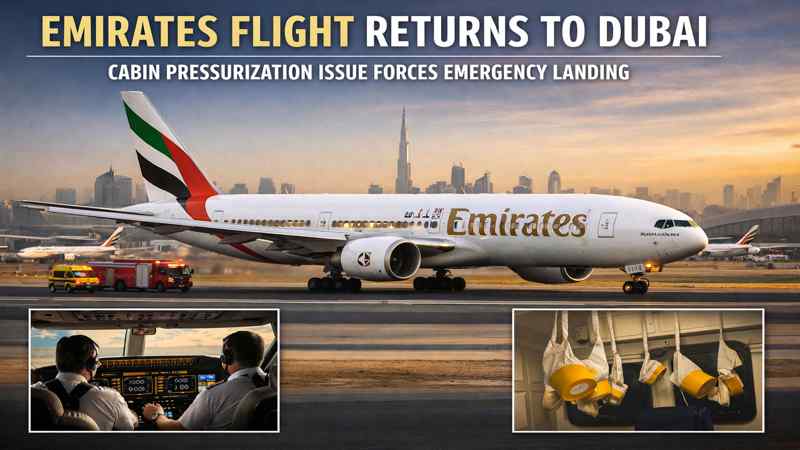
An Emirates Airline long-haul flight from Dubai to Cairo was forced to return to its departure airport after experiencing a cabin pressurization issue at cruise altitude, highlighting the airline’s safety protocols and operational response to in-flight technical irregularities.
The incident involved flight EK929, operated by a Boeing 777-200, which departed Dubai International Airport en route to Cairo International Airport. While cruising at 36,000 feet over Saudi Arabian airspace, the flight crew detected a loss of cabin pressurization, triggering emergency procedures onboard the aircraft.
Emergency Descent and Safety Measures
As a precautionary measure, oxygen masks were deployed for passengers and cabin crew. The pilots initiated an emergency descent, reducing altitude to 9,000 feet to ensure a breathable cabin environment while the situation was assessed.
After leveling off, the aircraft entered a holding pattern at the lower altitude. The crew evaluated the technical condition of the aircraft and determined that a return to Dubai was the safest course of action. Throughout the event, standard safety procedures were followed to minimize risk and maintain passenger well-being.
Safe Landing and Ground Response in Dubai
The Boeing 777 remained at 9,000 feet for the return leg to Dubai, landing safely on runway 30L approximately two hours after leaving cruise altitude. Emergency services were positioned to meet the aircraft upon arrival as a routine precaution, according to aviation monitoring outlet Aviation Herald.
Emirates later confirmed that there were no injuries among passengers or crew. The airline attributed the pressurization issue to a component failure in the aircraft’s air conditioning system, which directly affected cabin pressure regulation.
Aircraft Grounded for Inspection
The aircraft involved in the incident, a Boeing 777-200 registered as A6-EWB, remained on the ground at Dubai International Airport following the diversion. Emirates initiated inspections and maintenance checks to identify and rectify the faulty component before returning the aircraft to service.
Such inspections are standard procedure following pressurization-related events, particularly on long-haul widebody aircraft, where environmental control systems play a critical role in passenger comfort and safety.
Replacement Aircraft Deployed for Cairo Service
To minimize disruption, Emirates deployed a replacement Boeing 777-300 to operate the affected Cairo service. The substitute aircraft, registered A6-ECE, eventually transported passengers to Cairo with a delay of approximately eight hours.
While delays of this length can be operationally challenging, the airline prioritized safety and equipment readiness over schedule adherence, consistent with industry best practices.
Similar Incident Highlights Operational Consistency
The Cairo diversion followed a separate Emirates incident involving flight EK543 from Chennai to Dubai. That service returned to Chennai shortly after departure when the flight crew detected a technical irregularity.
EK543, operated by a Boeing 777-300ER, departed Chennai International Airport at 10:44 a.m. after a brief delay. Soon after takeoff, the cockpit crew notified air traffic control of the issue, prompting emergency protocols and priority landing clearance. The aircraft landed safely on runway 28 at 11:17 a.m. with 268 passengers and 12 crew members onboard.
Maintenance teams resolved the issue on the ground within 90 minutes, allowing the aircraft to depart again for Dubai later the same day. Aviation authorities, including the Directorate General of Civil Aviation, logged the event as part of routine oversight.
Focus on Safety and Operational Reliability
Emirates continues to emphasize strict operational safety standards across its global network, supported by regular fleet maintenance, real-time technical monitoring, and coordinated responses between pilots, air traffic control, ground teams, and engineering staff.
Chennai and Cairo remain key destinations within the airline’s international network, connecting major regional markets to Dubai and onward global routes. The airline’s handling of both incidents reflects its focus on maintaining safety while managing the operational complexities inherent in operating one of the world’s largest widebody fleets.
