


Incident Disrupts Malaga–Gatwick Service
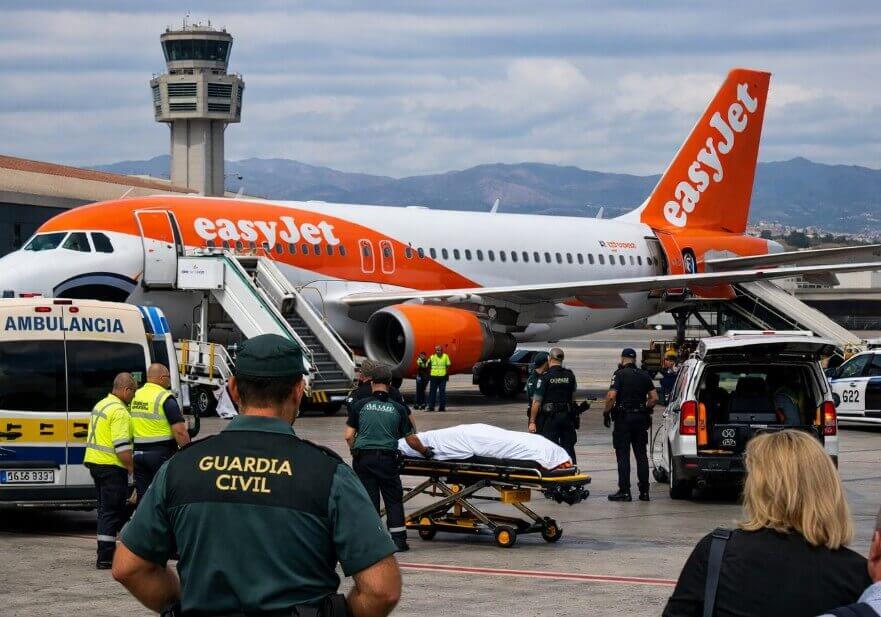
An easyJet flight from Malaga to London Gatwick was delayed for nearly 12 hours after an 89-year-old British passenger died onboard shortly before departure, forcing the aircraft to return to the stand and prompting an emergency response from Spanish authorities.
The incident occurred on an easyJet service scheduled to depart Malaga Airport at 11:15 a.m. local time. The passenger, who had boarded the aircraft with family members, was later confirmed to have died while the plane was taxiing for takeoff. The disruption resulted in significant delays, passenger disembarkation, and extended ground operations before the flight could continue later that evening.
Boarding Raises Early Concerns
According to accounts from multiple passengers, the elderly woman was assisted onto the aircraft in a wheelchair by five relatives and seated toward the rear of the cabin. Witnesses said her condition appeared fragile during boarding, prompting visible concern among nearby travelers.
Several passengers reported that family members informed ground staff that the woman was unwell but fatigued, and that she was fit to travel. Some travelers claimed that ground personnel questioned the family multiple times about her condition and were reassured that she was simply asleep. Witnesses also alleged that members of the family identified themselves as medical professionals.
Despite these reassurances, passengers said the woman appeared unresponsive during boarding. One witness noted that a family member appeared to be supporting her head as she was wheeled down the aisle, raising further alarm among those seated nearby.
Aircraft Returns to Stand
After boarding was completed and the aircraft began taxiing, cabin crew reportedly became increasingly concerned about the woman’s condition. Moments before takeoff, the flight was halted and returned to the stand when it was confirmed that the passenger had died onboard.
Spanish authorities were immediately notified, and emergency services attended the aircraft. The woman was formally pronounced dead before the flight departed. The Civil Guard later confirmed their involvement, stating they responded to reports of a deceased elderly British woman on a Gatwick-bound aircraft.
easyJet later confirmed that the passenger had been alive when she boarded and held a valid fit-to-fly certificate. The airline stated that the flight returned to the stand due to a customer requiring urgent medical assistance and confirmed that the passenger had sadly passed away.
Passenger Reaction and Crew Response
The incident sparked shock and frustration among passengers, many of whom questioned how the woman was permitted to board given her apparent condition. Social media posts from travelers described distress at witnessing the events unfold, alongside concern for the woman’s family.
At the same time, several passengers praised the flight crew for their professionalism during the ordeal. The first officer, in particular, was credited with calmly explaining the situation, addressing passenger concerns, and maintaining order during the lengthy delay.
Passengers acknowledged the emotional strain placed on both the crew and the family involved, even as frustration mounted over the disruption and uncertainty surrounding the flight’s status.
Operational Impact and Delay
The flight, designated EZY8070, remained grounded for most of the day as authorities completed their procedures and easyJet assessed operational next steps. All passengers were required to disembark following the aircraft’s return to the stand.
The service eventually departed Malaga at 10:47 p.m. local time, nearly 12 hours after its scheduled departure. The aircraft landed at London Gatwick close to midnight.
easyJet provided food and drink vouchers to affected passengers during the delay. However, some travelers said the compensation did not adequately reflect the length of the disruption or the emotional toll of the incident.
Broader Questions for Airlines
While authorities confirmed that the passenger was alive when she boarded, the incident has raised broader questions about medical screening, special assistance procedures, and decision-making during boarding. Airlines rely heavily on fit-to-fly certificates and passenger disclosures, particularly when accommodating elderly or vulnerable travelers.
The Malaga incident highlights the ethical and operational challenges airlines face when medical issues arise at the intersection of passenger welfare and flight safety. For those onboard, the episode was both distressing and disruptive, leaving lingering concerns about safeguards within commercial aviation and how such situations are assessed before departure.
