

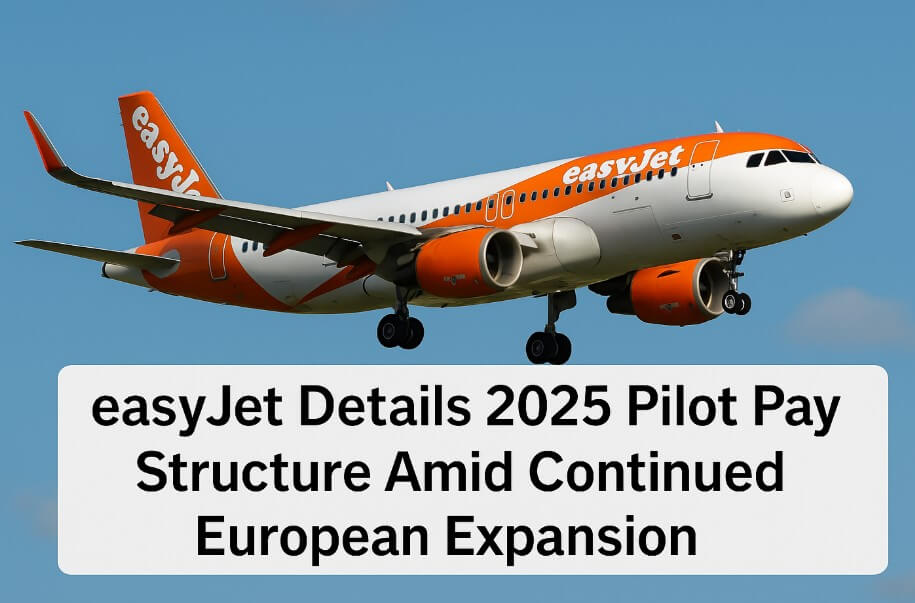
LUTON, U.K. — easyJet, one of Europe’s largest low-cost airlines, has outlined its 2025 pilot compensation structure as the carrier continues to expand its network of more than 925 routes across 34 countries. The disclosure offers a detailed look at salaries, allowances, and benefits for the nearly 3,000 pilots who support its growing operations from bases across the U.K., mainland Europe, and Switzerland.
Founded 30 years ago and headquartered at London Luton Airport, easyJet has built its network around short- and medium-haul flying throughout Europe, with select routes to Africa and Asia. The airline, which operates a fleet of more than 350 Airbus A320-family aircraft, relies on a significant pipeline of new aviators entering through its long-running cadet program in partnership with CAE.
Salary Tiers Structured by Experience
easyJet’s pilot pay scales are divided into three primary categories — second officers, first officers, and captains — with earnings rising substantially as flight hours and command responsibilities increase. The airline reports that total annual pay for pilots ranges from £57,235 to £157,424, depending on seniority.
Second officers, typically recent graduates of the carrier’s cadet program, begin their careers logging supervised flight hours under senior crew. They receive a fixed annual salary of £57,235, with access to most company benefits but no additional pay for flight-hour accumulation.
First officers, who generally serve two years before advancing to senior first officer status, earn £67,628 per year, while senior first officers can make up to £83,020 annually. Their responsibilities include aircraft safety checks, air-traffic communication, and assisting captains during all phases of flight.
In addition to base salary, first officers receive distance-based allowances:
-
0–400 nautical miles: £20.76
-
401–1,000 nautical miles: £31.14
-
1,001–1,500 nautical miles: £38.93
-
1,501+ nautical miles: £64.88
Captains, the most senior pilots responsible for flight management and crew supervision, earn between £136,890 and £157,424 a year. Long-tenured captains receive progressive bonuses: 5% for two to four years of service, 10% for four to ten years, and 15% for more than a decade at the airline.
Captains also receive flight-length allowances:
-
0–400 nautical miles: £34.54
-
401–1,000 nautical miles: £51.96
-
1,001–1,500 nautical miles: £64.95
-
1,501+ nautical miles: £108.25
Benefits and Career Development
The airline supplements its salary packages with a suite of benefits aimed at retention and long-term career development. Pilots receive 25 days of paid annual leave, compensation for bank holidays, and access to staff-travel privileges, including eight free standby tickets a year and additional seats at a flat rate of £5 plus taxes. Depending on length of service, pilots may also receive £1,000 in credit toward easyJet Holidays.
Through a network of brand partnerships, pilots are eligible for discounts on hotels, car rentals, airport parking, and lounge access. The company’s online learning platform provides access to training modules and skill-building courses relevant to both flight operations and post-aviation careers. Insurance coverage includes global medical protection and life insurance.
Fleet and Growth Pipeline
easyJet’s operations are built entirely around the Airbus A320 family. As of 2025, the fleet includes:
-
82 Airbus A319-100
-
180 Airbus A320-200
-
73 Airbus A320neo
-
19 Airbus A321neo
The carrier also holds significant orders for future deliveries: 127 A320neo and 165 A321neo aircraft.
Hiring Requirements and Recruitment Process
Entry requirements vary by rank. First officer candidates must hold an ATPL, a current Class 1 medical certificate, ICAO English Level 4, a valid passport, and unrestricted rights to live and work in the U.K., EU, or Switzerland. Type-rated co-pilots must have at least 500 hours on the A320, while non-type-rated applicants must have 500 hours on aircraft over 10 tonnes MTOW.
Captain candidates must meet stricter thresholds, including at least 4,000 total flying hours and 1,000 PIC hours either on the A320 (for type-rated applicants) or on jet aircraft over 30 tonnes MTOW.
The airline’s five-step hiring process includes an online application, online reasoning and psychometric tests, application review, non-technical assessments at Gatwick or Milan, and a technical simulator evaluation. Successful candidates receive conditional job offers pending background and medical clearance.
As easyJet continues to expand across Europe and increase its aircraft orders, the airline’s structured pay progression and benefits are positioned to support one of the region’s largest pilot workforces while sustaining its competitive recruitment pipeline.
