


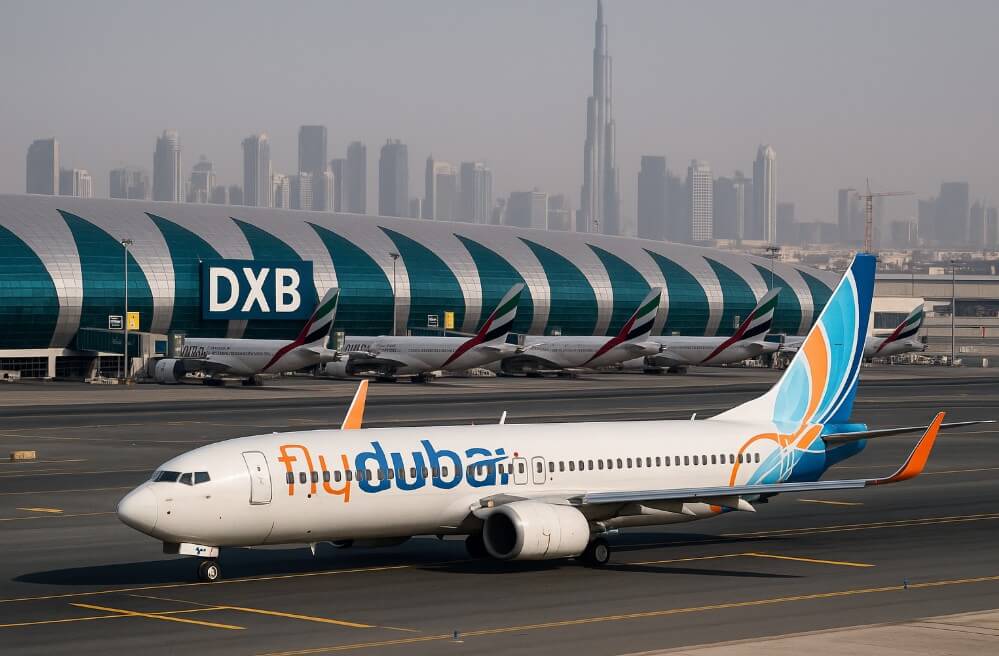
DUBAI, UAE — Dubai International Airport (DXB) has added another accolade to its name, securing recognition as the Middle East’s best low-cost hub in the latest OAG Mega Hubs 2025 report. The findings position DXB not only as a premium international gateway but also as a leading player in the global budget travel market.
The report, which evaluates airports worldwide on their connectivity and performance of low-cost carriers (LCCs), ranked DXB as the world’s fifth most connected low-cost hub. This achievement underscores the airport’s evolving role in balancing luxury air travel with the rapidly growing demand for affordable options.
A Dual Identity: Premium and Budget Travel
DXB’s rise in the rankings is driven in part by the expansion of flydubai, which now accounts for roughly 28 percent of the airport’s flights. The airline’s growth has contributed to a 4 percent year-on-year increase in low-cost routes, cementing Dubai’s position as a hub that serves both ends of the passenger spectrum.
What makes DXB’s success stand out is its ability to cultivate a thriving low-cost network while maintaining its reputation as a global premium hub. The airport secured 15th place in the overall “most connected airports” ranking, up one notch from last year’s 16th position.
The numbers tell a broader story: DXB handled more than 92 million passengers in 2024, a 6.1 percent increase compared to the previous year. This dual momentum reflects the emirate’s strategy to diversify connectivity, enabling it to capture market share among both premium flyers and price-sensitive travelers.
Regional and Global Competition
While Dubai continues to dominate the regional landscape, other airports in the Middle East are mounting competitive challenges. Istanbul Airport (IST) delivered one of the most dramatic gains, leaping from eighth to second place globally in low-cost connectivity. With Turkish Airlines operating about 79 percent of its flights, IST has become a formidable force in international aviation.
Closer to home, Riyadh’s King Khalid International Airport (RUH) and Doha’s Hamad International Airport (DOH) follow DXB in the regional rankings. Riyadh climbed from 42nd to 31st globally, signaling Saudi Arabia’s aggressive push to expand its aviation footprint. Doha remains a strong contender, largely powered by Qatar Airways, which controls 77 percent of its flights.
Against this competitive backdrop, DXB’s diversified connectivity strategy gives it an edge. By expanding low-cost offerings alongside established premium services, Dubai can attract travelers across market segments while reinforcing its role as a pivotal Middle Eastern hub.
Preparing for the Future
Authorities in Dubai are already looking ahead to sustain momentum. Plans are underway to transition much of DXB’s operations to Al Maktoum International Airport (DWC), which is projected to eventually accommodate up to 260 million passengers annually. This long-term vision reflects Dubai’s intent to scale capacity, ease congestion, and fortify its reputation as a premier global gateway.
Industry analysts note that DXB’s success does not come without challenges. Rapid growth in low-cost traffic demands upgrades in infrastructure, operational efficiency, and passenger services. Balancing the needs of budget travelers while maintaining high standards for premium flyers will require careful execution.
Bottom Line
Dubai’s latest ranking in the OAG Mega Hubs 2025 report reaffirms its standing as a global aviation powerhouse. The airport’s dual identity—serving as both a luxury hub and a thriving low-cost gateway—illustrates its adaptability in a shifting global travel landscape.
As airlines expand routes and travelers seek more affordable options, DXB’s ability to deliver seamless connectivity positions it at the center of global aviation growth. The challenge ahead lies in ensuring that infrastructure, strategy, and execution keep pace with demand.
For now, Dubai’s success story is clear: it is no longer just a premium stopover, but a competitive hub for the world’s budget-conscious travelers.
