


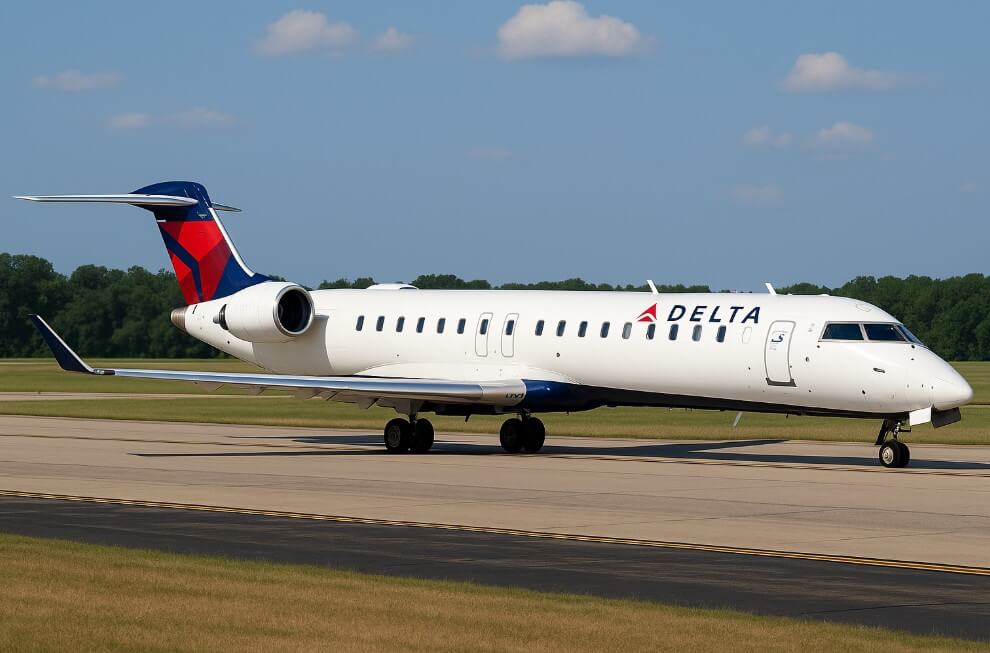
ATLANTA — A year after suffering catastrophic damage in a ground collision at Hartsfield–Jackson Atlanta International Airport, a Delta Air Lines CRJ-900LR has returned to service — a rare and remarkable comeback that underscores the airline’s engineering expertise and commitment to fleet sustainability.
The regional jet, operated by Delta’s subsidiary Endeavor Air, had its tail sheared off when a larger Airbus A350 clipped it with a wingtip during taxiing on September 10, 2024. At the time, the aircraft was holding short of a runway while preparing for departure to Lafayette, Louisiana. The impact destroyed the vertical stabilizer and caused major structural damage, though only one flight attendant suffered minor injuries.
Many in the aviation industry expected the damaged jet to be scrapped. Instead, Delta chose an ambitious path — a full structural rebuild. The decision, while costly and time-consuming, highlights a broader shift in airline operations toward extending aircraft lifespans through advanced repair technologies.
“Despite the extensive damage, Delta Air Lines chose not to retire the aircraft,” the company confirmed.
The extensive restoration, carried out over nearly 12 months, involved replacing the entire tail section and performing rigorous inspections of the airframe and systems before the jet was recertified for flight. According to aviation data site PYOK, Delta’s choice reflects “a growing industry trend to extend aircraft lifecycles through advanced repair technologies.”
A Symbol of Resilience and Engineering Precision
The repaired aircraft, bearing registration number N302PQ, reemerged from Delta’s maintenance hangar last month, freshly painted in the carrier’s signature livery. Aviation photographer Brian Uretsky captured the first images of the aircraft back in operation, marking a symbolic milestone for both Delta’s maintenance division and its regional fleet.
Following successful ground tests, the jet completed its first post-repair flight on September 24, 2025 — a 90-minute test sortie that verified systems integrity and flight performance. It then made a short repositioning flight to Middle Georgia Regional Airport for final paintwork before being cleared for passenger service.
Collision Circumstances
Preliminary findings from the National Transportation Safety Board (NTSB) provide more detail about the 2024 incident. Investigators reported that the CRJ-900LR had stopped roughly 56 feet short of the runway threshold — closer than the standard holding position. Meanwhile, the A350’s captain, focused on other traffic, failed to notice the smaller jet positioned on his right. The A350’s wingtip struck the CRJ’s tail, severing it completely.
Emergency crews responded within minutes. The initial damage assessment categorized the jet as a “major structural failure.” However, Delta’s engineering team saw a viable opportunity for restoration. The CRJ, only 11 years old at the time, still had more than two decades of potential service life remaining.
“The remarkable recovery showcases both Delta’s engineering commitment and the resilience of its maintenance teams,” the company said.
A Broader Industry Pattern
Experts say Delta’s decision reflects a growing willingness among major airlines to invest in complex rebuilds rather than writing off damaged aircraft. The economics of post-pandemic fleet management — coupled with global supply chain delays for new aircraft — have made repair and restoration more viable options.
Aviation analysts also point to a recent precedent: in 2023, United Airlines successfully repaired a Boeing 767 that sustained heavy damage during a landing incident. That aircraft, too, re-entered service after extensive structural work, demonstrating that modern engineering and safety oversight can restore even severely compromised jets.
“Mechanics who worked on the project described it as one of the most technically challenging restorations in Delta’s history,” according to Delta.
Return to the Skies
After nearly a year of precision engineering, stress testing, and flight validation, the CRJ-900LR has officially rejoined Delta’s regional operations. The jet will resume short-haul routes across the southeastern United States, serving as both a testament to technical innovation and a symbol of operational resilience.
While such recoveries remain rare in commercial aviation, Delta’s effort shows how far repair capabilities have come — and how economic realities are pushing airlines to think differently about asset management.
As the CRJ-900LR returns to routine passenger service, its journey from near-total loss to full restoration stands as a striking example of modern aviation’s mix of engineering ambition, economic pragmatism, and enduring dedication to safety.
Stay tuned with us and follow us on social media for the latest updates.
