


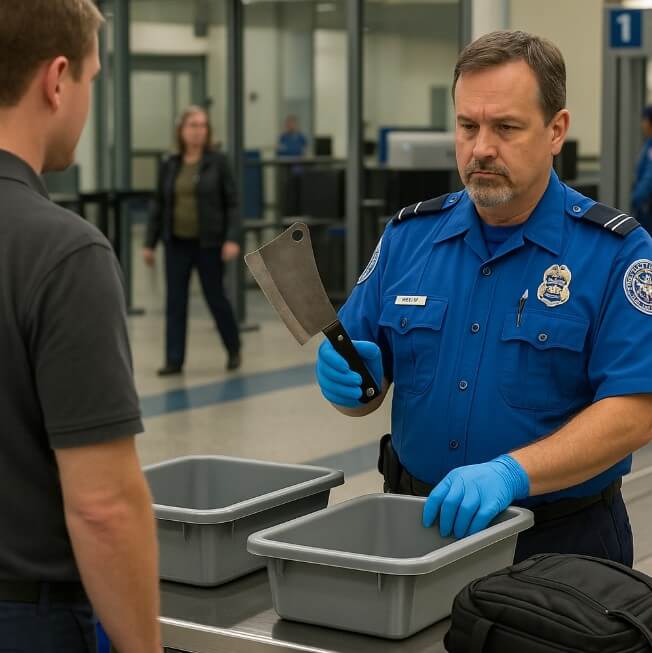
A Delta Air Lines flight departing Portland International Airport on Thursday evening was delayed for hours after a passenger passed through Transportation Security Administration screening with a meat cleaver in their carry-on bag—an incident that aviation security analysts say underscores persistent weaknesses in TSA detection capabilities.
The flight, bound for Salt Lake City International Airport, was preparing for departure when a flight attendant spotted the large blade inside the cabin. The discovery immediately triggered a full security response. Crew members reported the threat, prompting the airline to deplane all passengers and require a complete re-screening of travelers and baggage. According to the travel site View from the Wing, the process added roughly two and a half hours to the scheduled departure.
TSA confirmed that its screening team at Portland failed to detect the weapon. The agency acknowledged that screeners “were not sufficiently trained to detect the weapon” and said it would review the incident, evaluate employee performance, and consider corrective actions. The statement fits within a broader pattern: while TSA often publicizes isolated security successes, it rarely discloses detailed performance data related to detection failures.
Delta Air Lines stated that no arrests were made. While carrying a prohibited bladed weapon through a security checkpoint can result in both civil penalties and potential criminal charges, the lack of detention suggests investigators deemed the passenger to pose minimal threat. TSA investigators also face the optics of aggressively pursuing a case that highlights shortcomings in their own screening processes.
Passengers bringing knives to security checkpoints is not unusual. Travelers frequently reuse bags for outdoor activities or picnics and later forget that kitchen tools—including knives or even cleavers—remain inside. Others routinely carry pocketknives or, in more extreme cases, firearms, only to assert that they forgot the items were in their luggage. Some individuals travel with blades for personal safety, unaware that such items fall under TSA’s prohibited list. But aviation security observers note that overlooking a large meat cleaver is far more serious than failing to identify a small pocketknife. The size and shape of the object make it easier to detect on X-ray images, making the failure particularly notable.
The incident calls renewed attention to TSA’s long-documented challenges with threat detection. For years, covert government testing revealed that TSA checkpoints missed contraband at alarmingly high rates, with some internal tests showing miss rates above 90 percent across multiple cycles. Following repeated failures, the agency stopped releasing detection data, classifying the results as sensitive security information. Transparency advocates argue the move has shielded the agency from accountability, while lawmakers have periodically raised concerns about whether TSA is improving at the pace required to address modern security risks.
In the aftermath of Thursday’s incident, TSA’s local leadership at Portland is expected to produce an internal incident report outlining recommended training adjustments. Industry experts anticipate new emphasis on X-ray image interpretation and near-term “threat recognition refreshers” for screening personnel. Historically, such measures have amounted to incremental fixes rather than broader reforms of TSA’s screening systems or technology.
The Portland workforce, like TSA employees nationwide, is operating under significant strain. Many screeners recently worked through a government shutdown without timely pay, and some are still awaiting full compensation. While there is no indication that staffing or financial stress contributed directly to last week’s failure, the pressures highlight the operating environment in which screeners are expected to perform consistently and accurately. Retention and training challenges have persisted across the agency since its creation more than two decades ago.
Despite the seriousness of the incident, TSA’s internal reviews typically end with limited accountability. Past investigations have often concluded with findings that downplay systemic issues or assign the cause to isolated human error. For airlines, such delays represent both operational disruptions and renewed concerns about checkpoint reliability. For passengers, the episode serves as a reminder that even mandatory federal screening systems are not foolproof.
The Delta flight ultimately departed after every traveler had been re-screened and cleared. But the unanswered questions—about how a meat cleaver passed unnoticed through a federal checkpoint and what meaningful corrective steps TSA will take—ensure the incident will remain part of the broader conversation about U.S. aviation security oversight.
