


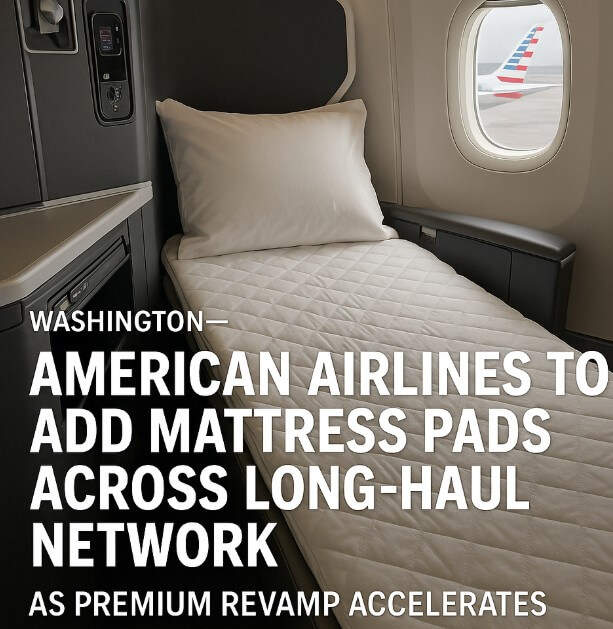
WASHINGTON— American Airlines is launching mattress pads across its entire long-haul network, signaling a renewed push to elevate its international business-class experience as competition intensifies among U.S. carriers. The enhancement expands a feature previously limited to select transpacific and South Pacific routes and marks a significant step in the airline’s broader premium-focused strategy.
Expanding Comfort in Flagship Business
American Airlines will introduce mattress pads for all Flagship Business passengers on long-haul services, extending a comfort amenity that had been removed in 2024 but brought back on a limited basis in mid-2025. The decision comes as the airline works to align itself more closely with bedding standards offered by Delta and United, which have leaned heavily into premium-cabin investments in recent years.
Industry observers note that bedding quality has become a tangible differentiator among carriers competing for lucrative corporate and premium-leisure travelers. Delta currently provides mattress pads on its long-distance routes, while United is widely recognized for offering one of the strongest bedding packages in the industry. American’s move seeks to ensure its international product remains competitive and consistent across all major hubs, including Dallas–Fort Worth (DFW) and Miami International Airport (MIA).
Airline leadership has emphasized that the mattress pads are part of a broader effort to reposition American toward travelers who prioritize comfort, reliability, and high-touch service.
New Suites and Upgraded Aircraft
The bedding upgrade coincides with sweeping changes to American’s premium cabins, including redesigned business-class seats, enhanced catering, and refreshed lounge options. At the center of the transformation is the new Adient Ascent business-class suite, now appearing on the latest Boeing 787-9 deliveries.
These aircraft feature 51 Flagship Suites—an increase from the previous 30 seats—reflecting American’s aim to grow premium capacity. Premium economy has also expanded from 21 to 32 seats, aligning the 787-9 with broader industry shifts toward higher-yield cabin layouts.
American plans to retrofit its Boeing 777-300ER and 777-200ER fleets with similar enclosed suites, replacing older reverse-herringbone seats and creating a more unified long-haul product. The upcoming Airbus A321XLR, which will fly transatlantic missions, will feature enclosed herringbone business-class suites based on the Collins Aurora design, further reinforcing premium consistency even on narrowbody aircraft.
Competitive Pressures Intensify
The carrier’s renewed focus on premium service comes as Delta and United maintain strong positions in the long-haul market. United’s widebody fleet is the largest among U.S. airlines, while Delta has invested heavily in its Delta One lounges and international service strategy. American’s upgrades—both soft-product and hard-product—reflect an effort to close the perceived quality gap and capture a greater share of high-yield demand.
Executives at American have acknowledged the need to modernize the airline’s premium experience while expanding long-haul capacity to support future network growth. Although American has historically lagged behind its peers in premium differentiation, the introduction of mattress pads across all long-haul routes signals a clear shift in approach.
A Clearer Premium Strategy Takes Shape
The rollout of network-wide mattress pads highlights American Airlines’ broader commitment to enhancing comfort, improving service consistency, and rebuilding its global competitive standing. Paired with the introduction of new suites, expanded premium seating, improved catering, and upgraded lounges, the initiative reflects a coordinated strategy to appeal to both business travelers and premium-leisure customers.
As U.S. carriers continue to escalate premium-product investments, American’s decision to standardize comfort offerings marks a meaningful step forward in its international repositioning. The updates suggest that the airline is preparing not only to match its competitors but to redefine its place in the long-haul market.
