


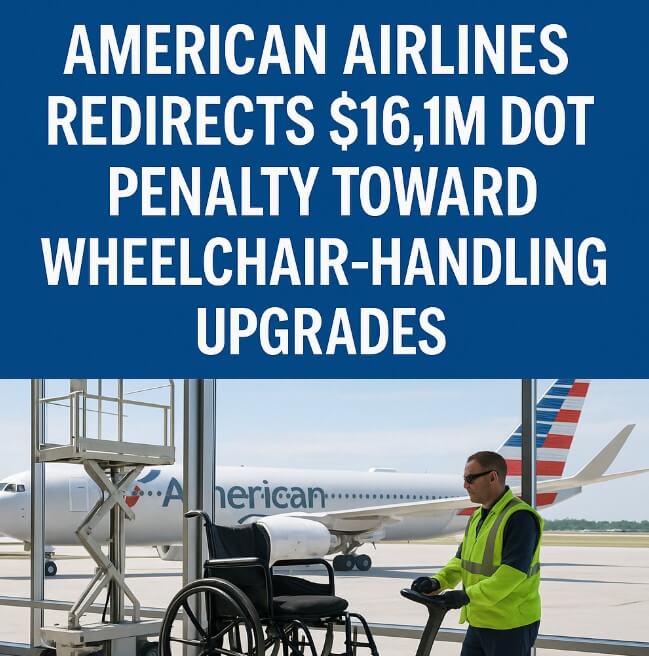
American Airlines has sidestepped paying the remaining USD 16.1 million of a record federal fine after the U.S. Department of Transportation approved a revised compliance plan allowing the carrier to invest the funds directly into equipment and technology intended to improve how it handles wheelchairs and mobility devices across major airports.
The decision, announced this week, marks a significant shift in the agency’s enforcement strategy, prioritizing on-the-ground improvements for disabled travelers over additional financial penalties. The move comes nearly a year after the DOT levied a USD 50 million civil penalty against the carrier—the largest disability-related fine in aviation history—following a multiyear investigation into mishandled wheelchairs, damaged mobility devices, and inconsistent assistance for passengers with disabilities.
A Revised Approach to Compliance
Under the amended consent order, the DOT will allow American to reinvest its outstanding penalty amount into targeted upgrades within its operation rather than sending the funds to the U.S. Treasury. Regulators said the change is designed to ensure that the dollars are used to directly support the passengers most affected by past service failures.
The airline has already paid USD 8.3 million to the federal government and received credits for previous accessibility improvements. DOT officials said the revised structure maintains accountability while pushing for improvements that are more likely to generate tangible, immediate benefits for travelers who rely on wheelchairs and other mobility devices.
Agency representatives said the updated terms help ensure that “funds withheld from the Treasury would instead be used directly to improve wheelchair services.” The department added that the approach “encourages practical improvements rather than relying solely on financial penalties.”
The compliance adjustment follows widespread complaints filed between 2019 and 2023, including viral footage from Miami International Airport showing baggage handlers mishandling a wheelchair on a ramp. Regulators also reviewed lawsuits and passenger reports involving lost or severely damaged mobility devices, contributing to the decision to impose the original record-setting fine.
Mandatory Investment in Technology and Ground Equipment
As part of the revised agreement, American must follow a detailed USD 16.1 million investment plan functioning as what officials described as a mandatory “shopping list.”
The largest share—USD 10.6 million—will support new mobile technology and software designed to track passengers’ wheelchairs from check-in through arrival. The system is expected to reduce mishandling incidents by improving communication among ground teams and enhancing visibility across the airline’s operational footprint. The DOT has given American until May 2027 to fully implement the tracking platform.
Another USD 5.3 million will be used to purchase 119 specialized lifts that allow mobility devices to be safely transported between the aircraft door and the tarmac. American plans to deploy these lifts at Philadelphia, Miami, and Chicago O’Hare—three of the airline’s largest hubs and airports with some of the highest volumes of passengers requiring assistance.
An additional USD 300,000 will cover the purchase of 23 electric wheelchair movers, equipment that enables employees to handle heavy power chairs more safely and efficiently. Delivery and deployment of these devices may take up to a year beyond the software implementation timeline, according to the DOT.
The agency also credited American with USD 700,000 for voluntary compensation already paid to passengers whose mobility devices were damaged or mishandled within the past year.
Ongoing Performance Concerns
Even with these investments, American faces continuing scrutiny over its wheelchair-handling record. The July 2025 Air Travel Consumer Report found that the airline mishandled 1.39 wheelchairs or mobility devices per 100 transported. By comparison, United Airlines recorded 1.26 mishandlings per 100 devices, while Delta Air Lines reported a significantly lower rate of 0.47.
While American has shown incremental improvement since 2024, regulators say substantial progress is still needed, especially given the large number of travelers affected. The carrier transports more than 146,000 mobility devices each year and provides assistance to roughly eight million passengers annually.
What Comes Next
With the revised DOT order now in place, American Airlines will not owe further payment to the federal government, but it remains obligated to invest the full USD 16.1 million into the specified technology and equipment upgrades. The carrier will also be required to meet phased implementation deadlines over the next several years.
Whether these investments ultimately lead to measurable reductions in mishandling incidents remains to be seen. Regulators and disability advocates will likely monitor performance closely as the new systems and equipment come online.
Stay tuned with us. Further, follow us on social media for the latest updates.
