


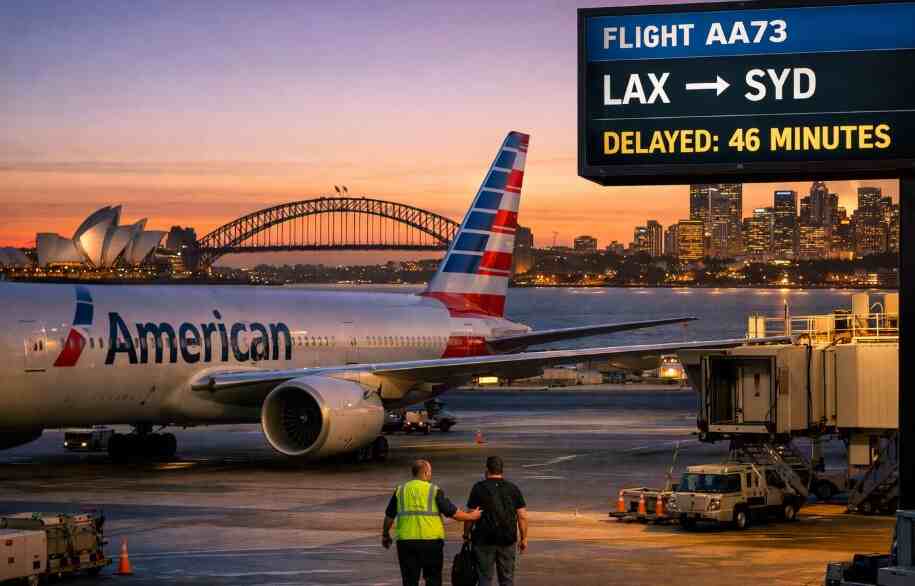
FORT WORTH — American Airlines made an unusual operational decision this month when it held an international flight from Los Angeles to Sydney for 46 minutes and issued a complimentary ticket so a grieving passenger could arrive in time for a funeral following the Bondi Beach terror attack.
The decision highlights how discretionary airline operations, typically driven by rigid schedules and cost controls, can occasionally be leveraged to meet extraordinary human circumstances.
A Journey Disrupted by Delays
The passenger was traveling from Miami to Sydney to attend the funeral of Rabbi Eli Schlanger, who was killed during a Chanukah event at Bondi Beach. His itinerary involved a domestic flight on American Airlines from Miami International Airport to Los Angeles, followed by a separate, unprotected award ticket on United Airlines for the transpacific segment.
The Miami–Los Angeles flight, American Airlines flight AA1193, encountered rolling delays. As the delays mounted, it became clear the passenger would arrive too late to make United Airlines flight UA839 to Sydney, which was scheduled to depart from a different terminal.
Because the flights were booked on separate tickets, there was no obligation for either airline to protect the connection.
Friends Seek Help as Options Narrow
Three longtime friends from Los Angeles, Miami, and Brooklyn had planned the journey together to honor Rabbi Schlanger. While the New York traveler arrived in Los Angeles on time, the Miami passenger faced the risk of missing the only viable flight that would allow him to arrive before the funeral.
A friend already in Los Angeles contacted American Airlines through social media, explaining the urgency of the situation. American alerted its local airport team and advised that United Airlines be contacted to explore options. United Airlines, however, was unable to hold its Los Angeles–Sydney departure.
At that point, American Airlines took a step that is rare in modern commercial aviation.
American Airlines Holds Its Own Flight
Rather than leaving the traveler behind, American Airlines offered him a seat on its own Los Angeles–Sydney service, flight AA73, and made the decision to delay departure to accommodate his arrival.
American coordinated internally to reduce connection risk. The Miami flight was reassigned from a domestic gate in Terminal 4 to the Tom Bradley International Terminal, placing the arriving aircraft steps away from the departing Sydney flight.
While AA1193 was still en route, the captain delivered a written message to the passenger confirming that operations had been coordinated and that AA73 would be held. The passenger was also moved forward in the cabin to allow for the fastest possible exit upon arrival.
Escort, Gate Coordination, and a Complimentary Ticket
When the Miami flight landed in Los Angeles, an American Airlines agent was waiting at the jet bridge to escort the traveler directly to the international departure gate. Boarding for the Sydney flight was paused while ground staff and flight crews maintained continuous communication.
In a gesture that stood out even among customer-focused recovery efforts, American Airlines issued a complimentary ticket covering the full cost of the international flight.
AA73 ultimately pushed back 19 minutes after the Miami flight arrived and departed approximately 46 minutes behind schedule. Despite the delay, the aircraft made up time en route and arrived in Sydney ahead of schedule.
United Airlines’ Role in the Outcome
United Airlines, while unable to delay UA839, also contributed to the overall outcome. The two friends who remained on the United flight received expedited handling upon arrival in Sydney, although their aircraft landed later due to a gate wait.
All three travelers cleared immigration quickly, reunited curbside in Sydney, and reached the funeral only moments before it began.
Why This Decision Was Unusual
American Airlines has selectively held flights in the past, but such decisions require coordination across dispatch, airport operations, crew scheduling, and customer service teams. In this case, three operational factors aligned:
-
A gate reassignment that eliminated a terminal transfer
-
A controlled delay on a long-haul international flight
-
Dedicated staff escort and priority handling
American Airlines later confirmed the account and stated that its mission includes supporting customers during difficult life events when circumstances allow.
Bottom Line
The three travelers had maintained a close friendship for decades, formed during their school years, with Rabbi Eli Schlanger serving as a central figure in their lives.
Their journey underscores how individual operational decisions, often invisible to passengers, can shape profoundly personal outcomes. While airline schedules are built on precision, this case demonstrates that flexibility—when possible—can make a meaningful difference.
Both American Airlines and United Airlines played roles in ensuring the travelers arrived in time to pay their final respects following the Bondi Beach attack.
