


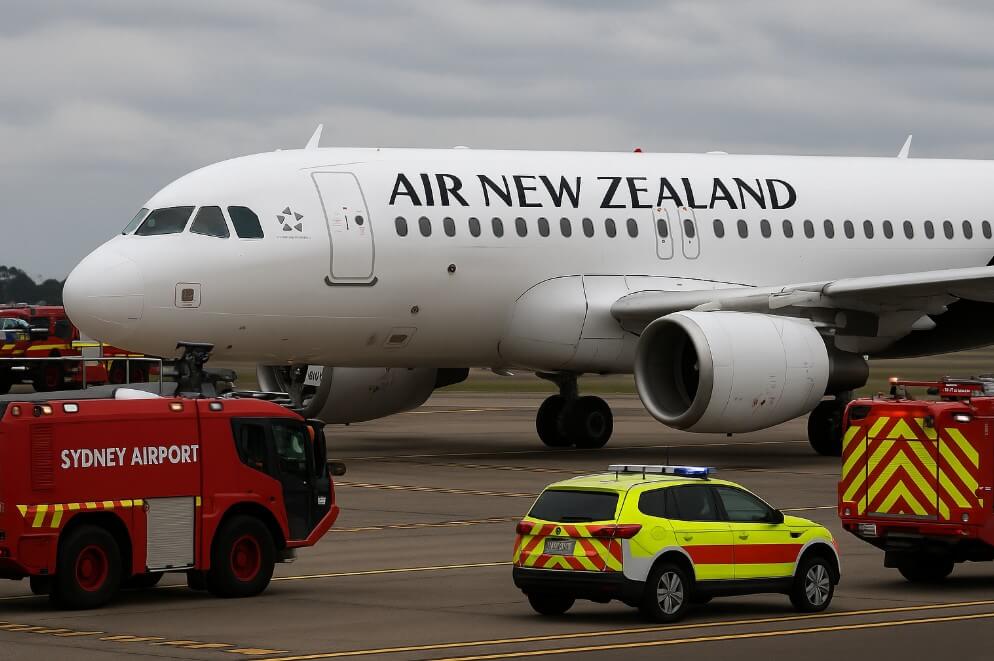
WELLINGTON — An Air New Zealand flight from Christchurch to Sydney made an emergency landing on Friday morning after the crew reported a suspected hydraulic failure mid-flight, prompting precautionary measures and the rapid deployment of emergency services at Sydney Airport.
Flight NZ221, operated by an Airbus A320neo, departed Christchurch (CHC) early on October 24, 2025, and landed safely in Sydney (SYD) shortly before 9 a.m. According to Air New Zealand, the aircraft’s crew followed standard emergency protocols after identifying a technical issue while crossing the Tasman Sea.
Upon arrival, the aircraft taxied to an apron where fire trucks and rescue vehicles were already in position. The airline confirmed that no injuries occurred and that all passengers disembarked safely after engineers performed initial checks.
“The aircraft landed safely and will undergo a detailed inspection before re-entering service,” said Air New Zealand’s Chief Safety and Risk Officer.
Calm Amid the Alert
Passengers on board said they were alerted about 20 minutes before landing that the flight would be performing an emergency arrival. Despite the announcement, multiple eyewitnesses described a composed atmosphere in the cabin. One passenger told reporters the landing felt “smooth,” and that travelers “remained calm throughout.”
After the landing, the aircraft remained stationary on the tarmac for about two hours as engineering crews conducted safety assessments. Ground staff provided assistance to passengers who were kept on board during the inspection, before being escorted into the terminal.
Mechanical Issue Under Review
Initial reports indicate the incident was caused by a hydraulic system malfunction, a component essential for controlling landing gear, flaps, and brakes. The airline’s technical team is now performing a comprehensive inspection of all related systems before the aircraft can return to service.
NZ221 was operated by an Airbus A320neo, registered ZK-NHC — a 6.6-year-old aircraft powered by two Pratt & Whitney engines. While officials have not speculated on the root cause, Air New Zealand emphasized that the flight crew’s swift and coordinated response minimized risk to passengers and operations.
“Safety is our highest priority,” the airline reiterated, confirming that “appropriate follow-up will be conducted before releasing the aircraft back into service.”
Aviation analysts note that modern jetliners are built with multiple layers of system redundancy, allowing pilots to maintain control and perform safe landings even when one system fails. The crew’s ability to execute a controlled descent and landing is being viewed as a testament to effective training and adherence to established safety protocols.
Operational and Regulatory Implications
The emergency diversion has drawn attention to the robustness of in-flight contingency procedures and the importance of real-time communication between flight crews, airline operations centers, and air traffic control.
Industry experts expect regulators, including the Civil Aviation Authority of New Zealand and the Australian Transport Safety Bureau, to review the incident closely, particularly given its link to hydraulic systems. Similar operators may also be advised to monitor maintenance and performance data from comparable aircraft.
While the event caused minor disruptions to Air New Zealand’s flight schedule, the airline said alternative arrangements were provided for affected travelers. No significant operational impact is expected beyond the inspection delay.
Lessons and Takeaways
The incident underscores the vital role of rapid crew decision-making and system redundancy in ensuring passenger safety during in-flight emergencies. Though mechanical faults are rare, airlines maintain detailed procedures to mitigate potential risks when they occur.
Friday’s emergency landing follows a string of routine safety responses by global carriers in recent months, highlighting the aviation industry’s emphasis on proactive risk management. For passengers aboard NZ221, the event served as a quiet demonstration of aviation safety systems performing exactly as designed.
The hydraulic issue that forced the emergency landing will remain under investigation until engineers complete a full assessment. In the meantime, Air New Zealand has reaffirmed its commitment to transparency and safety assurance as part of its ongoing review.
As commercial air travel continues to rebound, the smooth handling of NZ221’s emergency underscores a reassuring fact for travelers: even under pressure, the systems and people tasked with keeping passengers safe are proving their reliability.
