


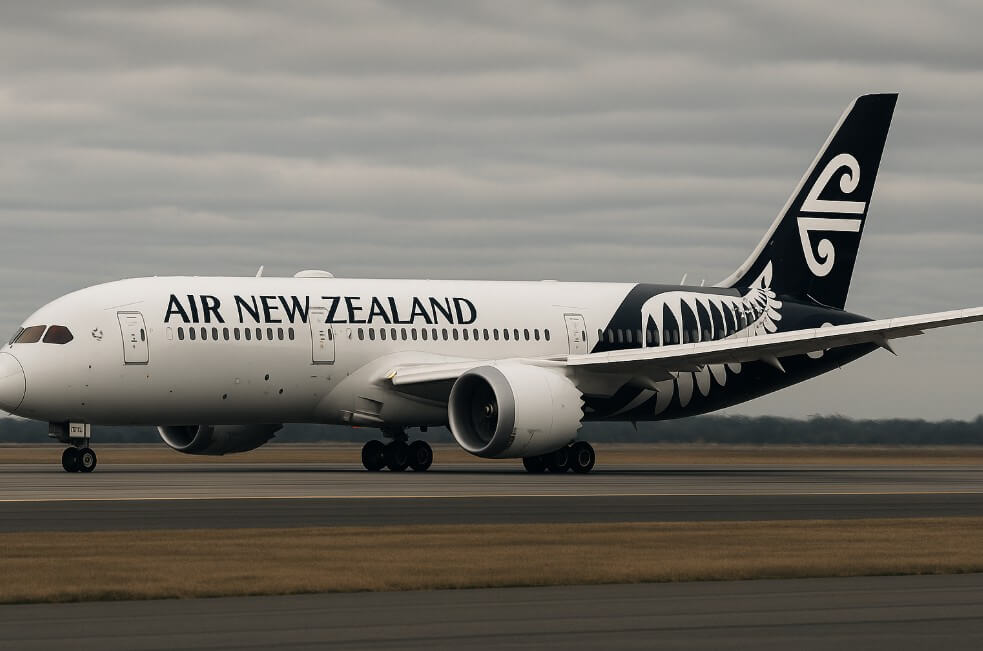
Air New Zealand reported a decline in annual earnings as rising operating costs, weaker domestic demand, and ongoing global engine issues put pressure on the airline’s bottom line.
For the 2025 financial year, the carrier posted earnings before taxation of $189 million, down from $222 million the prior year. Net profit after tax came in at $126 million, in line with the company’s April guidance.
Softer Market Meets Operational Headwinds
The airline’s financial results underscore the twin challenges of a cooling domestic market and industry-wide engine maintenance disruptions. Passenger revenue fell 2% to $5.9 billion, reflecting a 4% reduction in network capacity due to grounded aircraft.
Fuel provided some relief, with costs down 12%—or $208 million—thanks to softer jet fuel prices and lower consumption. However, that benefit was outweighed by a $235 million jump in non-fuel operating costs, a 6% increase year-on-year. The added expense stemmed from higher landing charges, labor costs, and engineering materials, with inflation running ahead of New Zealand’s Consumer Price Index.
The airline sought to offset those pressures through cost discipline, renegotiated supplier contracts, and procurement efficiencies. Its Kia Mau transformation program delivered $100 million in benefits, bolstered by stronger ancillary revenue, sustained premium travel demand, and technology upgrades such as live chat and automated rebooking.
Operational improvements helped trim disruption costs and lifted on-time performance by six percentage points in the second half of the year.
Leadership’s Take
Chair Dame Therese Walsh characterized the results as evidence of resilience under tough conditions. “This is a solid outcome despite significant operational and economic challenges,” Walsh said.
“It reflects the capability of our team and the financial discipline instilled by CEO Greg Foran.” Walsh pointed to the company’s strong balance sheet and disciplined strategy as reasons for confidence in its future.
Air New Zealand returned $38 million to shareholders through a buyback program announced in February. Walsh also acknowledged Foran’s upcoming departure. “Greg has led with clarity and focus, leaving the airline in a strong position. We thank him for his remarkable leadership,” she said.
Navigating Engine Disruptions
CEO Greg Foran stressed that the most acute headwinds stemmed from engine reliability problems. At times, the airline had as many as six narrowbody and five widebody aircraft grounded.
While Air New Zealand secured $129 million in compensation from engine makers, Foran estimated earnings could have been $165 million higher without the disruptions.
“These decisions were costly but necessary to support our customers and network stability,” he said, referring to the company’s moves to secure additional engines and aircraft while adjusting schedules.
The airline continues to work with Rolls-Royce and Pratt & Whitney on compensation and repair timelines. “There are no quick fixes, but we’re navigating with the same focus and discipline,” Foran said.
Progress Despite Challenges
Even amid disruptions, Air New Zealand made significant strides in 2025. Four Boeing 787-9 Dreamliners returned to service with upgraded interiors, enhancing passenger experience. The airline also unveiled a new uniform, announced a new international lounge for Auckland Airport, and broke ground on a new engineering hangar due to open later this year.
Expansion of the Christchurch Engine Centre and the rollout of AI service tools to 3,000 staff members further illustrated the carrier’s ongoing transformation.
“These achievements show our ability to execute our plan while seizing growth opportunities,” Foran said.
Outlook for 2026
Looking ahead, engine-related disruptions are expected to persist into 2026, though the most severe constraints should ease during the year. More than half of the Boeing 787 fleet will feature premium-focused interiors by next year, and deliveries of two new GE-powered 787s, an A321neo, and an ATR aircraft are expected to boost capacity on key routes.
Still, higher aviation charges and subdued domestic demand will weigh on performance. The company expects earnings before taxation for the first half of 2026 to be similar to or lower than the $34 million reported in the second half of 2025.
“We know what it takes to improve our financial performance, and progress is underway. As the network scales up and our transformation efforts continue, results will improve,” Foran said.
He added that while recovery may not be linear, the airline’s “strong balance sheet, clear strategy, and dedicated team give us confidence in the future.”
Despite near-term uncertainties—including unresolved compensation discussions with engine manufacturers—Air New Zealand signaled it remains focused on restoring reliability, delivering for customers, and creating long-term value for shareholders.
