


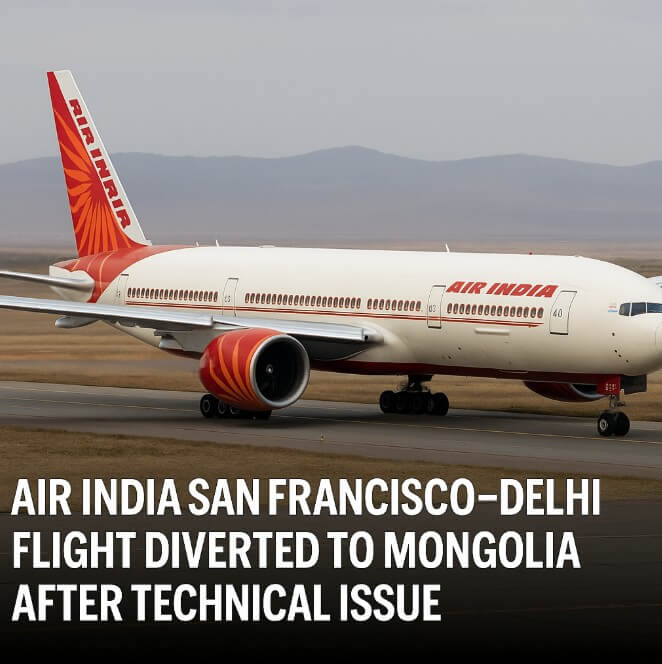
An Air India Boeing 777 operating flight AI174 from San Francisco to Delhi made a precautionary landing in Mongolia’s capital, Ulaanbaatar, after pilots detected a possible technical issue mid-flight. The aircraft, carrying 228 passengers and 17 crew members, landed safely without incident, the airline confirmed.
The Tata Group-owned carrier said in a statement that “Air India confirmed it is arranging alternate travel to Delhi while the aircraft undergoes technical checks.” The diversion occurred as a safety precaution in accordance with standard operating procedures.
Mid-Air Decision and Safe Landing
Flight AI174 departed from San Francisco International Airport (SFO) on Sunday, November 2, 2025, at 2:25 p.m. local time. The Boeing 777-200LR, registered as VT-AEH, was en route to Kolkata and onward to Delhi when the cockpit crew identified a potential technical issue mid-journey.
Following standard safety protocols, the pilots decided to divert to Ulaanbaatar (ULN), Mongolia—a sparsely populated but strategically located refueling and emergency stop point for transpolar routes. The aircraft touched down safely at Ulaanbaatar International Airport, where ground services and emergency teams were on standby.
After landing, “all passengers were served meals onboard before being disembarked,” according to Air India. Immigration formalities were completed, and the airline arranged hotel accommodations for passengers while alternate arrangements were made for onward travel to India.
A spokesperson added that the 16-year-old Boeing 777-200LR “is undergoing a detailed inspection,” emphasizing that “passenger safety remains its top priority” and expressing “regret for the inconvenience caused.”
Replacement Aircraft and Technical Support
Air India said it is dispatching an alternate aircraft along with a team of engineers and necessary equipment to Ulaanbaatar. The replacement jet will transport passengers and crew to Delhi, while the engineering team works to resolve the technical issue with the original aircraft.
Such procedures are routine in international aviation, particularly on ultra-long-haul routes that traverse remote regions with limited diversion options. “The airline has assured timely communication and full support for all passengers during the delay,” Air India said in a statement.
The decision to divert, while precautionary, underscores the company’s focus on safety oversight and operational integrity—a growing emphasis since Air India’s acquisition by the Tata Group, which has been investing heavily in fleet modernization and service reliability.
Context and Past Incidents
This is not the first time Air India’s long-haul operations between San Francisco and India have experienced mid-air diversions due to technical issues. In June 2023, a San Francisco–Delhi service diverted to Magadan, Russia, after a technical snag, stranding passengers for nearly 39 hours before an alternate aircraft arrived. The airline later issued full refunds and travel vouchers to affected travelers.
In another instance, a Delhi–San Francisco flight diverted to Krasnoyarsk, Russia, in July 2024. In that case, Air India managed a faster turnaround, dispatching a replacement aircraft from India within hours.
These incidents highlight the operational complexity of ultra-long-haul flights—some exceeding 15 hours—where airlines must maintain robust contingency measures to address unexpected technical or weather-related issues. For Air India, which operates multiple polar and trans-Siberian routes, diversions to remote airports are an accepted but infrequent operational reality.
Separate Domestic Diversion
In a separate incident earlier this week, an Air India flight from Delhi to Bengaluru carrying 172 passengers was diverted to Bhopal after a technical alert. The Airbus A320neo operating flight AIC 2487 declared a full emergency following a cargo hold warning shortly after takeoff.
Airport officials confirmed that “the flight’s crew reported a warning signal from the cargo compartment shortly after takeoff. In response, Air Traffic Control (ATC) at Bhopal Airport initiated emergency protocols at 19:33 IST to ensure passenger safety.” The crew later confirmed the alert had cleared, but the aircraft continued the diversion as a precaution, landing safely at 8:00 p.m. All passengers and crew disembarked without incident, and the aircraft remains under inspection.
Ongoing Commitment to Safety
Air India has reiterated that its “safety culture remains uncompromising” as it continues expanding its international footprint. The airline’s growing long-haul operations—particularly to North America—have placed greater emphasis on predictive maintenance and contingency readiness.
While the Ulaanbaatar diversion caused travel disruptions, the carrier’s rapid response and adherence to protocol underscored its commitment to passenger safety and operational transparency. Passengers from AI174 are expected to reach Delhi once the replacement aircraft arrives and clearances are completed.
As Air India continues its modernization drive under Tata Group ownership, the carrier faces the dual challenge of upgrading legacy aircraft while maintaining stringent safety standards across its global network.
