

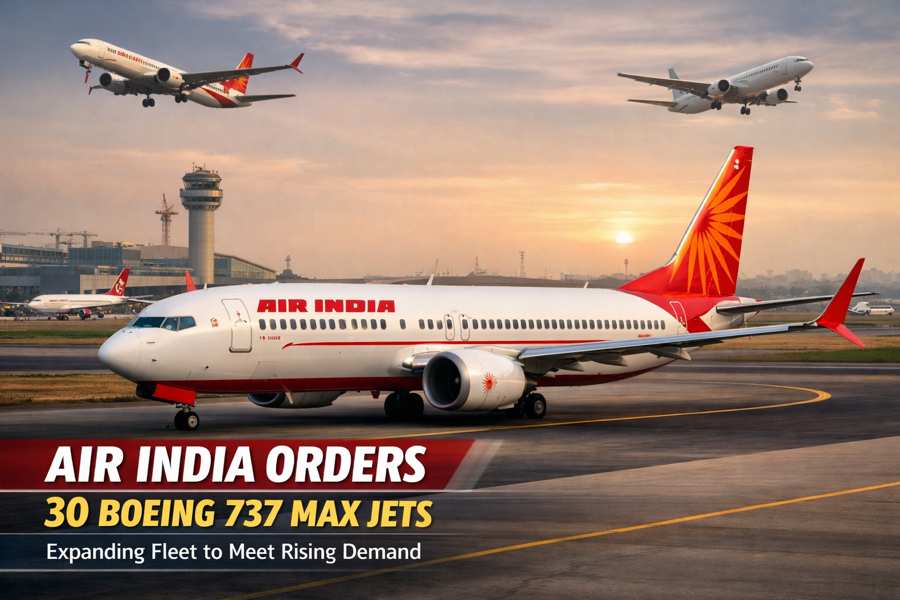
Air India is preparing to confirm an order for 30 additional Boeing 737 MAX aircraft, a move that further reinforces the Tata Group-owned carrier’s focus on expanding its narrowbody fleet to meet rising demand in India’s domestic and short-haul markets. The announcement is expected to be made at the Hyderabad Airshow, according to people familiar with the matter, and was first reported exclusively by Bloomberg.
The planned order would firm up options that Air India placed in 2023 and add to one of the largest aircraft acquisition programs in global aviation. For Air India, the additional jets represent another step in a multiyear strategy to modernize its fleet, increase capacity, and strengthen its competitive position in one of the world’s fastest-growing aviation markets.
Building on a Historic Aircraft Commitment
The 30 Boeing 737 MAX aircraft are part of Air India’s broader 470-aircraft commitment announced in 2023, which marked a turning point for the airline following its return to private ownership under the Tata Group. Of the total order, 220 aircraft were placed with Boeing, including 190 Boeing 737 MAX jets intended primarily for short-haul and high-frequency routes.
Most of the 737 MAX fleet is earmarked for Air India Express, the group’s low-cost subsidiary that focuses on domestic services and nearby international destinations. By expanding the narrowbody fleet at Air India Express, the group aims to capture price-sensitive demand while improving fleet commonality and operational efficiency.
The latest confirmation would represent Air India’s second major conversion of aircraft options into firm orders. In 2024, the airline finalized an order for 100 Airbus aircraft, underscoring its dual-supplier strategy and long-term confidence in traffic growth.
Details regarding the specific 737 MAX variants included in the latest order have not been disclosed. Delivery schedules have also not been announced and will depend on Boeing’s production capacity and its existing order backlog.
Tata Group’s Push to Transform Air India
Since acquiring Air India from the Indian government in 2022, the Tata Group has pursued an aggressive transformation agenda. This has included renewing the airline’s aging fleet, refurbishing cabins, improving operational reliability, and expanding both domestic and international networks.
Air India currently operates 191 aircraft, making it India’s second-largest domestic airline after IndiGo. While IndiGo continues to dominate the market with a largely single-type narrowbody fleet, Air India is positioning itself as a full-service carrier with a growing low-cost arm, supported by a mix of narrowbody and widebody aircraft.
The group’s strategy combines the induction of new aircraft with upgrades to legacy planes that remain in service. Executives have said the objective is to improve customer experience and on-time performance while adding capacity in high-growth markets across India, South Asia, and beyond.
Air India and Boeing did not respond immediately to requests for comment on the prospective order.
India’s Expanding Aviation Market
The planned expansion comes as India cements its status as a major global aviation growth engine. Boeing estimates that India and South Asia will require 3,290 new aircraft by 2044 to support rising passenger demand. India’s commercial fleet has grown rapidly, expanding from roughly 100 aircraft in 2000 to nearly 900 today.
Indian airlines now have more than 1,500 aircraft on order, representing the largest order backlog of any country. India has also emerged as the world’s third-largest domestic aviation market, behind only the United States and China.
Government investment has been a key driver of this growth. Authorities continue to pour funds into airport infrastructure, with plans to significantly increase the number of operational airfields over the next two decades to improve regional connectivity and reduce congestion at major hubs.
Risks and Challenges Remain
Despite strong long-term fundamentals, the expansion comes against a backdrop of recent challenges for Indian aviation. In 2025, the industry was shaken by the country’s worst aviation accident, involving a Boeing 787 Dreamliner. A final investigation report into the crash is still awaited.
At the same time, operational disruptions at IndiGo have had spillover effects across the market, highlighting infrastructure and capacity constraints that can accompany rapid growth. Even so, airlines such as Air India continue to press ahead with ambitious fleet expansion plans, betting that structural demand growth will outweigh near-term risks.
As Air India prepares to confirm its latest Boeing order, the move signals both confidence in India’s aviation trajectory and the Tata Group’s determination to reshape the former state carrier into a globally competitive airline.
