


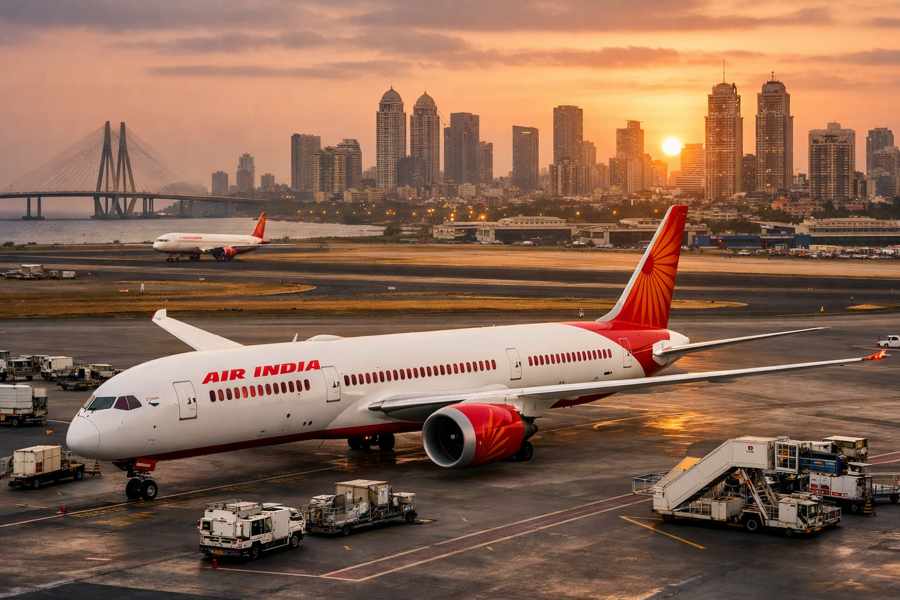
GURUGRAM— Air India is accelerating a strategic reset of its international network by rebuilding Mumbai as a premium long-haul hub, deploying newly inducted and retrofitted Boeing 787 aircraft as part of its Vihaan.AI transformation program. The effort is designed to better align capacity with demand from India’s financial capital while improving yields through a stronger mix of corporate and premium traffic.
The airline will begin operating its newest Boeing 787-9 on the Mumbai–Frankfurt route from February 1, marking the first deployment of a production widebody aircraft from Air India’s landmark 470-aircraft order signed three years ago. The move underscores a broader shift toward premium product upgrades and selective network realignment rather than capacity expansion for its own sake.
Refocusing International Capacity From Mumbai
Air India plans to significantly increase its effective international capacity from Mumbai by inducting both new and upgraded Boeing 787 aircraft. The strategy addresses what executives see as a longstanding gap between Mumbai’s strong corporate travel demand and the limited availability of long-haul international services.
Currently, Air India operates medium- to long-haul flights from Mumbai to Frankfurt, London Heathrow, and New York/Newark. By comparison, Delhi supports a far more extensive long-haul network spanning Europe, East Asia, and Australia. As part of the recalibration, Air India will discontinue its nonstop Mumbai–San Francisco service from March 1, reflecting a more disciplined approach to route economics.
According to The Hindu Business Line, the revised strategy is expected to improve revenue quality and traffic mix rather than simply add seats, signaling a focus on profitability and sustainable growth.
Corporate Demand Drives the Shift
While Delhi benefits from stronger inbound diaspora and leisure traffic, Mumbai remains India’s largest corporate travel market. Despite this advantage, Air India has historically struggled to fully capitalize on the city’s business demand due to network constraints and product inconsistency.
Mumbai once served as Air India’s primary operational base. That changed after the opening of Terminal 3 at Delhi Airport in 2010 and the airline’s decision to shift its headquarters to the national capital in 2013. Over time, Delhi emerged as the carrier’s dominant international gateway.
Air India now aims to rebalance that dynamic by enhancing onboard products and expanding capacity on select Mumbai routes that can support higher-yield traffic. “We will expand our capacity and upgrade our product on our Mumbai flights,” an airline official said, adding that the initiative is expected to strengthen yields and improve overall route profitability.
New Boeing 787-9 Debuts on Frankfurt Service
The introduction of the Boeing 787-9 on the Mumbai–Frankfurt sector represents a visible step in Air India’s fleet and product renewal. The aircraft is equipped with fully flat business-class seats and a new-generation in-flight entertainment system featuring QLED HDR touchscreens.
Passenger-focused enhancements also include Bluetooth headphone pairing and wireless charging pads, bringing the onboard experience closer to global premium standards and addressing a key expectation of corporate travelers. The aircraft was formally unveiled at Begumpet Airport in Hyderabad, highlighting its role as a milestone delivery within the broader fleet modernization plan.
Fleet Modernization and Consistent Product Standards
In parallel with new aircraft deliveries, Air India is refurbishing its existing Boeing 787 fleet to ensure consistency across the widebody operation. The first retrofitted 787 is scheduled to return to service in the first quarter of 2026.
By the end of December, the airline expects to operate 20 Boeing 787 aircraft featuring upgraded cabins and enhanced inflight systems. Management views the dual-track approach—new deliveries alongside retrofits—as essential to maintaining a uniform premium product while the fleet transitions.
Potential New Routes From Mumbai
Sources familiar with the airline’s planning say Air India is evaluating additional long-haul routes from Mumbai, including a potential service to Tokyo’s Haneda Airport. The carrier is also considering the reintroduction of flights to Johannesburg, restoring connectivity that has been absent for several years.
If implemented, these routes would further reinforce Mumbai’s role as a strategic international gateway alongside Delhi. For Air India, the rebuild is less about reclaiming past prominence and more about aligning aircraft, products, and routes with the realities of India’s evolving travel market—particularly the high-value corporate segment centered in Mumbai.
