


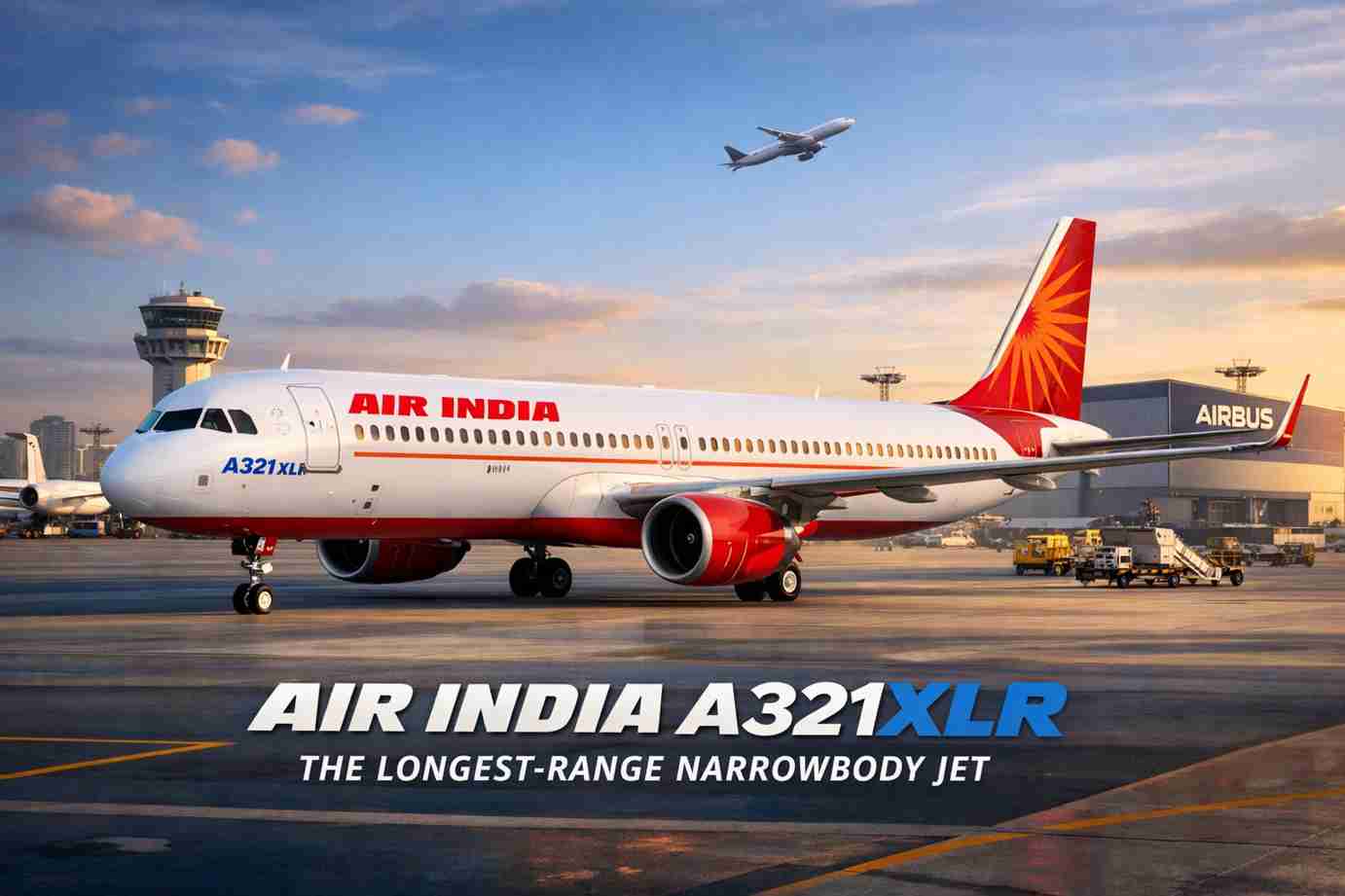
Air India has taken another step in reshaping its long-term fleet and network strategy by upgrading part of its narrowbody aircraft order to Airbus’s longest-range single-aisle jet. The airline announced on January 29 that it will convert 15 Airbus A321neo aircraft into the newer A321XLR variant, strengthening its ability to operate longer international routes with greater efficiency. The announcement was made during Wings India 2026, held in Hyderabad.
The move signals Air India’s intent to deepen its presence in medium-haul international markets while maintaining a strong focus on fuel efficiency, flexibility, and passenger comfort. Deliveries of the newly converted A321XLR aircraft are scheduled to begin in 2029 and continue through 2030.
Part of a Landmark Airbus Order
The A321XLR conversion is part of Air India’s landmark aircraft order with Airbus, originally placed in 2023 and expanded in 2024. The agreement ranks among the largest commercial aviation deals in Indian history and reflects the airline’s ambition to modernize rapidly following its privatization.
Under the overall deal, Air India has firm orders for 50 Airbus A350 widebody aircraft and 300 single-aisle jets from the A320 Family. Of the 300 narrowbody aircraft, 210 were originally ordered as A321neo models, while the remaining 90 were A320neo aircraft.
With the latest adjustment, 15 of the A321neo aircraft will now be delivered as A321XLRs. The remaining narrowbody aircraft will retain their original configurations. This selective conversion allows the airline to tailor its fleet more precisely to evolving network requirements without altering the overall scale of its order.
Expanding Reach With Single-Aisle Economics
The Airbus A321XLR is the most advanced evolution of the A320neo Family and is designed to bridge the gap between traditional narrowbody and widebody operations. With a range of up to 4,700 nautical miles, the aircraft is capable of flying long-haul and medium-haul international routes that were previously the domain of larger twin-aisle jets.
For Air India, the A321XLR opens up opportunities to launch new nonstop international services from India to overseas destinations where demand may not justify widebody capacity. It also provides added flexibility on existing high-demand routes by allowing more precise capacity matching.
In addition to extended range, the A321XLR offers improved fuel efficiency and lower emissions, supporting Air India’s sustainability objectives. The aircraft’s modern cabin design also enhances passenger comfort, an important consideration as the airline seeks to reposition itself in competitive international markets.
Supporting a Broader Transformation Strategy
The A321XLR decision aligns with Air India’s broader post-privatization transformation strategy, which emphasizes fleet modernization as a cornerstone of operational and financial renewal. Since being privatized in January 2022, the airline group has pursued an aggressive plan to rebuild its fleet and network.
Air India has inducted nearly 170 aircraft through a combination of new deliveries, leases, fleet consolidation, and the reactivation of previously grounded jets. These efforts are aimed at improving reliability, reducing operating costs, and enhancing the overall customer experience.
As of now, the airline has outstanding deliveries of 542 aircraft from a total firm order book of 600, including 344 Airbus aircraft. The scale of these deliveries highlights the long-term nature of Air India’s fleet renewal program and its commitment to building one of the youngest fleets in the global aviation industry.
Deepening Ties With Airbus
Beyond aircraft procurement, Air India maintains a long-standing and multifaceted partnership with Airbus. The two companies operate a 50:50 joint venture that established an advanced pilot training center at the Air India Training Academy in Gurugram, inaugurated in September 2025.
The facility is equipped with 10 Full Flight Simulators and is designed to train more than 5,000 pilots over the next decade. This initiative supports not only Air India’s expanding fleet but also the broader growth of India’s aviation sector, which continues to see rising demand for skilled flight crews.
Bottom Line
The conversion of 15 A321neo aircraft to the A321XLR variant strengthens Air India’s future network strategy by combining extended range with single-aisle operating economics. As deliveries begin at the end of the decade, the aircraft are expected to play a key role in opening new international routes and improving efficiency on existing ones. The decision reinforces Air India’s commitment to long-term growth, modernization, and global competitiveness in the rapidly evolving aviation market.
