


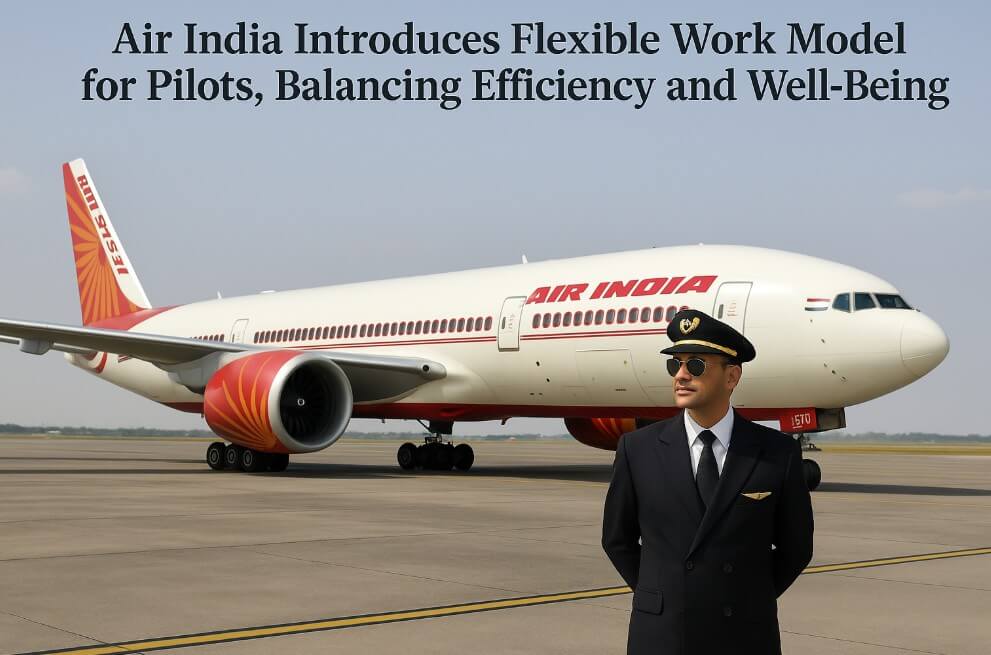
NEW DELHI — Air India, the Tata Group-owned national carrier, has rolled out a new flexible contract model for its pilots, introducing shorter, more balanced duty cycles across key aircraft fleets. The initiative, called the “Flexi Contract for Pilots” programme, offers a year-long work arrangement aimed at providing greater scheduling flexibility while maintaining the airline’s operational efficiency.
The scheme, unveiled this week, applies to Line Pilots and Line Training Captains flying Airbus A320, Boeing 777, and Airbus A350 aircraft. Junior First Officers, Type Rating Instructors, and Direct Entry pilots are not eligible for the programme.
According to the airline, the new contract is designed to “align pilot roster preferences with fleet-demand realities without disrupting service.” The initiative comes amid Air India’s ongoing transformation under the Tata Group, which is focused on fleet modernization, network expansion, and workforce optimization.
New Duty Patterns and Terms
Under the new flexi model, pilots operating wide-body aircraft—including the Boeing 777 and Airbus A350—will follow a 15-days-on / 15-days-off roster. They will also receive eight privilege leave days and four sick leave days annually.
Pilots on narrow-body aircraft, such as the Airbus A320, will operate under a 20-days-on / 10-days-off schedule, accompanied by 12 privilege leave days and six sick leave days each year.
The contract runs for a 12-month period and can be extended at the airline’s discretion. Once the term concludes, participating pilots revert to their prior contractual terms.
Air India plans to implement the scheme in two waves — one beginning in January 2025 and the next in March 2025. For commanders, the rollout includes 50 A320 slots in Bengaluru, Delhi, and Hyderabad; 30 Boeing 777 slots in Mumbai and Bengaluru; and 20 A350 slots in Delhi.
First Officers are allotted 20 A320 slots across Bengaluru, Mumbai, and Hyderabad; 70 Boeing 777 slots in Delhi, Mumbai, and Bengaluru; with A350 slots to be announced later.
Selection and Eligibility
Eligibility is confined to specific captain and training-captain roles on the designated fleets. Pilots will be selected through an Expression of Interest process, taking into account seniority and operational requirements.
Participants may choose to exit the programme by providing three months’ notice. However, if a pilot is scheduled for a fleet or command upgrade, the flexi contract will automatically end upon entering training. Declining an upgrade will trigger the standard career policy’s “freeze” period.
Air India retains the right to revert a pilot to their prior contract terms, without changes to the compensation that applied before joining the flexi model.
Pay Structure and Benefits
Salary under the flexible model will be based on a minimum monthly availability of 12 days for wide-body pilots and 15 days for narrow-body pilots, qualifying them for 40 hours of pay. Hours beyond 40 will be compensated at the same hourly rate as under existing contracts.
Key allowances—including those for trainers, wide-body operations, dead-head flights, and layovers—remain unchanged. Car lease payments and National Pension System (NPS) contributions will continue, adjusted against the flexible salary structure.
Importantly, the airline clarified that off-days under this model remain dedicated to Air India, and pilots are prohibited from taking up outside work during these periods.
Leave-bidding will now function on an ad-hoc basis, with previously accrued bids forfeited. Under the new structure, bid-points total 20 for wide-body pilots and 30 for narrow-body pilots.
All other terms — including loss-of-license insurance, medical coverage, seniority protection, and merit or demerit policies — will remain unchanged. Upon returning to their original contracts, pilots will re-enter the next standard leave-bidding cycle.
Balancing Flexibility and Growth
The flexi-contract initiative marks a significant shift in Air India’s approach to workforce planning at a time when the airline is aggressively expanding its fleet and international network. Industry observers say the model may help retain senior pilots who prefer shorter rosters and attract experienced professionals seeking better work-life balance.
“Air India’s flexi-contract scheme introduces a structured approach to pilot rostering, offering manageable duty cycles of 15-15 and 20-10 for key fleet crews,” the airline said. “While aiming to enhance work-life balance and retain talent within a rapidly expanding airline, the model also safeguards core operational allowances and seniority protections.”
The success of the programme will likely depend on pilot participation levels and its ability to balance crew expectations with the carrier’s operational needs. For Air India, the initiative represents another step in its effort to modernize its HR practices as it evolves into a global full-service airline under Tata Group stewardship.
