


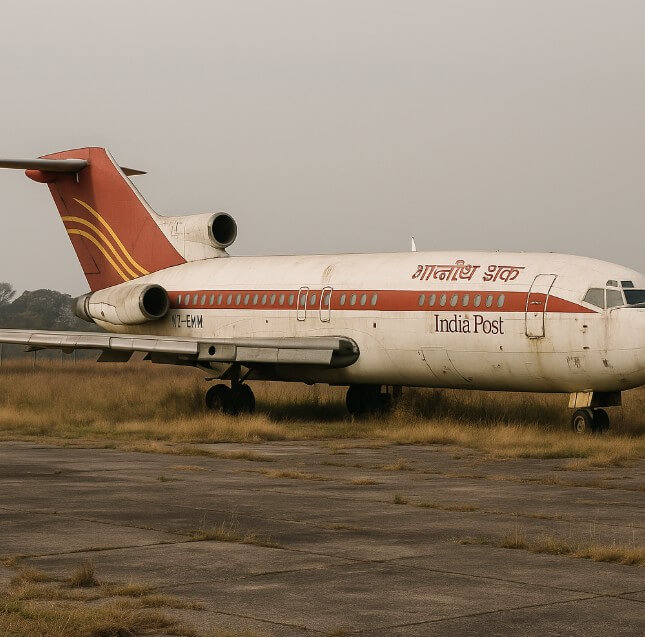
GURUGRAM — Air India’s rediscovery of a long-forgotten Boeing jet has exposed deep structural weaknesses in the airline’s former state-run asset-management practices, raising new questions about oversight during the years before privatization.
The carrier recently learned that a 43-year-old Boeing 737-200 had been sitting abandoned at Kolkata Airport (CCU) for more than a decade — unnoticed in official records and omitted from financial documentation across multiple administrative cycles. The discovery came only after airport officials contacted the airline to request that the obsolete aircraft be removed from the airfield.
The jet, registered VT-EHH, was delivered to the former Indian Airlines in 1982 and later flew for Alliance Air before Air India converted it into a freighter in 2007. It operated in partnership with India Post before being grounded in 2012. From there, it slipped into obscurity, stored in a remote corner of the airport and effectively erased from the carrier’s fixed-asset records.
The lapse triggered a detailed internal audit, which found that the aircraft had disappeared from depreciation schedules, insurance documentation, maintenance forecasts, and financing-related registers. Because the airline was still state-owned at the time, the financial consequences were ultimately borne by taxpayers. As the original press release noted, “At the time, taxpayers were responsible for losses, and the outdated processes allowed this lapse to persist.”
A Jet Lost in the System
The plane remained invisible to the airline’s operational ecosystem for years. Insurers had no active file for it, maintenance teams had no scheduled tasks associated with it, and finance departments did not track its long-term cost exposure. The omission meant the aircraft was not factored into asset valuations during the Tata Group takeover — a striking example of how incomplete documentation can distort the true condition of a large enterprise.
Air India CEO Campbell Wilson acknowledged the extent of the oversight to employees, explaining that across several years leading up to privatization, VT-EHH was repeatedly absent from internal registers used to track property and equipment. According to the press release, “At the time, taxpayers were responsible for losses, and the outdated processes allowed this lapse to persist.”
Additional historical accounts referenced in the release indicate that VT-EHH had once been stored alongside another classic jet, VT-EGG, at Kolkata. While VT-EGG was eventually transported to Rajasthan and turned into an aircraft-themed restaurant, VT-EHH never left the airport. Some aviation observers noted that the aircraft had previously been seen at Delhi Airport (DEL) before ultimately ending up as a themed structure in Rajasthan.
A Legacy Problem for a Modernizing Airline
The rediscovery of VT-EHH illustrates the scale of the cleanup required after the Tata Group purchased the airline from the government in 2022. The conglomerate has since embarked on a multi-year modernization effort, overhauling information-technology infrastructure, standardizing procurement, renegotiating vendor contracts, addressing human-resources inconsistencies, and implementing internationally aligned governance practices.
Air India’s legacy as a state-run carrier meant its documentation often lagged behind global industry norms. Well-run airlines typically maintain tight fixed-asset registers to track depreciation, parking charges, insurance liabilities, and maintenance cycles — systems essential for accurate budgeting and risk assessment. Before privatization, those processes were inconsistent, and in the case of VT-EHH, nonexistent.
The sale and transfer of the long-forgotten aircraft were completed after its rediscovery, though the airline has not disclosed the buyer or sale price. The episode underscores why rigorous record validation is crucial when overhauling large, historically complex organizations.
As the press release concluded, “The case reflects legacy gaps that once shaped the former state-run airline’s asset management practices.”
Air India’s leadership has framed the incident as a reminder of the importance of modern controls rather than a reflection of current operational standards. Still, the story of an entire airframe forgotten for more than a decade — only to be rediscovered after a call from an airport authority — highlights the depth of transformation needed to bring the airline in line with global best practices.
Stay tuned with us. Further, follow us on social media for the latest updates.
