


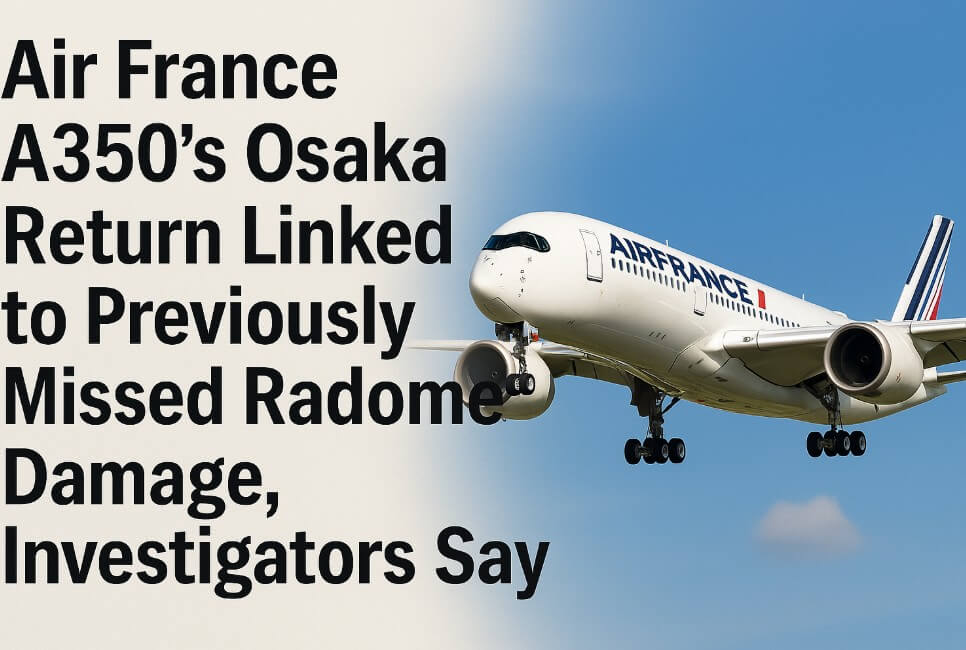
Air France has revised its inspection and training protocols after French investigators determined that previously undetected radome damage triggered a series of failures aboard Flight AF291, an Osaka–Paris service forced to return shortly after departure. The Airbus A350-900, carrying 309 passengers and 14 crew members, landed safely at Osaka Kansai Airport with no injuries reported.
Hidden Damage and a Critical Failure in Flight
The BEA, France’s air-accident investigation agency, found that the aircraft’s radome had suffered internal damage during a bird strike one month before the incident. Although the initial strike was documented, maintenance teams did not identify debonding on the radome’s inner skin—a defect investigators say was essential to the sequence of events.
French investigators concluded that “a bird strike one month before the Osaka to Paris service likely caused debonding of the radome’s inner skin.” Despite weather-radar anomalies appearing three days before departure, indicating that the antenna was obstructed, the issue did not prompt a deep inspection. According to Flight Global, the radar antenna obstruction “should have prompted a more detailed inner-surface inspection.”
Once AF291 departed Kansai on May 28, 2023, radar faults reappeared as the aircraft climbed through 35,000 feet. The crew elected to return, but “as the aircraft descended through 30,000 ft, the radome collapsed inward.” The sudden structural failure disturbed airflow around the nose, disrupted pressure measurements in the air-data probes, and generated conflicting airspeed indications.
These disruptions triggered multiple flight-control law transitions—normal to alternate, back to normal, and then alternate again—as the crew attempted to determine whether they were dealing with radome failure or an air-data probe malfunction.
Crew Response and System Misunderstandings
Airspeed fluctuations intensified as the aircraft descended, leading the pilots to initiate unreliable airspeed procedures. At first, they kept the autopilot, autothrust, and flight director engaged while analyzing fault messages. At 15,000 feet, rising vibration and aerodynamic noise prompted them to consider diverting to Tokyo, though they ultimately chose to continue toward Osaka.
During configuration changes, including slat and flap deployment, “the crew observed sudden drops and marked differences between primary speed indications.” They later “stated that they believed they had lost the radome and that the abnormal speed variations confirmed this.”
The pilots disconnected automated systems and switched to manual flying. One pilot relied on the head-up display, while the other used pitch-thrust tables to validate speed data. Investigators, however, concluded that the crew’s actions reflected limited understanding of the A350’s advanced NAIADS backup air-data system.
“Investigators noted that this decision reflected limited understanding of the A350’s NAIADS system.” The system, which supports airspeed and altitude information even when pitot sensors fail, “remained functional throughout the event,” meaning automated flight could have been safely maintained. The BEA added that fragmented manual descriptions and insufficient training contributed to the crew’s uncertainty. “In less favourable conditions, remaining on automated systems is generally preferred because it preserves crew workload.”
Safe Landing Despite System Changes
Despite inconsistent airspeed indications, the flight crew stabilized the aircraft on a long downwind leg to runway 24R. Because the A350 was overweight for landing, the extended path allowed time to manage descent and configuration. Airspeed fluctuations triggered another brief shift from normal to alternate law before the system recovered.
The aircraft intercepted the ILS and landed safely in Osaka. No passengers or crew were injured.
Industry Response and Safety Enhancements
In the aftermath of the investigation, Airbus reinforced radome maintenance procedures, directing technicians to perform full inner-surface inspections following bird-strike, hail, or similar impacts. The manufacturer also updated the A350 flight manual, adding a dedicated section on radome-collapse scenarios and clarifying when airspeed fluctuations may occur, reducing the likelihood that crews disengage automation prematurely.
Air France has strengthened its maintenance checks following bird, hail, or lightning strikes and increased follow-up on weather-radar fault reports to ensure underlying issues are fully investigated. The airline has also expanded pilot training on NAIADS to improve confidence in automated systems during air-data irregularities.
The Osaka event, though resolved safely, has drawn renewed attention to radome integrity and the importance of clear system documentation as modern aircraft rely increasingly on advanced air-data architectures.
