


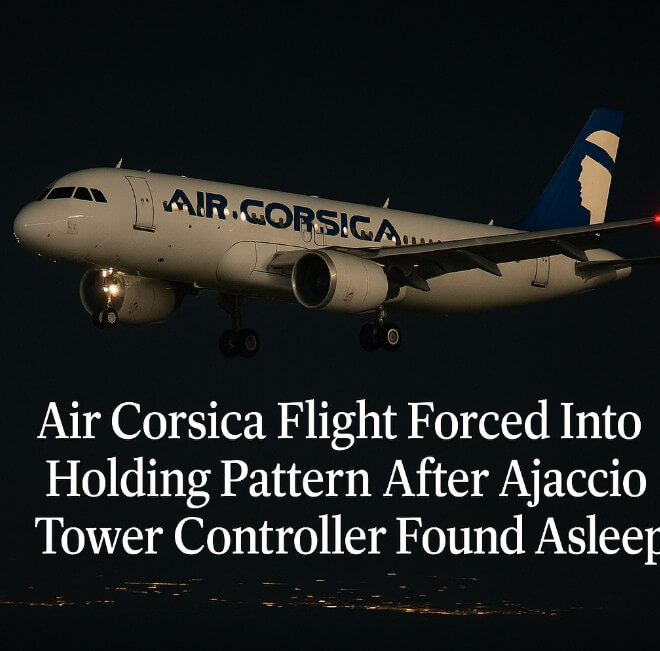
AJACCIO, France — A late-night Air Corsica flight from Paris to Ajaccio was forced to circle the skies over Corsica for nearly half an hour after losing contact with the control tower, an incident now under investigation by French aviation authorities.
On September 15, 2025, Air Corsica flight XK777, an Airbus A320neo traveling from Paris Orly Airport (ORY) to Ajaccio Napoleon Bonaparte Airport (AJA), was preparing to land when communication with air traffic control abruptly ceased. The runway lights remained off, and repeated calls from the cockpit went unanswered.
What followed was an unusual and potentially serious lapse in airport operations. The sole controller on duty had reportedly fallen asleep, leaving the incoming flight without guidance.
A Routine Flight Turns Into an Unscheduled Hold
According to flight records, XK777 departed Orly at 10:45 p.m. local time, about 27 minutes behind schedule. The 75-minute journey proceeded uneventfully until the aircraft began its descent over the Gulf of Ajaccio, leveling off at 15,000 feet as it awaited landing clearance.
When the crew attempted to contact the tower, they received silence. Compounding the problem, the runway remained unlit, making a landing impossible. With passengers aboard and fuel considerations in mind, the pilots initiated a holding pattern over the Mediterranean Sea.
Tracking data shows the jet circled for roughly 20 minutes as the crew considered diverting to Bastia Airport (BIA), located across the island. Ultimately, the decision was made to continue holding in hopes the situation would resolve.
Discovery at the Tower
The resolution came not from radio contact but from the airport’s emergency services. Roughly 30 minutes after initial communication attempts failed, Ajaccio’s fire department was dispatched to the control tower.
Upon arrival, responders found the duty controller asleep at their post. Communications were immediately restored, and the runway lights were switched on.
The aircraft landed safely at 12:35 a.m., more than an hour behind its scheduled arrival, with a total flight duration of 109 minutes. No injuries were reported, and the passengers were able to disembark normally.
Authorities Launch Investigation
France’s Bureau d’Enquêtes et d’Analyses pour la Sécurité de l’Aviation Civile (BEA) confirmed it has opened an investigation into the incident. The inquiry will focus on staffing protocols, late-night operational procedures, and whether systemic factors contributed to the lapse.
The event, described by local authorities as “unprecedented,” underscores the risks of single-person coverage at regional airports during overnight hours. Unlike larger hubs, airports such as Ajaccio often rely on one controller to manage traffic during low-demand periods.
Aviation safety experts note that while redundancy is costly, fatigue management and staffing resilience are crucial safeguards. A controller falling asleep on duty is rare but not unheard of, and the consequences can be significant if multiple flights are affected.
Industry Reaction and Broader Concerns
Air Corsica has not yet issued a public statement, though the episode has drawn attention among both passengers and aviation professionals. Industry observers say the incident highlights long-standing concerns about fatigue in aviation, where demanding schedules and overnight shifts can impair alertness.
“Air traffic controllers are the last line of safety before a plane lands,” one industry analyst noted. “Even at smaller airports, the risks are too high to rely on a single individual without safeguards.”
For travelers, the disruption was little more than a delay, but for regulators, the incident raises questions about whether staffing levels and fatigue monitoring at regional airports are adequate.
Looking Ahead
As the BEA continues its probe, the case is expected to fuel calls for enhanced oversight and stricter fatigue mitigation measures at France’s smaller airports. Options under discussion include dual staffing during overnight hours, expanded use of automated systems, or revised rest schedules for controllers.
While the safe landing ensured the episode ended without harm, experts caution that the underlying vulnerabilities exposed on September 15 could have wider implications for regional aviation safety.
For Air Corsica, a carrier serving as a critical link between the French mainland and Corsica, the investigation may prompt closer scrutiny of operational reliability at its key airports
