


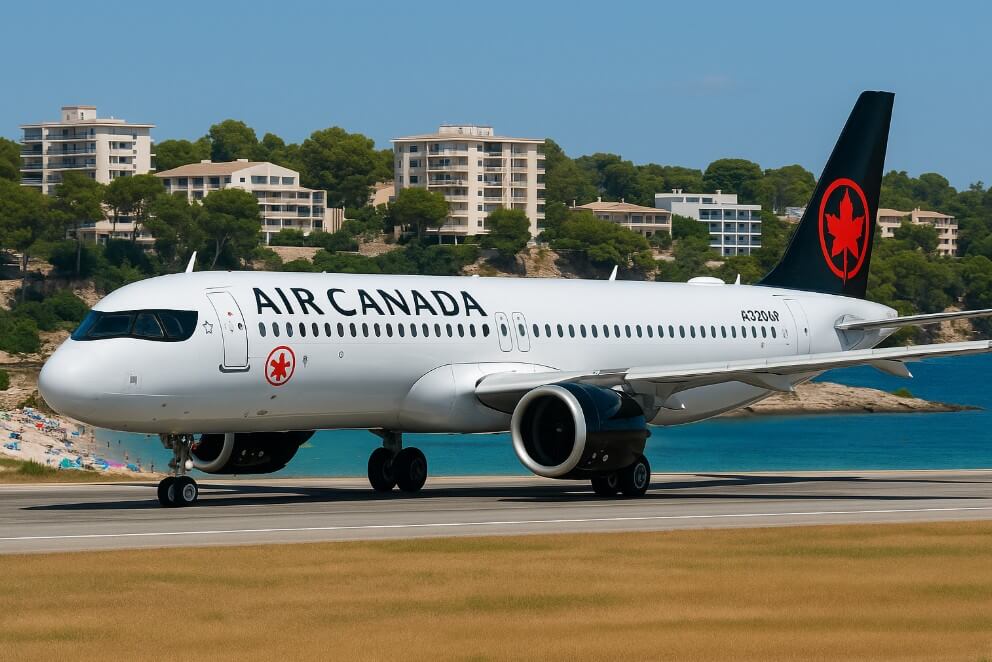
Montréal — Air Canada has chosen Spain’s Palma de Mallorca as the inaugural destination for its new Airbus A321XLR fleet, underscoring the carrier’s ambitions to expand transatlantic connectivity with more fuel-efficient, long-range narrow-body aircraft.
The service will begin in June 2026, linking Montréal–Trudeau International Airport (YUL) with Palma de Mallorca Airport (PMI). The new route, now open for reservations, will mark the first time a Canadian airline serves the popular Mediterranean island directly.
Strategic Expansion with New Aircraft
The Airbus A321XLR represents a pivotal shift in Air Canada’s international strategy. The model, known for its extended range and efficiency, allows airlines to operate long-haul routes with smaller, more versatile aircraft. For Air Canada, that translates to access into markets previously considered too small for wide-body jets.
Mark Galardo, Executive Vice President, Network Planning and Revenue Management, and President, Cargo at Air Canada, emphasized the importance of the new aircraft type for the airline’s future.
“The A321XLR represents a transformative addition to our fleet, facilitating strategic growth into underserved destinations such as Palma de Mallorca,” Galardo said.
He added that the new service will tap into growing interest among Canadian travelers for Mediterranean destinations.
“As the first Canadian carrier to serve this culturally rich Mediterranean destination, we anticipate strong demand for its renowned coastal attractions and historical significance.”
A Premium Narrow-Body Experience
Unlike typical narrow-body jets, the A321XLR will introduce a premium onboard experience to Air Canada’s long-haul network. The aircraft will seat 182 passengers, including 14 lie-flat Signature Class seats alongside 168 Economy Class seats.
The cabin design, according to the airline, will bring wide-body standards to a smaller aircraft, offering upgraded interiors and enhanced amenities. For passengers, that means the possibility of a more comfortable and seamless experience on long-haul flights normally served by larger jets.
The investment also signals Air Canada’s intent to differentiate itself in a competitive North Atlantic market, where demand for comfort and convenience continues to grow.
Beyond Mallorca: A Broader Deployment
While Palma de Mallorca will be the A321XLR’s first destination, Air Canada plans to roll out the aircraft across other transatlantic routes.
Year-round flights between Montréal and Toulouse–Blagnac Airport (TLS) will transition to the new aircraft, strengthening connections between French- and English-speaking markets. Seasonal Montréal–Edinburgh (EDI) service will also return in 2026 with the A321XLR.
As more aircraft join the fleet, additional routes from Toronto, Ottawa, and Halifax are expected, reflecting Air Canada’s strategy of using the A321XLR to link secondary Canadian cities with European destinations.
Fleet Modernization and Growth
Air Canada has ordered 30 A321XLRs, with initial deliveries set for the first quarter of 2026. The planes are being acquired through a leasing agreement with Air Lease Corporation. Up to 10 aircraft are scheduled to arrive in 2026 alone, giving the airline the ability to accelerate its international growth plans.
The investment aligns with industry trends. Global airlines are increasingly turning to fuel-efficient narrow-bodies like the A321XLR, which combines lower operating costs with the ability to serve new point-to-point markets. For Air Canada, the aircraft is expected to improve profitability while offering flexibility in a network that spans both major hubs and leisure-focused destinations.
Positioning for the Future
The launch of the Palma de Mallorca service highlights how Air Canada intends to leverage its new aircraft to capture demand in niche but high-potential markets. By marrying efficiency with passenger comfort, the airline hopes to appeal to both leisure and business travelers.
The announcement also comes as airlines worldwide adapt to shifting travel patterns post-pandemic, with leisure-driven destinations in Europe seeing sustained demand from North America. For Air Canada, adding Mallorca not only diversifies its network but strengthens its position in the growing Canada–Europe leisure market.
As deliveries ramp up, the A321XLR is expected to become a cornerstone of Air Canada’s long-term fleet modernization strategy. The carrier’s move illustrates how next-generation aircraft are reshaping international air travel by enabling direct connections that were once out of reach.
