


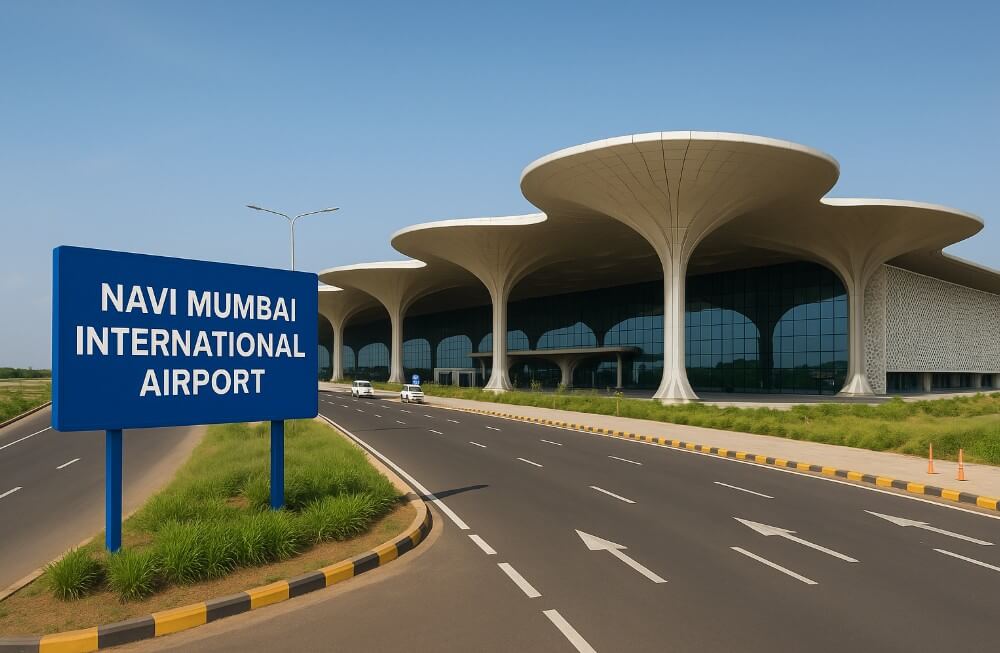
NAVI MUMBAI — India officially entered a new era of aviation infrastructure with the inauguration of the Navi Mumbai International Airport (NMIA), a landmark project poised to transform connectivity and logistics across western India. Prime Minister Narendra Modi presided over the opening ceremony, hailing the airport as a cornerstone of India’s rapid modernization drive.
Developed under a Public-Private Partnership between Mumbai International Airport Limited (MIAL)—a subsidiary of Adani Airport Holdings Limited—and CIDCO, the greenfield airport represents one of the largest aviation developments in India in decades. Designed to work in tandem with the Chhatrapati Shivaji Maharaj International Airport (CSMIA), the facility will eventually allow the Mumbai Metropolitan Region (MMR) to handle up to 90 million passengers annually, easing congestion and positioning Mumbai among the world’s premier dual-airport hubs.
A Strategic Hub for Regional and Global Connectivity
Spanning more than 1,160 hectares near Panvel, NMIA is central to the government’s “Viksit Bharat 2047” vision to build world-class infrastructure and enhance India’s global competitiveness. In its initial phase, the airport is expected to handle 20 million passengers per year, with future expansions set to raise that figure to 90 million.
The site’s strategic location integrates multiple transport modes, including direct access to the Mumbai Trans Harbor Link (Atal Setu), suburban rail, metro corridors, and planned inland waterways. This multimodal design significantly reduces travel times between the airport, Mumbai, and key industrial zones along the JNPT–Mumbai corridor.
Officials said this networked approach not only improves passenger convenience but also creates a foundation for a robust trade and logistics ecosystem throughout Maharashtra and beyond.
Architecture Rooted in Culture and Sustainability
NMIA’s terminal design, conceived by Zaha Hadid Architects, draws inspiration from India’s national flower—the lotus—symbolizing purity and resilience. Its sculptural columns and floating, lotus-shaped roof maximize natural light and promote passive cooling, combining aesthetic appeal with environmental responsibility.
The airport incorporates extensive sustainability measures, including solar power generation, water recycling systems, and adherence to international green building standards. Adani Group executives said these features make NMIA a model for future eco-conscious aviation projects across Asia.
Maharashtra’s Emerging Economic Engine
Economists and regional planners expect NMIA to significantly reshape Maharashtra’s economic landscape. By diverting air traffic from the saturated CSMIA, the new airport will catalyze growth across Navi Mumbai, Raigad, and Pune, generating employment and spurring investment in allied sectors such as real estate, logistics, and hospitality.
Early signs of this transformation are already visible. Property prices in surrounding areas—including Ulwe and Panvel—have surged since the project’s groundbreaking. Analysts estimate that NMIA’s full operation could boost Maharashtra’s gross state domestic product (GSDP) by up to 0.5%, reflecting heightened commercial activity and infrastructure expansion.
A Future-Ready Cargo and Logistics Powerhouse
Cargo operations are integral to NMIA’s design, reflecting India’s ambition to strengthen its position in global supply chains. The airport will initially handle 500,000 tonnes of cargo annually, with capacity expanding to 3.2 million tonnes over time.
The airport’s fully automated cargo terminal features AI-enabled monitoring, a Pharma Excellence Center with temperature-controlled storage, and specialized zones for perishable goods. Situated near the Jawaharlal Nehru Port Trust (JNPT), NMIA will enable efficient sea-air transshipment for high-value industries including pharmaceuticals, perishables, and e-commerce.
Passenger Experience and Commercial Vision
Beyond logistics, NMIA is designed to redefine the passenger journey. The terminal complex includes over 110 retail outlets and a 1,800-square-meter duty-free zone, along with cultural pavilions, dining venues, and landside entertainment accessible to both travelers and visitors.
The airport’s 67 general aviation stands cater to premium and business travelers, further reinforcing Mumbai’s growing stature as a global aviation hub comparable to Dubai and Singapore.
From Blueprint to Reality
The vision for Navi Mumbai International Airport was first approved in 2007 as a response to Mumbai’s expanding air traffic demand. Years of environmental, engineering, and resettlement challenges delayed progress until 2021, when the Adani Group assumed leadership of the project. Land transfer in 2022 and the unveiling of the lotus-inspired design in 2023 accelerated construction toward completion.
With NMIA now operational, India joins global metropolises such as London, New York, and Tokyo, each anchored by twin-airport systems supporting surging passenger and cargo volumes. As the airport begins operations, industry observers view it as a symbol of India’s expanding aviation ambitions—and a gateway to the world for the country’s next generation of travelers and businesses.
