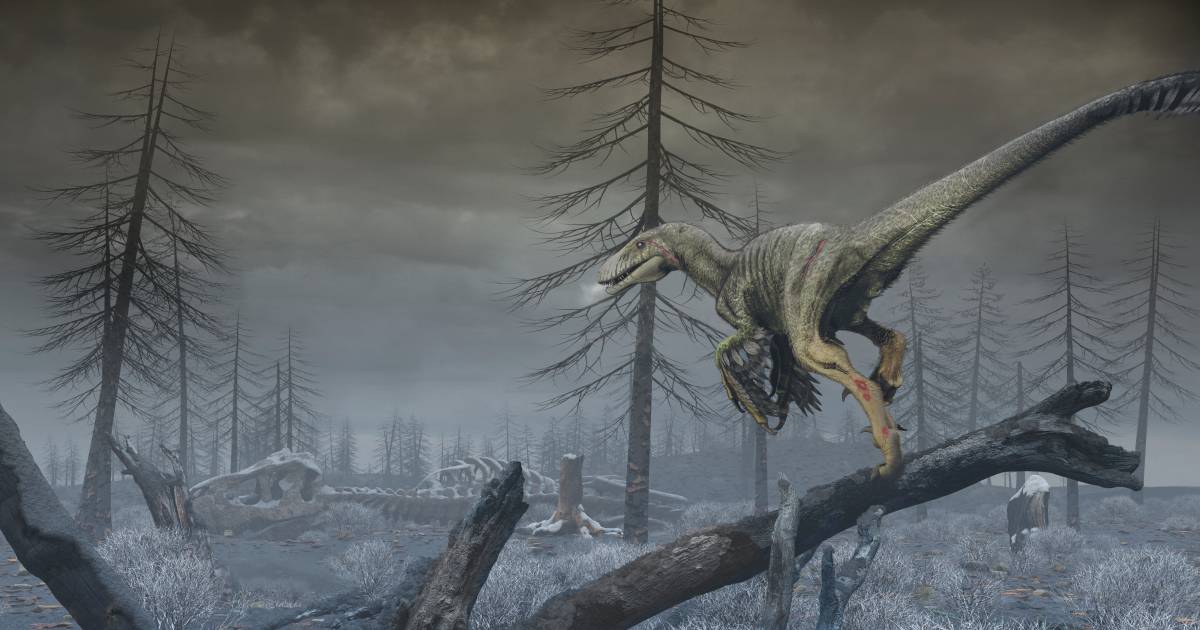
According to Belgian scientists, microparticles herald the eventual end of dinosaurs: ‘a chain reaction of extinction started’ | Science and the planet
Particles from crushed rock released by the Chicxulub meteorite impact played a dominant role in the extinction of life on our planet about 66 million years ago. This would have caused a cooling of the climate and a disruption of the process of photosynthesis, with all the ensuing consequences. This is the conclusion of a new study published in the journal Nature Geoscience, to which Belgian researchers also contributed.
The Chicxulub meteorite impact caused a global winter impact event that likely led to the demise of flightless dinosaurs and about 75 percent of species on Earth 66 million years ago. The exact causes of the mass extinction at the boundary between the Cretaceous and Paleogene geological periods have not yet been well understood.
Previous research indicated that sulfur gas and particles released during the collision and soot from forest fires after the collision were the main causes of the winterization. But was that true? Scientists have also asked themselves this question. What effect will the different types of impact material ejected from the crater into our atmosphere, including silicate dust, have on global climate?
To investigate the role of sulfur dust, soot and silicates in the post-impact climate, scientists from the Royal Observatory of Belgium have developed a new paleoclimate model, specializing in simulating the consequences on climate and nature after the Chicxulub impact. These simulations took into account new field data from a geological site in North Dakota, US.
Sediment samples were collected and measured through laser diffraction grain size analysis by scientists at Vrije Universiteit Brussels (VUB) and Vrije Universiteit Amsterdam (VUA). “We specifically took the top one millimeter thick of the Cretaceous-Paleogene boundary layer. We saw that the fine particles that fell from the air at that time were related to meteorite impact. These new results show that these grains were much finer, ranging in size from 0.8 to 8.0 micrometers. This has important consequences for climate reconstruction. “Because in the past, scientists introduced different grain sizes into their climate models,” explains Pim Kaskis (VUB).
Scientist Jim Burke Senel of the Royal Belgian Observatory explains further: “New fine-grain-size simulations show that silicate dust could have remained in the atmosphere for up to fifteen years after the impact. This contributed to a global cooling of the Earth’s surface of up to to 15 °C shortly after the impact. According to co-authors Stephen Goderis and Philip Claes (both VUB), this time scale is consistent with insights gained from the recent discovery of a clay layer in the middle of the Chicxulub impact crater in Mexico. This indicates that the precipitation of this material was It will occur over a period of 20 years, which is consistent with new climate model results.
In addition, researchers discovered that the particles block solar radiation. This means that photosynthesis on Earth was essentially at a standstill for about two years. This is a long enough time scale to have an impact on marine and terrestrial life. Animals and plants that were not able to adapt to survive this dark, cold, nutrient-poor period would have gone extinct en masse. A chain reaction of extinction began. This is consistent with fossil data, according to co-author Johan Velicoop (University of Leuven and Royal Belgian Institute of Natural Sciences). “Plants and animals that can enter a resting phase or adapt to not relying on a particular food source will generally survive a meteorite impact better.”
Small and medium-sized asteroids are most common in the solar system and can also cause devastation on a regional or national scale
“Chicxulub-sized impacts by kilometer-sized asteroids causing mass extinctions are rare, but small and medium-sized asteroids in the 100-meter range are more common in the solar system and can cause devastation on a regional or national scale,” he says. Ozgur Karatkin of the Royal Belgian Observatory. That’s why the observatory and VUB are contributing to the Hera mission, an international planetary defense experiment. The Hera mission will test the kinetic impact technique for asteroid deflection and provide scientific information, allowing us to gain more knowledge about asteroid formation and collision processes.
Scientists discover new giant whale ancestor: “This may have been the heaviest animal on Earth”
Why fossils from the past are important for our future: “We have to adapt, if not, forget it” (+)
Melting permafrost releases viruses that have been dormant for 50,000 years: how dangerous could it be?
Free unlimited access to Showbytes? Which can!
Log in or create an account and never miss a thing from the stars.