

Close Menu
Aviation Analysis – Industry Travel NewsAviation Analysis – Industry Travel News
    Facebook X (Twitter) Instagram
    Facebook X (Twitter) Instagram
    Aviation Analysis – Industry Travel NewsAviation Analysis – Industry Travel News
    Subscribe
    • Home
    • Top News
    • World
    • Economy
    • Science
    • Tech
    • Sport
    • Entertainment
    • Contact Form
    Aviation Analysis – Industry Travel NewsAviation Analysis – Industry Travel News
    Home»Science»Hubble sees a colorful pocket of stars – spinning close up, like bees swarming around a hive
    Science

    Hubble sees a colorful pocket of stars – spinning close up, like bees swarming around a hive

    Moses YarboroughBy Moses YarboroughSeptember 7, 2020No Comments2 Mins Read
    Share Facebook Twitter Pinterest LinkedIn Tumblr Email
    Hubble sees a colorful pocket of stars – spinning close up, like bees swarming around a hive
    Share
    Facebook Twitter LinkedIn Pinterest Email Copy Link

    by European Space Agency / Hubble
    6 September 2020

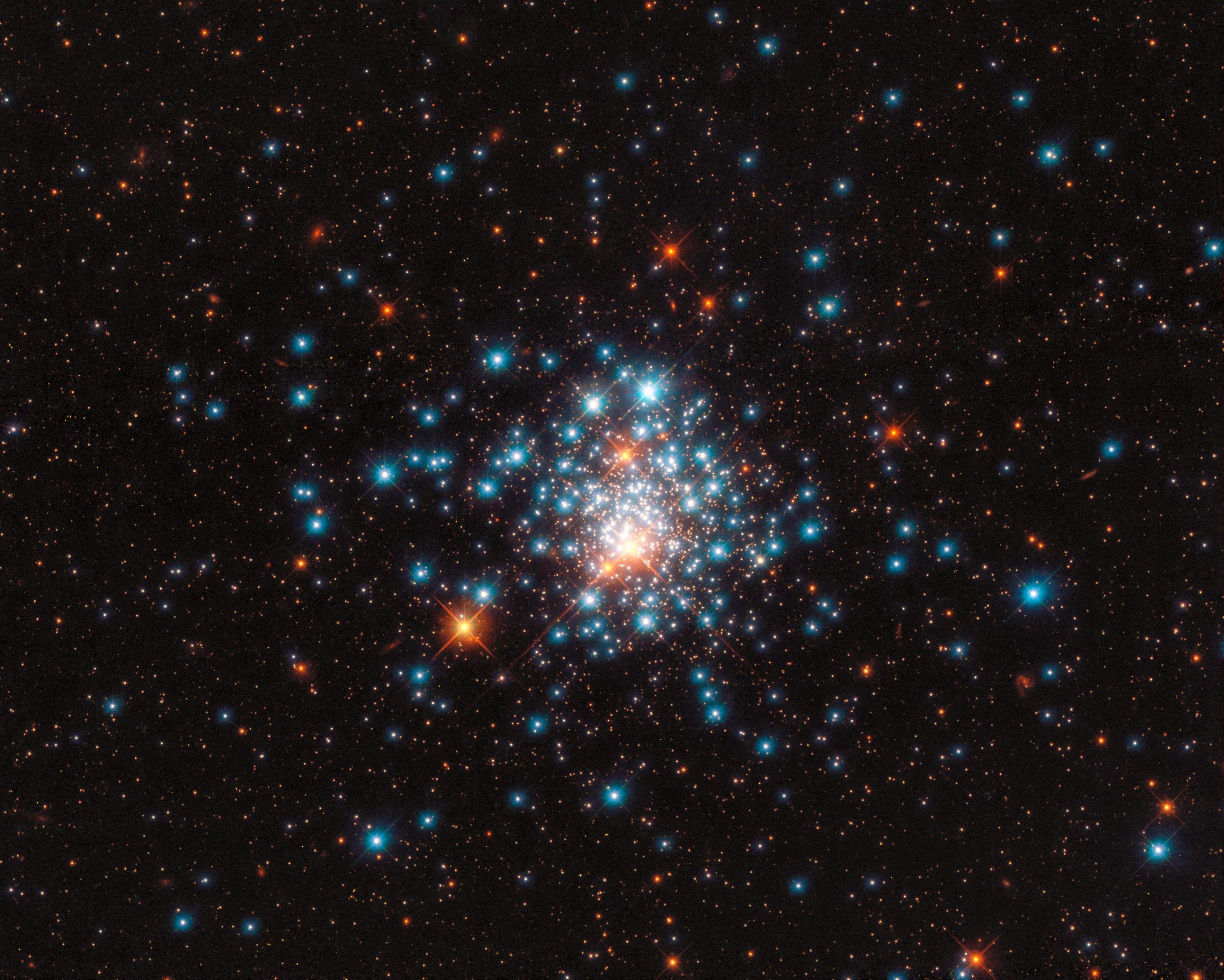
    NGC 1805 Spherical Cluster

    Credit: ESA / Hubble & NASA, J. Kalirai

    Several of the colored stars are grouped close together in this image of NGC 1805 globular cluster NGC 1805 NASA/ This Hubble Space Telescope. This tiny cluster of thousands of stars sits near the edge of the Large Magellanic Cloud, our own galaxy Milky Way. The stars orbit closely together, like bees swarming around a hive. In the dense center of one of these clusters, the stars are 100 to 1,000 times closer together than the closest stars to our sun, making the surrounding planetary systems unlikely.

    The striking difference in star colors is beautifully illustrated in this image, which combines two different types of light: blue stars, the brightest in near-ultraviolet light, and red stars, illuminated in red and near-infrared. Space telescopes like Hubble can detect ultraviolet rays because they are positioned above the Earth’s atmosphere, which absorbs most of this wavelength, making it inaccessible to ground installations.

    This young globular cluster can be seen from the Southern Hemisphere, in the constellation Dorado, and in Portuguese means dolphin fish. Globular clusters usually contain stars that are born at the same time. However, NGC 1805 is unusual in that it appears to host two different star constellations millions of years apart. Observing such clusters of stars can help astronomers understand how stars evolve, and the factors that determine whether they end their lives as white dwarves or explode as supernovae.

    Share. Facebook Twitter Pinterest LinkedIn Tumblr Email
    Moses Yarborough

    Devoted music ninja. Zombie practitioner. Pop culture aficionado. Webaholic. Communicator. Internet nerd. Certified alcohol maven. Tv buff.

    Related Posts

    Neodymium Magnet Uses and Safety Tips for 2025

    October 4, 2025

    Researchers want to whiten clouds to combat global warming

    August 28, 2024

    “Blockchain DNA” is possible after scientific progress

    August 26, 2024
    Navigate
    • Home
    • Top News
    • World
    • Economy
    • Science
    • Tech
    • Sport
    • Entertainment
    • Contact Form
    Pages
    • About Us
    • DMCA
    • Contact Form
    • Privacy Policy
    • Editorial Policy
    STAY UPTODATE

    Get the Latest News With Aviationanalysis.net

    OFFICE

    X. Herald Inc.
    114 5th Ave New York,
    NY 10011, United States

    QUERIES?

    Do you have any queries? Feel free to contact us via ourĀ Contact Form

    Visit Our Office

    X. Herald Inc.
    114 5th Ave New York,
    NY 10011, United States

    • About Us
    • DMCA
    • Contact Form
    • Privacy Policy
    • Editorial Policy
    © 2025 ThemeSphere. Designed by ThemeSphere.

    Type above and press Enter to search. Press Esc to cancel.