


Europe’s largest telescope takes stunning images of the sun that show intricate detail of sunspots and plasma unlike anything researchers have seen before.
- The largest telescope in Europe took its first high-resolution images of the sun
- Solar magnetic fields captured at 516 nm wavelength
- The telescope was also able to capture an image of sunspots at 430 nm
- The team attributes the feat to the lockdown of the coronavirus and the ability for new optics
The sun burns more than 93 million miles from Earth, but the new images provide a close-up look at the complex structures up to 30 miles wide on their fiery surface.
Using the largest telescope in Europe, known as GREGOR, scientists have captured amazing details about the evolution of sunspots and the intricate design of solar plasma.
These are the highest-resolution images the European telescope has observed, which the team attributes to new optics capable of examining the massive star’s magnetic fields, convection, solar flares and sunspots in great detail – unlike ever before.
The images show solar magnetic fields captured at a wavelength of 516 nanometers and sunspots at 430 nanometers, which astronomers say is “as if someone saw a needle on a perfectly sharp soccer field from a distance of one kilometer.”
Scroll down for the video
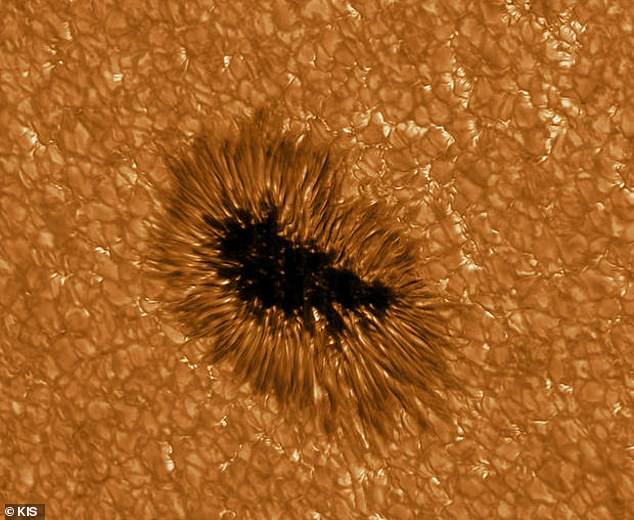
Using the largest telescope in Europe, known as GREGOR, scientists have captured amazing details about the evolution of sunspots and the intricate design of solar plasma. Pictured is a sunspot observed with high resolution by the GREGOR telescope at a wavelength of 430 nm
Our star is covered with many cell-like structures – each the size of the US state of Texas – that are products of violent convection motions that transfer heat from deep within the sun’s interior.
In each of them, hot plasma rises in the bright center of the cell before it cools and descends again into the star to form dark corridors that GREGOR can see – and some have compared it to the appearance of popcorn.
“This was a very exciting project, but also very challenging. In just one year we have completely redesigned the optics, mechanics and electronics to achieve the best possible image quality,” said Dr. Lucia Clint, who led the project and the German solar telescopes in Tenerife.
Kleint and her team made major progress in March during the coronavirus lockdown that allowed them to get a close-up look at the sun.
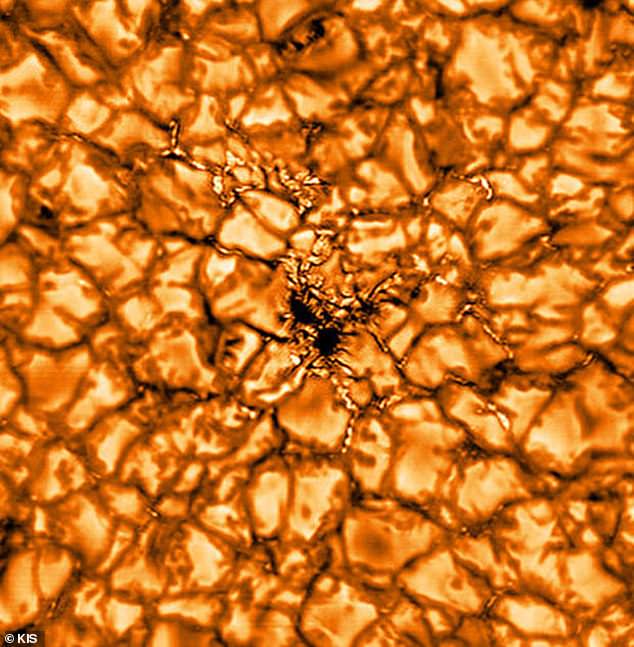
The images show solar magnetic fields captured at a wavelength of 516 nm (pictured) and sunspots at 430 nm, which astronomers say is “ as if someone saw a needle on a perfectly sharp soccer field from a distance of one kilometer. ”
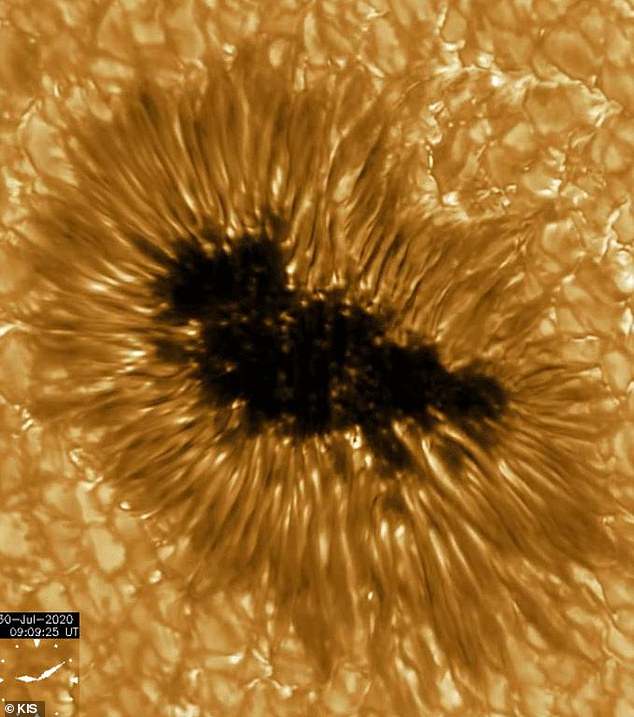
Sunspot observed with high resolution with the Gregorian telescope at a wavelength of 430 nm. These stunning images follow the first photos obtained in July by a team working with the Inwi Solar Telescope in Hawaii.
The group was stranded at the observatory, which gave them time to design a new optical laboratory.
Dr Svetlana Berdyogina, Professor at Albert Ludwig University in Freiburg and Director of the Leibniz Institute for Solar Physics (KIS), is very happy with the outstanding results: “ The project was somewhat risky because these telescope upgrades usually take years, but the brilliant teamwork and meticulous planning resulted in This success.
“Now we have a powerful puzzle solving tool on the sun.”
The stunning images come on the heels of the first photoshoots obtained by a team working at the Enowe Solar Telescope in Hawaii in July, which allows astronomers to analyze details of the sun’s surface and learn more about how space weather was formed.
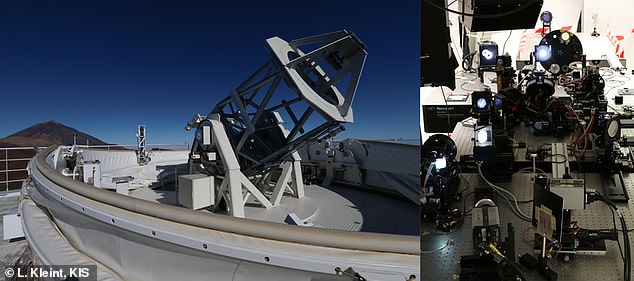
These are the highest-resolution images that the European telescope has observed, which the team attributes to new optics capable of examining the massive star’s magnetic fields, convection, solar flares and sunspots in great detail – unlike ever before.
“On Earth, we can predict whether it will rain substantially anywhere in the world with great accuracy, but space weather was not there yet,” Matt Mountain, president of the Association of Universities for Research in Astronomy, said in July.
Our forecasts are 50 years behind terrestrial weather, if not more.
“What we need is to understand the physics behind space weather, and this starts with the sun, which is what the Enoy Solar Telescope will study.”
Ads
