


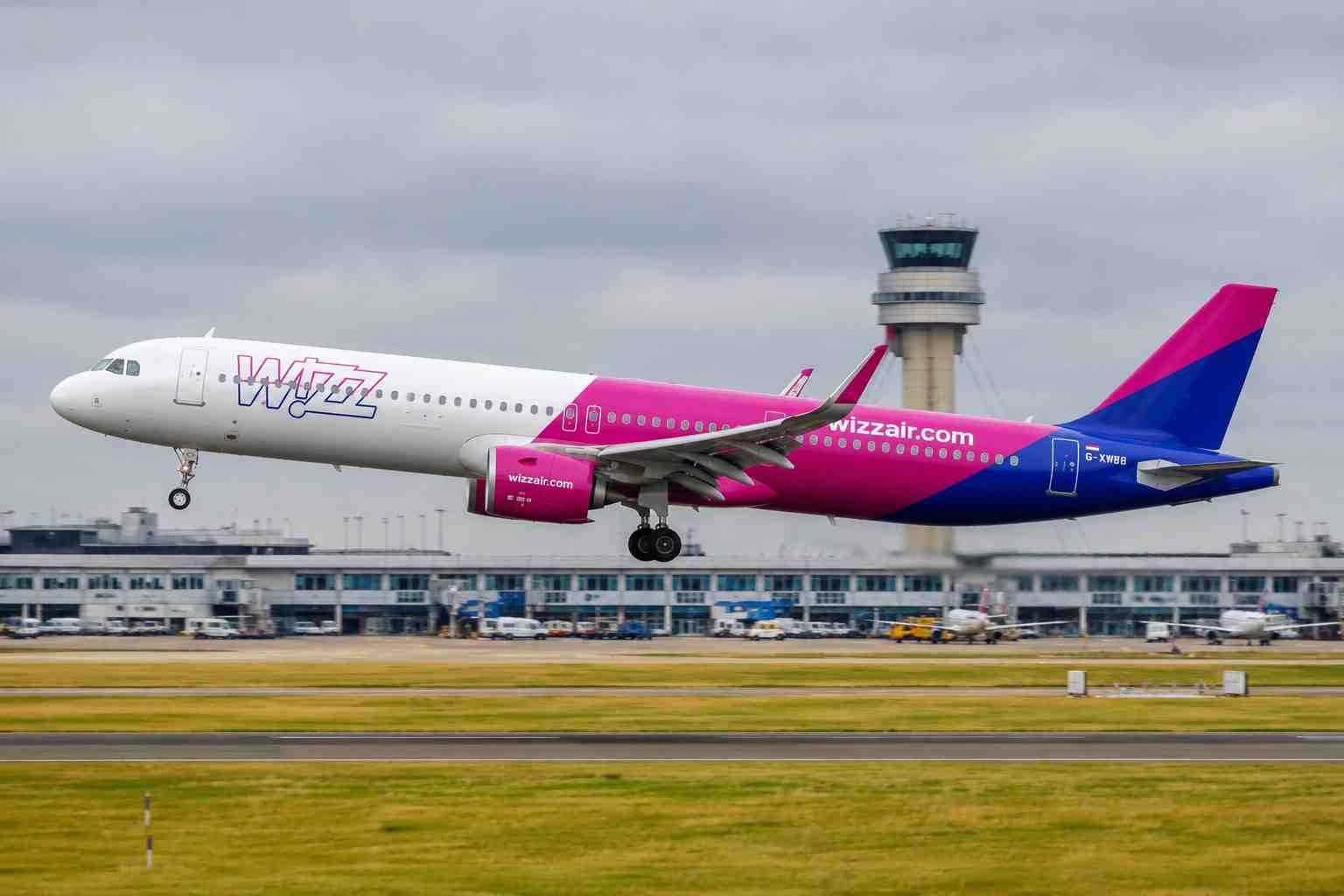
LONDON — Wizz Air has removed its longest scheduled routes from London Gatwick Airport to Saudi Arabia, ending flights to Jeddah and Medina and signaling a major shift in how the airline plans to deploy its Airbus A321XLR fleet.
The ultra-low-cost carrier has quietly withdrawn the services from its booking system, only months after outlining plans to expand operations in Saudi Arabia. The move eliminates the airline’s longest scheduled flights and removes the primary routes that were specifically designed to take advantage of the Airbus A321XLR’s extended range capabilities.
The decision comes as Wizz Air reassesses its long-haul ambitions and adapts its fleet strategy following significant operational and structural changes over the past year.
Saudi Expansion Plans Reversed
The London Gatwick–Jeddah and London Gatwick–Medina routes had represented one of Europe’s most ambitious low-cost long-haul ventures. The nearly seven-hour flights were among the few services in Wizz Air’s network that fully utilized the range advantages offered by the Airbus A321XLR.
Earlier in 2026, the airline had planned to strengthen its presence in Saudi Arabia. Those plans included increasing flights between London and Jeddah to twice daily while maintaining daily service to Medina.
However, passengers are no longer able to book nonstop flights on either route, effectively ending Wizz Air’s only scheduled operations that required the additional range of the A321XLR.
The withdrawal raises questions about the future role of the aircraft within the carrier’s network and highlights a broader strategic pivot away from some of its earlier long-range growth ambitions.
Executives Signal More Flexible Aircraft Deployment
Speaking to Aviation Week, Group Chief Commercial Officer Ian Malin said the airline would continue evaluating opportunities for the aircraft but would otherwise operate them similarly to its standard A321neo fleet.
He added that Wizz Air would consider alternative missions only if they improved profitability without adding operational complexity.
Those comments suggest the airline is prioritizing efficiency and financial returns over network expansion that could introduce additional operational challenges.
Abu Dhabi Closure Reshaped Long-Haul Plans
The route cancellations are closely tied to changes that followed the closure of Wizz Air Abu Dhabi in 2025. The Abu Dhabi-based operation had originally been expected to play a central role in launching and supporting many of the airline’s planned long-range Airbus A321XLR services.
Following the closure of the joint venture, Wizz Air significantly reduced its commitment to the aircraft type. The airline converted 36 of its 47 Airbus A321XLR orders into standard Airbus A321neo aircraft, leaving a planned fleet of just 11 A321XLRs.
Management pointed to several factors behind the decision, including geopolitical uncertainty in the Middle East, regulatory hurdles, demanding operating environments that affected Pratt & Whitney engines, and a limited number of commercially attractive long-range opportunities within Europe and neighboring regions.
The revised fleet strategy reflects a more cautious approach to expansion, particularly in markets that present higher operational risks.
Limited Long-Range Opportunities Remain
With the Saudi Arabia routes removed, Wizz Air now has very few scheduled services that require the additional range offered by the Airbus A321XLR.
Most destinations within the airline’s core markets—including Europe, North Africa, and the Caucasus—can already be served efficiently by the Airbus A321neo, according to industry publication Simple Flying.
The airline has also repeatedly ruled out launching scheduled transatlantic flights, limiting potential opportunities for the long-range aircraft. At the same time, management has remained cautious about deeper expansion into parts of the Middle East and Africa due to ongoing geopolitical and operational concerns.
A321XLR Expected to Serve Supporting Role
Rather than becoming the foundation of a new long-haul network, the Airbus A321XLR now appears set to operate primarily as a flexible asset within Wizz Air’s broader fleet.
The aircraft will likely be deployed where its range or performance characteristics provide a commercial advantage, while continuing to operate alongside the airline’s much larger Airbus A321neo fleet.
The withdrawal of the Jeddah and Medina routes marks the latest indication that Wizz Air is focusing on profitability and operational simplicity, even if that means scaling back some of the long-range ambitions that once accompanied its Airbus A321XLR program.
