


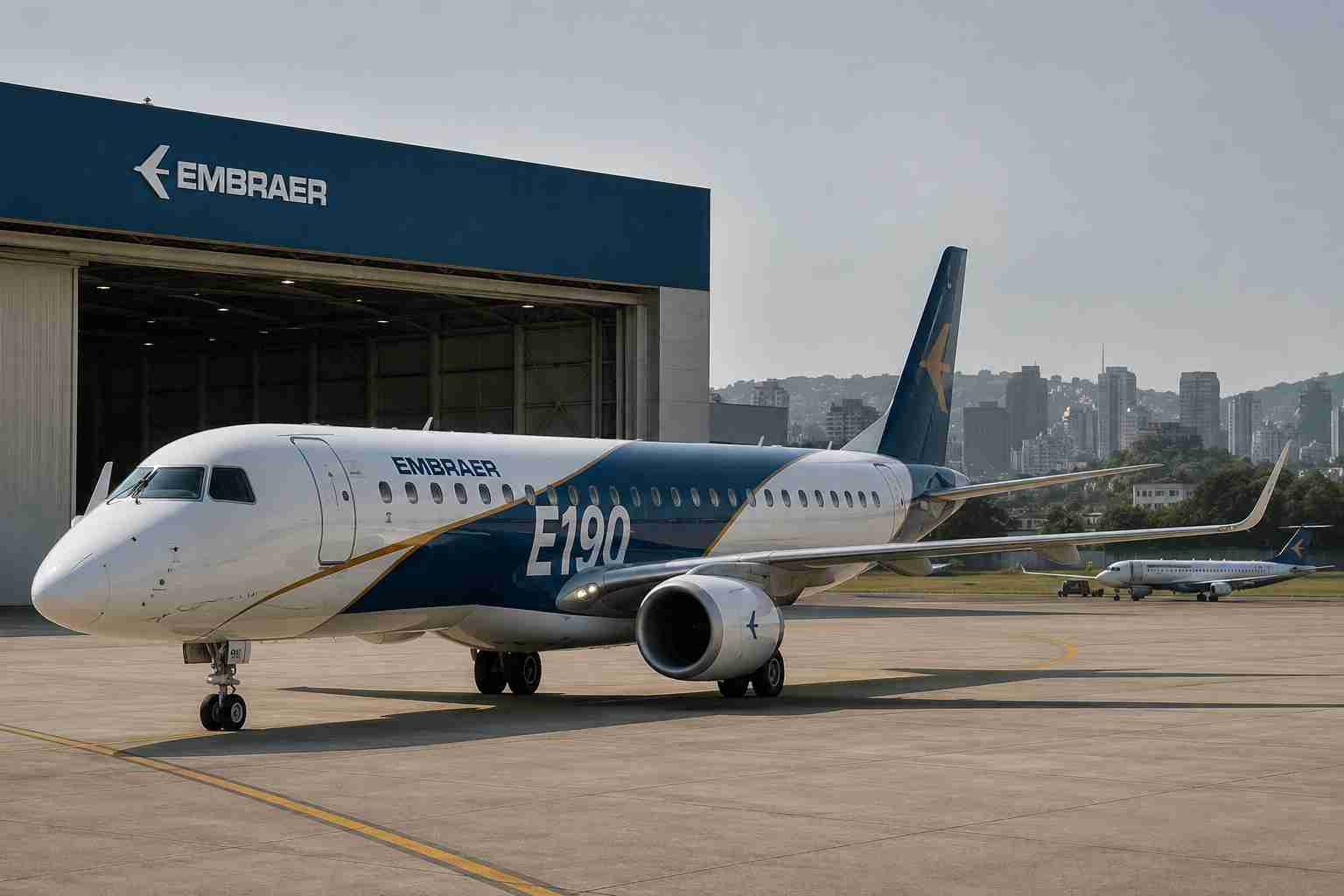
SÃO PAULO — Brazilian aerospace company Embraer expects India to become a significant growth market over the next decade after receiving type certification for additional aircraft models from the country’s aviation regulator. The approval enables the company to offer a broader range of aircraft to Indian airlines seeking to expand regional connectivity and develop underserved routes.
The Directorate General of Civil Aviation (DGCA) has granted type certification for Embraer’s E190, E195, and E195-E2 aircraft. The company’s E175 model had already received certification and is currently operated in India by Star Air, which focuses on connecting smaller cities and regional destinations.
The latest certification marks an important step for Embraer as it seeks to strengthen its presence in one of the world’s fastest-growing aviation markets. The company believes demand for regional and small narrowbody aircraft could create substantial opportunities as airlines expand their domestic networks.
Company Forecasts Demand for Up to 500 Aircraft
Embraer estimates that India could represent a market for as many as 500 aircraft over the next 10 years, driven by growing passenger demand and the need for improved connectivity between smaller cities.
According to Raul Villaron, Senior Vice-President Sales and Marketing and Head of Region Asia Pacific, Commercial Aviation at Embraer, the certification positions the company to address fleet requirements for both existing airlines and potential new carriers entering the market.
“We see a potential market of 500 aircraft over the next 10 years that we could bring to India. The E-Jet family certification allows us to cater to future demand from both existing airlines and possible new entrants that may look at small narrowbodies to start operations. The E175 is already flying in India, and we are hopeful of securing further E-Jet orders soon,” Villaron said.
Villaron noted that the approval broadens Embraer’s ability to support airlines looking for aircraft that can efficiently serve routes that fall between the capabilities of larger narrowbody jets and turboprop aircraft.
Regional Aviation Expansion Drives Opportunity
India’s aviation sector has experienced rapid growth in recent years, supported by increasing passenger traffic and government initiatives aimed at improving regional air connectivity. While major carriers have largely relied on large narrowbody aircraft and turboprops, Embraer sees a gap in the market for aircraft that can economically operate routes with moderate demand.
Many regional routes lack sufficient passenger volumes to justify larger aircraft, while turboprops can face operational limitations on longer sectors. Embraer believes its E-Jet family is well positioned to fill this gap.
Villaron said airlines can use the aircraft to unlock what he described as “blue ocean” opportunities—routes that are too small for large narrowbody jets yet too long for turboprops to operate efficiently.
Direct Routes Could Improve Connectivity
A significant portion of India’s air traffic remains concentrated around major metropolitan hubs. Travelers from second- and third-tier cities often depend on indirect connections, which can increase travel times and reduce convenience.
Embraer argues that aircraft such as the E175 and E190-E2 can support direct services between smaller city pairs, allowing airlines to bypass congested hub airports while improving network efficiency.
The manufacturer estimates that more than 800 city pairs across India currently lack direct air service despite generating sufficient demand for aircraft with fewer than 150 seats.
According to the company, approximately 90% of these unserved routes involve sectors longer than 500 kilometers, making them less suitable for turboprop operations. Embraer believes the E195-E2 is particularly well suited to these markets because of its operating economics and fuel efficiency.
Efficiency and Passenger Experience at the Center of Strategy
Embraer is positioning the E195-E2 as a solution that combines lower operating costs with an improved passenger experience. The aircraft features a two-by-two seating layout that eliminates middle seats, larger overhead storage compartments, and individual passenger service units.
Villaron said travelers can benefit from greater comfort, shorter travel times, reduced cabin noise, and increased cargo capacity compared with many turboprop aircraft operating regional routes today.
The company describes the E195-E2 as the world’s most fuel-efficient small narrowbody aircraft, a claim that aligns with airlines’ increasing focus on lowering operating costs and reducing emissions.
Embraer’s E-Jet program has established a broad global presence, with more than 1,900 aircraft delivered worldwide. The aircraft are currently operated by more than 80 airlines across over 50 countries, providing the manufacturer with a substantial track record as it seeks to expand its footprint in India’s rapidly growing aviation market.
