


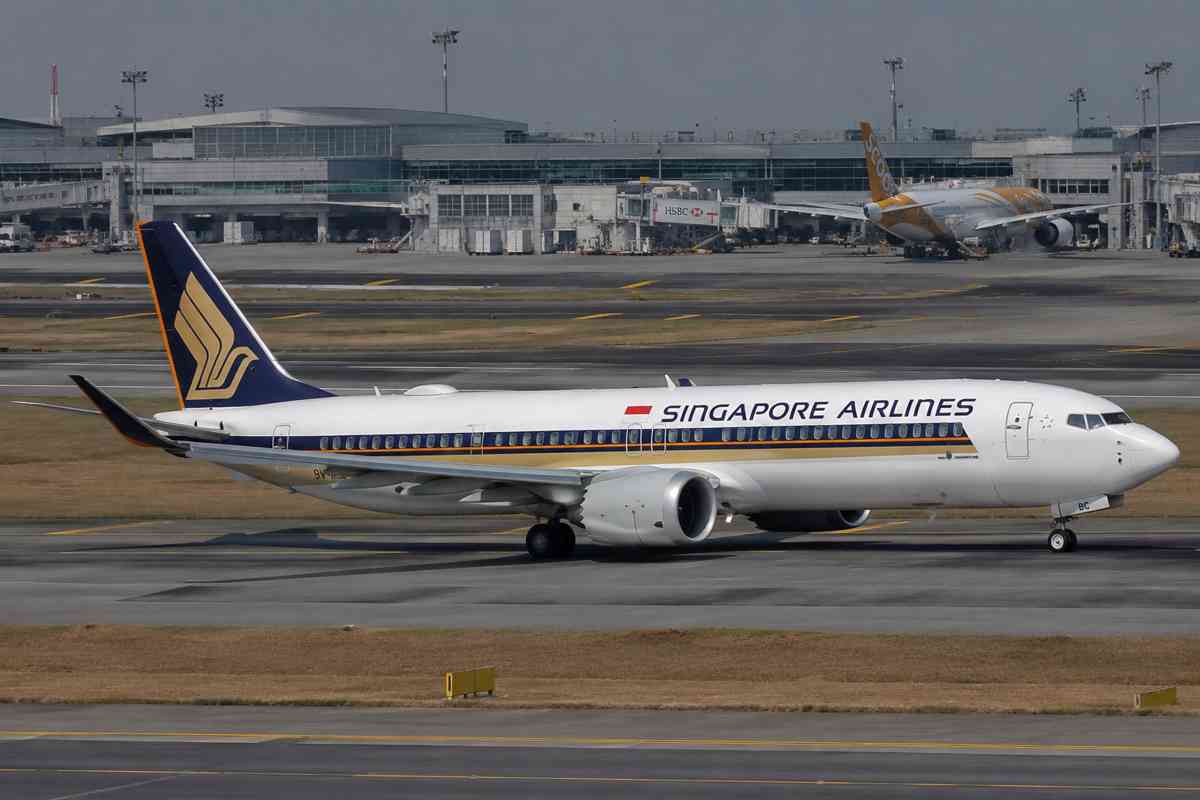
Carrier Replaces One Daily Wide-Body Service With Narrow-Body Jet Beginning August 2026
Singapore Airlines will deploy its narrow-body Boeing 737-8 MAX aircraft on selected flights between Singapore and Manila starting in August 2026, marking the carrier’s return to single-aisle operations on the route for the first time in more than 40 years.
The change affects one of the airline’s five daily services between Singapore Changi Airport and Manila’s Ninoy Aquino International Airport and replaces an Airbus A350 wide-body aircraft with the smaller Boeing 737-8 MAX. The move will significantly reduce premium cabin capacity and eliminate Premium Economy seating on the affected rotation.
According to MainlyMiles, the switch reverses a recent upgrade introduced earlier this year, when Singapore Airlines assigned the Airbus A350 Long Haul aircraft to the route in March 2026. That upgrade became a daily operation in May before being withdrawn only months later.
Aircraft Transition Will Occur in Two Stages
Singapore Airlines plans to phase in the Boeing 737-8 MAX on different Manila rotations depending on the travel season.
Between Aug. 1 and Oct. 24, 2026, the carrier will operate the narrow-body aircraft on flights SQ912 and SQ919, replacing the Airbus A350 Long Haul currently used on the lunchtime outbound and early-evening return services.
Beginning Oct. 25, 2026, the Boeing 737-8 MAX will instead operate the SQ916 and SQ921 pairing during the Northern Hemisphere winter schedule. At that point, the SQ912 and SQ919 rotation will revert to Airbus A350 Medium Haul service.
While the aircraft assignments differ by season, the overall effect remains the same: one wide-body aircraft is removed from the route and replaced with a smaller narrow-body jet.
The Airbus A350 Long Haul is currently scheduled to return to the SQ912 and SQ919 flights from Feb. 28, 2027, through late March 2027, although schedules remain subject to change.
Premium Capacity Takes a Major Hit
The aircraft change substantially reduces premium seating availability on the Manila route.
Singapore Airlines’ Boeing 737-8 MAX accommodates 154 passengers, compared with 253 seats on the Airbus A350 Long Haul and 303 seats on the Airbus A350 Medium Haul.
On the summer schedule, the MAX replaces the A350 Long Haul and reduces Business Class capacity from 42 seats to just 10, representing a 76% decline. The aircraft also removes the route’s only Premium Economy cabin, which had been sold as Economy seating on this service.
During the winter season, the MAX replaces the Airbus A350 Medium Haul, cutting Business Class seating from 40 seats to 10 while reducing Economy Class capacity by nearly half.
The cabin layout also differs significantly from the airline’s wide-body aircraft.
The Boeing 737-8 MAX Business Class cabin uses a 2-2, 1-1, 2-2 configuration, meaning many passengers seated by the window must climb over another passenger to access the aisle. By comparison, the Airbus A350 fleet offers a 1-2-1 layout with direct aisle access for every Business Class traveler.
Although the MAX seats convert into fully flat beds, Economy Class passengers will experience reduced seat pitch, narrower seating, and smaller in-flight entertainment screens compared with the Airbus A350 cabins.
Airline Adjusts Capacity Amid Fleet Constraints
Industry observers say the move likely reflects both shifting demand patterns and aircraft availability pressures within Singapore Airlines’ fleet.
In August 2025, the airline expanded Manila service to a record five daily flights, partly to absorb passenger demand following the collapse of Jetstar Asia. Reducing the size of one aircraft while maintaining frequency allows the carrier to scale back capacity without altering schedules.
Fleet limitations may also be contributing to the decision.
According to MainlyMiles, Singapore Airlines is expected to receive only Boeing 737-8 MAX aircraft deliveries during its 2026-27 financial year. The carrier is not scheduled to take additional Boeing 787-10 aircraft, while certification delays affecting the Boeing 777-9 continue to constrain long-haul fleet growth.
At the same time, upcoming Airbus A350 retrofit work may further pressure aircraft availability across the network, making the Boeing 737-8 MAX a practical option for regional routes such as Manila.
Return of Single-Aisle Service After Four Decades
While the deployment may appear unprecedented for modern Singapore Airlines operations, it represents a return rather than a first.
The airline previously operated single-aisle Boeing 707 aircraft to Manila during its early years before transitioning the route entirely to wide-body aircraft in the early 1980s. Since then, Manila has been served by aircraft including the Airbus A300, Airbus A310, Boeing 747, Boeing 777, Airbus A350, and Boeing 787.
Today, narrow-body aircraft remain common on the Singapore-Manila market through operations by Scoot, Cebu Pacific, and Philippine Airlines.
Award Travelers Face Reduced Availability
The reduction in premium cabin seating is also expected to affect KrisFlyer award availability.
Singapore Airlines currently offers one-way Economy Saver awards between Singapore and Manila starting at 13,000 KrisFlyer miles, while Business Class Saver awards begin at 25,000 miles. Taxes and fees are charged separately.
However, the steep reduction in Business Class capacity on the affected flights is likely to tighten award inventory, particularly for premium redemptions.
The Boeing 737-8 MAX also features two highly sought-after solo “throne” seats in Business Class — 12B and 12J — though advance access is largely restricted to PPS Club members until shortly before departure.
Narrow-Body Shift Signals Broader Network Strategy
Singapore Airlines’ decision to place the Boeing 737-8 MAX on the Manila route underscores how airlines are increasingly balancing premium demand, operational flexibility, and fleet constraints in regional markets.
For passengers, the aircraft swap represents a noticeable downgrade in cabin experience compared with the Airbus A350 services introduced earlier this year. For the airline, however, the move provides a way to manage capacity and optimize fleet deployment while awaiting additional aircraft deliveries and retrofit programs.
