


US Air Force seeks open mission systems to modernize legacy fleet and reduce update timelines from months to minutes
The United States Air Force is accelerating efforts to modernize its aging aircraft fleet through faster software updates and open mission systems, a strategy senior officials say is critical to maintaining operational relevance against rapidly evolving threats.
Service leaders said this week that technologies already integrated into next-generation platforms such as the B-21 Raider and Collaborative Combat Aircraft are now being adapted for legacy aircraft, including the F-22 Raptor. The effort is designed to streamline how mission software is updated, reducing delays that have historically left aircraft waiting months for new capabilities.
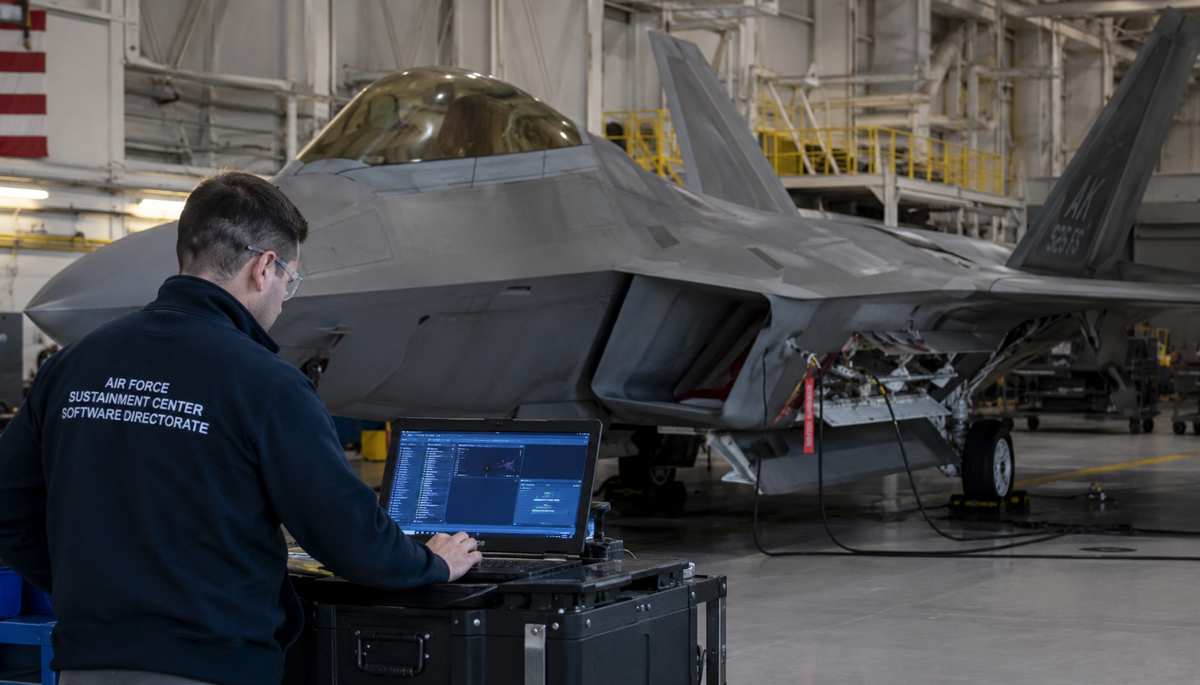
A recent demonstration at Edwards Air Force Base in California showed the potential of the approach, updating an F-22 in minutes instead of the extended maintenance timelines often associated with older systems.
Why The Air Force Is Prioritizing Open Mission Systems
Open mission systems allow aircraft software architectures to accept compatible applications and upgrades without requiring a complete redesign or lengthy certification process. The concept separates flight-critical safety systems from mission software, enabling updates to operational tools such as radar and electronic warfare systems while aircraft remain in service.
Vice Chief of Staff Gen. John Lamontagne said the Air Force intends to expand the approach across much of its fleet.
“That is where we’re headed on just about every platform going forward,” Lamontagne said during remarks June 4, 2026, at AFA’s Mitchell Institute for Aerospace Studies.
Lamontagne added that the Air Force wants open mission systems that are owned by the government rather than controlled solely by contractors.
The strategy addresses two major concerns for the service. First, it reduces the risk of “vendor lock,” which can make aircraft dependent on proprietary systems and slow modernization efforts. Second, it allows software providers to update individual mission applications without revalidating an aircraft’s entire software environment.
The Air Force has already adopted the model within its Collaborative Combat Aircraft program, enabling rapid and recurring software changes. Legacy aircraft, by contrast, can sometimes wait up to 18 months between updates.
The service has also begun integrating open mission systems into other long-serving platforms. Air & Space Forces Magazine reported in 2024 that upgrades to the B-2 Spirit’s software architecture helped preserve the bomber’s operational relevance as the Air Force transitions toward the newer B-21 Raider fleet.
Battlefield Conditions Are Driving The Need for Rapid Updates
Military analysts say the pace of modern warfare increasingly depends on how quickly forces can adapt software to changing battlefield conditions.
Bryan Clark, a senior fellow at the Hudson Institute, said adversaries are now evolving tactics and digital capabilities at a much faster rate, narrowing the technological advantage traditionally held by the United States.
According to Clark, even countries with less sophisticated military infrastructure can access many of the same underlying digital technologies used by advanced militaries. That shift is forcing the Air Force to continuously modify weapons profiles, targeting systems, and electronic warfare capabilities.
GPS Jamming and Electronic Warfare Challenges
Clark pointed to GPS disruptions in the Persian Gulf as one example of why software flexibility has become essential.
Signals in the region can be spoofed or jammed, requiring aircraft systems to rapidly adapt and compensate for unreliable positioning data. Without timely updates, aircraft could face degraded navigation accuracy or reduced survivability in contested environments.
The growing reliance on electronic warfare and data-driven combat operations means software is increasingly becoming as critical as hardware in determining combat effectiveness.
Tools Built To Manage Fleet-Wide Software Deployments
Private-sector defense technology firms are also developing tools aimed at simplifying large-scale software management for military fleets.
Rob Slaughter, chief executive of Defense Unicorns, said the company’s Unified Defense Stack Fleet platform can deploy software packages across multiple aircraft using only an Android tablet.
“I have these 35 different weapon systems and assets I can actually manage the software deployments across all of them,” Slaughter said.
The system allows operators to manage updates for multiple platforms using a single device instead of maintaining dedicated hardware for each aircraft type.
Defense Unicorns also offers a companion system called UDS Enterprise, which supports engineering and cybersecurity teams managing cloud-based and on-site infrastructure. The systems are designed to function in air-gapped environments, where networks remain disconnected from the internet to reduce cybersecurity risks.
F-22 Demonstration Signals Future Direction
In March, Defense Unicorns partnered with the Air Force Sustainment Center Software Directorate to demonstrate the technology on the F-22 Raptor at Edwards Air Force Base.
According to the company, the exercise showed how future Air Force maintainers and pilots could directly update aircraft software within an open mission systems environment.
Slaughter said the F-22 software update was completed in minutes, demonstrating the potential for significantly faster deployment cycles across the Air Force’s legacy fleet.
The demonstration reflects a broader shift within the Pentagon toward treating software as a continuously evolving capability rather than a fixed component tied to lengthy upgrade schedules. For the Air Force, officials say that transition could prove essential as adversaries increasingly adapt in real time.
