


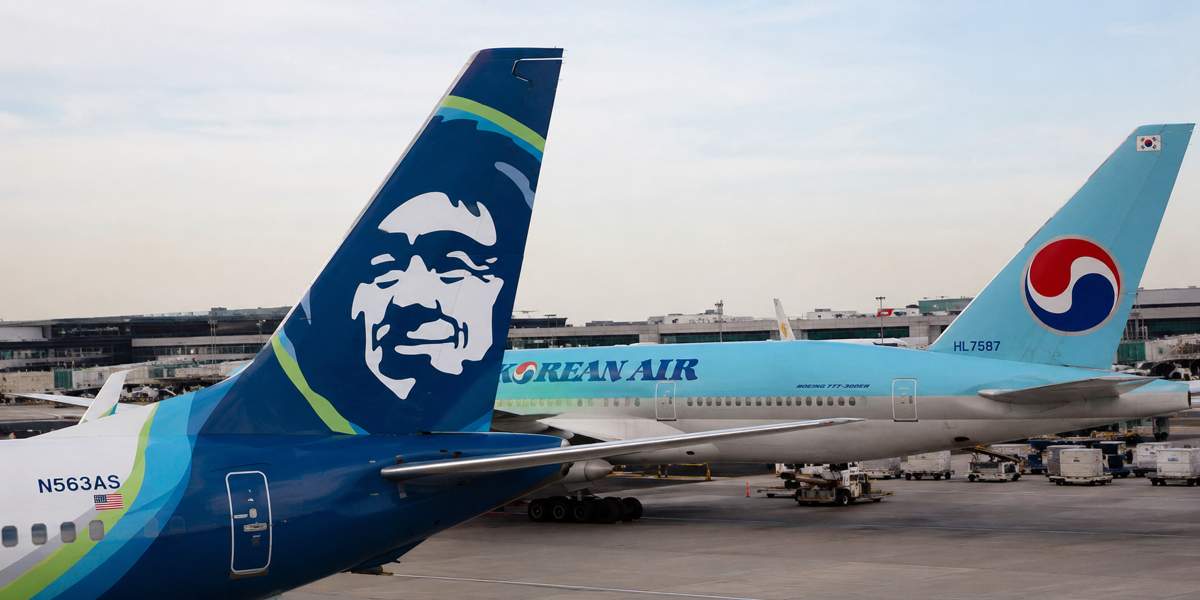
Alaska Airlines and Korean Air seek DOT approval for expanded Seoul-Incheon partnership connecting Seattle to Asia
SEATTLE — Alaska Airlines and Korean Air have submitted a proposal to the U.S. Department of Transportation seeking approval for a new transpacific codeshare partnership that would expand connections between Seattle and several Asian destinations through Seoul Incheon International Airport.
The proposed agreement would allow Alaska Airlines to place its flight code on select Korean Air-operated services beyond Seoul, giving the Seattle-based carrier broader access to key Asian markets without launching additional long-haul routes of its own.
The filing marks another strategic step in the evolving competitive landscape of Pacific aviation, where airlines continue to deepen partnerships to expand international reach while managing operational costs and fleet limitations.
Partnership Focuses on Seoul Incheon Connectivity
Under the proposal, Alaska Airlines would market Korean Air-operated flights under its own code on routes extending beyond Seoul Incheon International Airport. The agreement is designed to improve passenger connectivity between North America and Asia through Korean Air’s established regional network.
The partnership would strengthen Seattle–Tacoma International Airport as a gateway for travelers heading to destinations across South and Southeast Asia. Korean Air already maintains an extensive network from its Seoul hub, making it a strategically valuable partner for Alaska Airlines as it seeks to enhance its international offerings.
The filing submitted to the DOT seeks regulatory approval to implement the arrangement across multiple destinations in Asia. While the airlines have not disclosed a complete route list, the proposal outlines a six-destination codeshare framework centered on Seoul Incheon.
The structure of the agreement would allow passengers to book itineraries under a single Alaska Airlines reservation while connecting onto Korean Air-operated flights in Seoul. Industry analysts say such arrangements typically improve booking convenience, baggage transfers, and schedule coordination for international travelers.
Alaska Expands Reach Without Additional Long-Haul Flying
The proposed codeshare reflects a broader trend among U.S. carriers seeking international expansion through partnerships rather than direct aircraft deployment.
Alaska Airlines has steadily expanded its global connectivity through alliance relationships and codeshare agreements following its entry into the Oneworld alliance. By leveraging Korean Air’s established regional network, the carrier can offer customers access to more Asian destinations while avoiding the operational complexity and cost associated with opening new long-haul routes.
“This arrangement could improve seat utilization and scheduling efficiency for both airlines,” according to the filing summary. “It also positions Alaska Airlines (AS) to strengthen its international presence without launching additional direct routes.”
Seattle remains a critical strategic market for Alaska Airlines, which continues to dominate operations at Seattle–Tacoma International Airport despite growing competition from larger global carriers.
Complex Alliance Dynamics in the Pacific Market
The proposed partnership also highlights the increasingly flexible nature of airline alliances and commercial cooperation in the transpacific market.
Korean Air currently maintains a transpacific joint venture with Delta Air Lines, one of the deepest forms of airline cooperation that includes coordinated scheduling, pricing, and revenue-sharing across Pacific routes.
Delta has significantly expanded its Seattle presence over the past decade, increasing competition with Alaska Airlines at the airport while strengthening its own Pacific network.
Despite Delta’s growth, Alaska Airlines continues to hold a commanding share of the Seattle market, giving it leverage as international carriers seek access to the Pacific Northwest hub.
The proposed codeshare with Korean Air illustrates how airlines can maintain multiple strategic relationships simultaneously. While joint ventures typically involve deeper coordination, standard codeshare agreements remain a flexible tool for expanding connectivity without fully integrating operations.
Industry observers note that such arrangements have become increasingly important as airlines adapt to shifting demand patterns, geopolitical considerations, and evolving alliance strategies across international markets.
Regulatory Review Ahead
The Department of Transportation will now review the proposal before the codeshare can move forward. Regulatory approval is required for international commercial partnerships involving U.S. carriers and foreign airlines.
If approved, the agreement would formally restore and expand cooperation between Alaska Airlines and Korean Air with a renewed focus on Seoul Incheon connectivity.
The partnership would provide travelers departing from Seattle with additional one-stop access to destinations throughout Asia while reinforcing Seoul Incheon’s role as a major transpacific hub.
While the proposal appears commercially practical for both carriers, it also underscores the changing dynamics of global airline partnerships as airlines continue balancing competitive pressures, alliance obligations, and network expansion goals in the Pacific market.
