


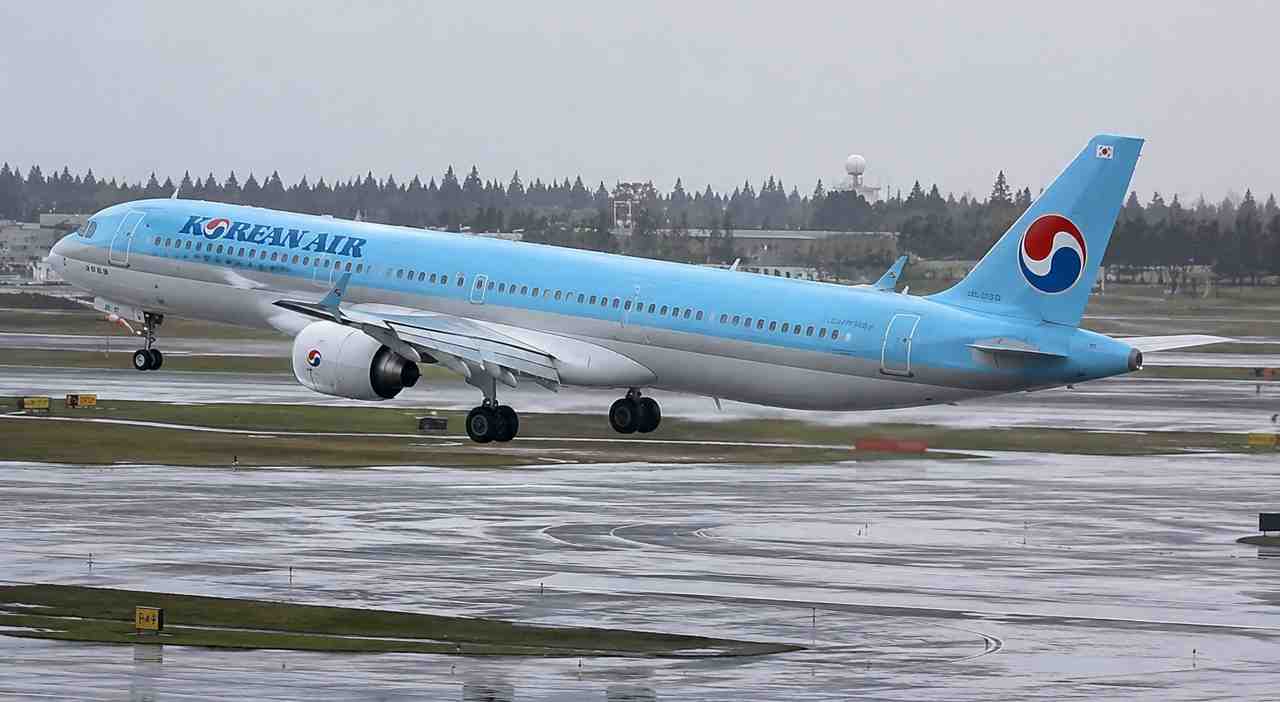
Viral Footage Captures Dramatic Go-Around Seconds Before Touchdown
TOKYO — A Korean Air Airbus A321neo narrowly avoided a potentially dangerous landing at Tokyo Narita International Airport after strong crosswinds destabilized the aircraft during final approach, forcing pilots to execute a go-around moments before touchdown.
Video footage of the incident, which quickly spread across social media platform X, showed the aircraft rocking sharply from side to side as it approached the runway at Narita International Airport (NRT), Japan’s primary international gateway. The pilots regained control and safely climbed away from the runway, with no injuries or damage reported.
The aircraft involved was identified as an Airbus A321neo operated by Korean Air (KE). According to aviation data, the jet was registered as HL8532 and is approximately 2.6 years old. The aircraft is powered by two Pratt & Whitney PW1000G engines and is part of the South Korean carrier’s narrowbody fleet.
Crosswinds Force Flight Crew to Abort Landing
The incident occurred during the final stages of the aircraft’s descent into Tokyo Narita, where gusty weather conditions created difficult landing circumstances for arriving aircraft.
Footage posted online by X user @8yb_p showed the jet wobbling significantly as crosswinds pushed against the aircraft during its approach. The wings visibly tilted under wind pressure while the fuselage drifted laterally near the runway threshold.
Moments before the aircraft was expected to touch down, the flight crew initiated a go-around procedure by applying full engine thrust and pitching the aircraft upward to abandon the landing attempt.
The maneuver allowed the jet to climb safely away from the runway before re-entering the traffic pattern for another approach.
A go-around is considered a routine and highly trained safety procedure in commercial aviation. Pilots are instructed to discontinue any landing attempt that becomes unstable or unsafe due to weather, runway conditions, or aircraft positioning.
Aviation regulators and airline safety programs view the procedure as a proactive safety measure rather than an operational failure.
Challenging Weather Conditions at Narita Airport
Tokyo experienced gusty surface winds during the time of the approach, creating difficult operating conditions at Narita International Airport.
Crosswinds occur when wind strikes an aircraft from the side rather than directly along the runway heading. Such conditions can reduce directional control and push aircraft away from the runway centerline during landing.
Commercial aircraft manufacturers establish certified crosswind limits for each aircraft type. When winds approach or exceed those limits, or when gusts become unpredictable close to the ground, pilots frequently choose to abort the landing attempt.
Narita International Airport, located east of central Tokyo in a relatively open area, is known for experiencing strong seasonal winds, particularly during autumn and winter months.
The airport’s two parallel runways are aligned in the same direction, which can leave both exposed to significant crosswind components during certain weather systems.
According to observers and aviation analysts reviewing the footage, the Korean Air flight crew reacted quickly and appropriately to the unstable approach. The pilots stabilized the aircraft within seconds and safely climbed away from the runway without incident.
Air traffic control subsequently vectored the aircraft for another landing attempt.
Aviation Experts Praise Crew Response
Aviation analysts reviewing the viral footage described the recovery as a textbook example of proper cockpit decision-making under adverse weather conditions.
Experts noted that the crew maintained controlled wings-level recovery, initiated go-around thrust at the correct moment, and avoided the risk of a hard landing that could have damaged the aircraft’s landing gear or lower fuselage structure.
No injuries to passengers or crew members were reported, and there were no indications of damage to the aircraft following the maneuver.
Korean Air has not issued a public statement regarding the specific incident, and aviation authorities have not formally verified the circulating video footage.
Why Go-Around Procedures Are Critical in Aviation
Go-arounds occur on a small percentage of commercial airline flights worldwide each year and are widely regarded as an essential safety tool in modern aviation operations.
Such procedures may be triggered by several factors, including wind shear, unstable approaches, runway obstructions, poor visibility, or traffic spacing issues.
Industry organizations, including the Flight Safety Foundation, encourage pilots to abandon any landing attempt that fails to meet stabilized approach criteria.
The Korean Air incident at Tokyo Narita International Airport highlights how standard aviation safety procedures are designed to protect passengers and aircraft during rapidly changing weather conditions.
While social media users praised the pilots for their handling of the aircraft, aviation experts emphasized that such recoveries are a direct result of extensive simulator training and standardized airline safety protocols rather than extraordinary circumstances.
