


Dubai Completes Landmark Urban Air Mobility Facility as U.S. Expands eVTOL Programs
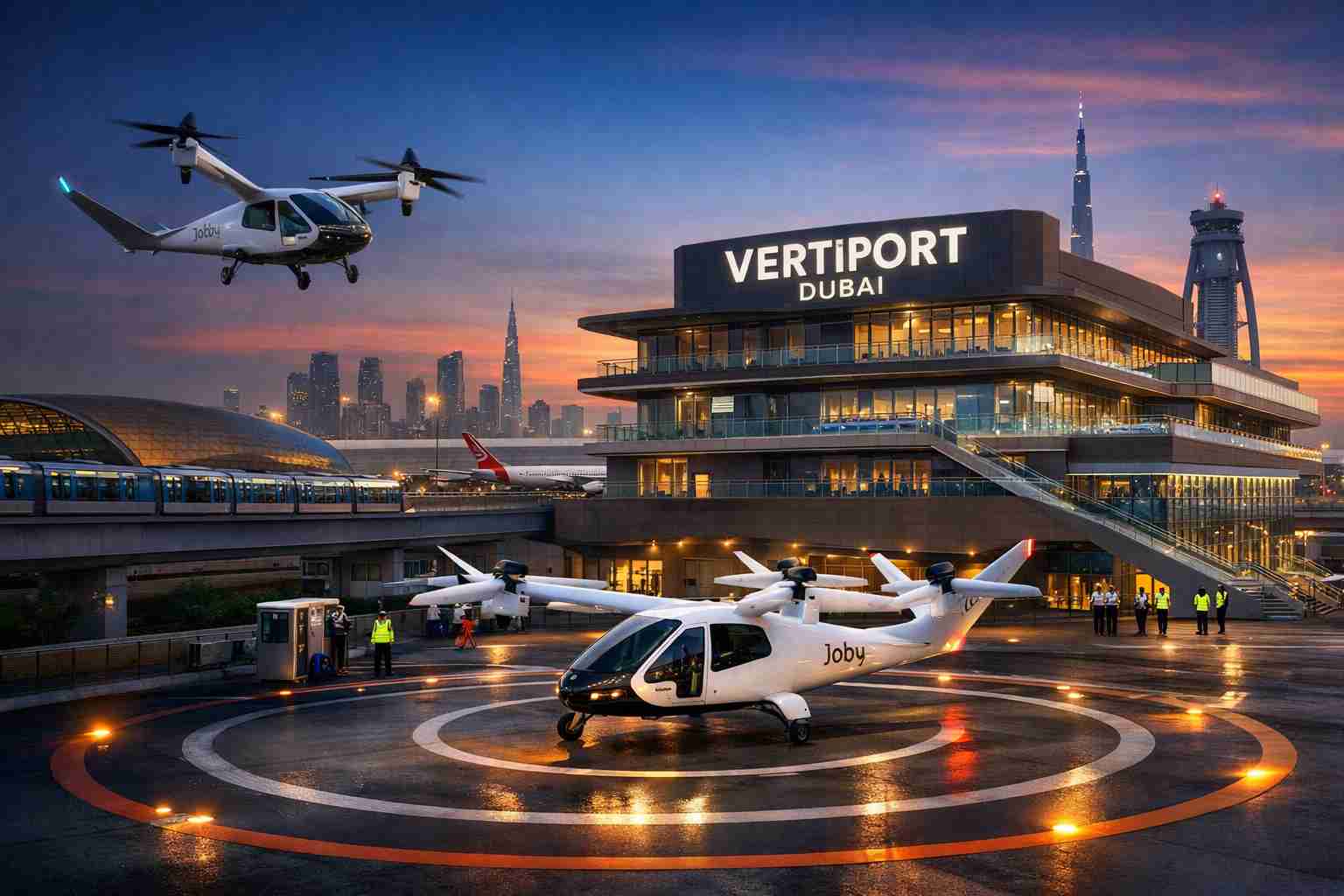
Dubai has reached a significant milestone in the evolution of urban aviation with the technical completion of what is being described as the world’s first commercial vertiport, a purpose-built facility designed to support electric Vertical Take-Off and Landing (eVTOL) aircraft operations at scale.
The project, developed by Skyports Infrastructure in collaboration with Dubai’s Roads and Transport Authority, signals a major step toward integrating advanced air mobility into everyday transportation networks. The announcement comes as the United States simultaneously accelerates its own efforts to establish eVTOL operations through federal pilot programs and airline partnerships.
Vertiport Reaches Technical Completion
The Dubai vertiport has achieved technical completion, indicating that the structure and its operational systems are ready to support aircraft movements. The multi-level facility includes four floors, a dedicated passenger terminal, and two landing and take-off zones designed to enable rapid turnaround of aircraft.
A key feature of the site is its integration of ultra-fast charging infrastructure. The system uses GEACS technology developed by Joby Aviation, allowing aircraft batteries to recharge quickly and support continuous, high-frequency operations.
Authorities have indicated that a commercial launch is planned by the end of the year, with Joby Aviation working alongside Dubai partners to finalize operational readiness.
Infrastructure Built for High-Volume Urban Travel
The vertiport is designed with a focus on efficiency and passenger throughput. It incorporates a digital passenger management system powered by a dedicated Joby Aviation application, enabling booking, check-in, and boarding processes to be handled seamlessly.
Planners estimate the facility will eventually support up to 170,000 passengers annually, along with approximately 42,000 aircraft movements. This level of capacity reflects expectations that urban air mobility could become a viable supplement to traditional ground transportation in densely populated cities.
The site is also strategically connected to Dubai’s broader transit network. It links directly to the Emirates Metro Station, located one stop from DXB Terminal 3 Metro Station, improving last-mile connectivity for travelers moving to and from Dubai International Airport.
In addition, the vertiport operates under a hybrid regulatory framework, allowing it to accommodate both eVTOL aircraft and conventional helicopters. This dual capability is intended to ease the transition toward new aviation technologies while maintaining compatibility with existing air traffic systems.
U.S. Advances eVTOL Integration Across Multiple States
While Dubai focuses on infrastructure deployment, the United States is advancing regulatory and operational frameworks for eVTOL adoption. The Federal Aviation Administration is leading efforts through its Advanced Air Mobility and eVTOL Integration Pilot Program (eIPP).
The initiative spans 26 states and includes eight selected projects aimed at testing real-world applications of eVTOL technology. These programs are evaluating a range of use cases, including urban air taxi services, cargo delivery, emergency medical transport, offshore logistics, and autonomous flight operations.
Airlines are also positioning themselves early in the emerging market. United Airlines has expressed interest in developing future air taxi networks, reflecting growing industry anticipation around the commercial viability of eVTOL services.
Meanwhile, Joby Aviation has begun testing aircraft that conform to FAA requirements, marking incremental progress toward certification and eventual commercial deployment.
However, unlike Dubai’s purpose-built vertiport model, U.S. planners are considering how to adapt existing aviation infrastructure—such as heliports and regional airports—to accommodate eVTOL operations, particularly in dense urban environments where space constraints pose challenges.
A Defining Moment for Urban Air Mobility
Dubai’s completed vertiport represents a foundational step in bringing urban air mobility from concept to reality. By combining dedicated infrastructure, integrated transit connectivity, and advanced charging systems, the project provides a working model for how eVTOL services could operate at scale.
At the same time, developments in the United States highlight the importance of regulatory readiness and operational testing in shaping the next phase of aviation. Together, these parallel efforts underscore accelerating global momentum toward the commercialization of eVTOL technology.
As both regions continue to refine their approaches, the coming years are likely to determine how quickly air taxis transition from pilot programs to mainstream transportation options.
