


Premium economy emerges as a strategic middle ground
SYDNEY — Premium economy cabins are becoming an increasingly important part of airline revenue strategies, particularly on ultra-long-haul flights where comfort plays a major role in consumer purchasing decisions. Qantas premium economy service operating from Sydney to Dallas Fort Worth International Airport illustrates how airlines are positioning the cabin as a practical upgrade over economy without approaching the cost of business class.
The route, which exceeds 15 hours, is among the longest in the airline’s global network and is operated by the Airbus A380. The aircraft also serves other long-haul destinations including London, Los Angeles, Johannesburg, and Singapore. These extended flight times amplify the physical challenges associated with standard economy seating, making comfort upgrades more relevant to travelers weighing cost against well-being.
Premium economy functions as a clear middle tier, offering structural and service improvements that go beyond incremental enhancements.
Cabin configuration prioritizes personal space
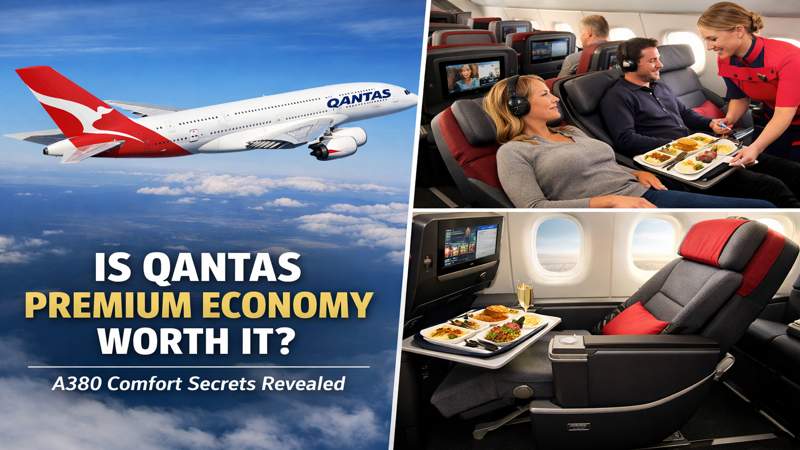
A key differentiator lies in the cabin’s physical layout and seat design. The premium economy section is located on the upper deck of the aircraft and contains 60 seats arranged in a 2-3-2 configuration. In contrast, the economy cabin accommodates 341 seats in a denser 3-4-3 layout.
This reduced density contributes to a quieter and less crowded environment, which can improve passenger comfort and reduce travel fatigue.
Seat dimensions also reflect a measurable upgrade. Premium economy seats are approximately 10 percent wider than economy seats, measuring 22.8 inches across. Seat pitch increases to 38 inches compared with 32 inches in economy, while recline extends to 9 inches versus 6 inches.
Beyond measurements, the mechanical design differs significantly. Standard economy seats recline by tilting the seatback backward, which can cause taller passengers to slide forward slightly during rest. Premium economy seats instead move the seat base forward and upward when reclining. This design keeps passenger weight centered and provides more stable support, which can improve sleep quality on long flights.
Enhanced service and onboard amenities
Service levels in premium economy also exceed those in economy class. Passengers receive a welcome drink before departure, with champagne available as an option. Meal portions are larger, and presentation is more refined than standard economy offerings.
Entertainment and comfort amenities are similarly upgraded. Premium economy passengers receive padded headphones and access to a 13-inch high-definition entertainment screen, slightly larger than the 12-inch screens installed in economy.
Although the seats do not convert into lie-flat beds like those in business class, the additional space and ergonomic design make rest more achievable than in economy.
These improvements target travelers seeking better comfort without paying premium business-class fares.
Pricing highlights the value proposition
Pricing data underscores premium economy’s position as a mid-tier product.
Return flights from Sydney to Dallas in premium economy cost approximately $1,677 more than economy, representing about a 60 percent increase. By comparison, business class fares on the same route can cost roughly $11,000 more than economy, equating to an increase of around 400 percent.
This substantial price gap makes premium economy a financially balanced alternative for long-haul travelers.
Passengers on strict budgets may still opt for economy, but travelers prioritizing sleep quality, reduced fatigue, and improved onboard experience may find the additional cost justified, particularly on flights exceeding 15 hours.
Long-haul travel economics drive demand
The deployment of the Airbus A380 on ultra-long-haul routes reflects broader airline economics and consumer demand trends. Flights lasting 13 to 15 hours or more create stronger incentives for passengers to pay for comfort, particularly among corporate travelers, older passengers, and leisure travelers beginning high-value vacations.
Improved rest during long flights can influence post-arrival productivity and overall travel satisfaction, factors that contribute to purchasing decisions.
Airlines benefit from premium economy by capturing additional revenue from passengers unwilling or unable to pay business-class prices but still seeking meaningful comfort improvements.
Balancing cost and comfort
Premium economy does not deliver the full luxury of business class, particularly the lie-flat bed that defines the higher cabin. However, it provides substantial gains over economy in seat width, legroom, recline, service, and cabin density.
For travelers facing ultra-long-haul flights, these improvements can translate into reduced physical strain and better overall travel experience.
As airlines continue expanding long-distance international routes, premium economy is likely to remain a key product segment, offering a compromise between affordability and comfort that aligns with evolving passenger expectations.
