


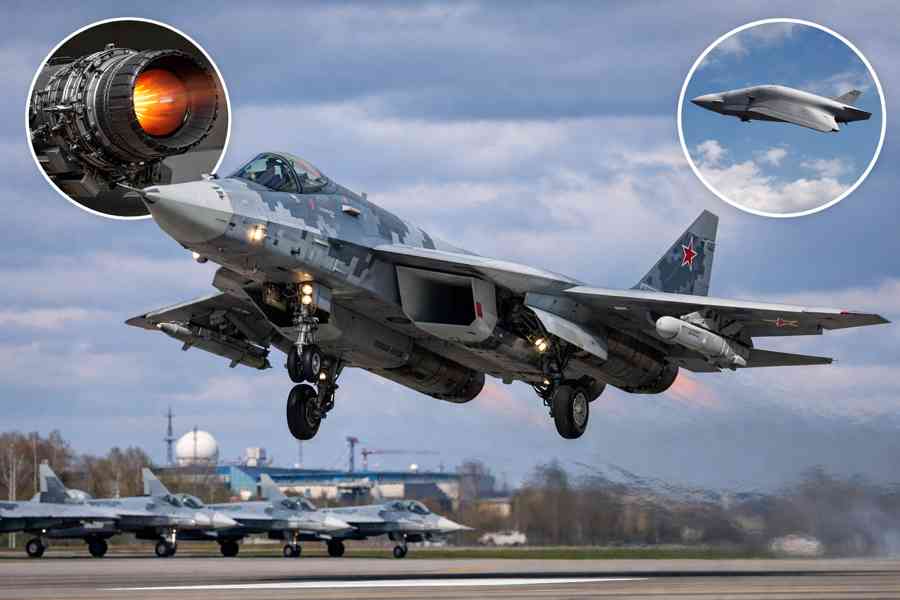
Russia has taken another measured step in the development of its fifth-generation fighter program with the induction of a new batch of Sukhoi Su-57 aircraft into frontline service, underscoring a strategy of gradual capability enhancement rather than rapid fleet expansion.
The latest aircraft were delivered by United Aircraft Corporation (UAC), part of the state-owned Rostec group, and formally accepted by operational units of the Russian Aerospace Forces. Officials said the jets feature a revised technical configuration, including updated onboard systems and weapons integration, though specific technical details were not disclosed.
The handover follows sustained combat use of the Su-57 during operations linked to the conflict in Ukraine, a deployment history that Russian officials say has informed a series of incremental refinements since the aircraft entered service in 2020. Production and flight testing continue at facilities supporting aerospace operations in and around Moscow, highlighting the industrial base backing the program.
Operational Feedback Drives Upgrades
Rostec confirmed that the newly delivered fighters incorporate enhanced systems designed to expand combat roles and operational flexibility. According to the company, the aircraft entered service in a new technical configuration to meet Defense Ministry targets, and the upgraded armament system enables the use of new categories of air-launched weapons.
While Moscow has released little public information about the precise nature of the improvements, the emphasis on operational feedback reflects a broader approach within Russia’s defense industry. Rather than introducing a single, definitive version of the aircraft, upgrades are being rolled out progressively as technologies mature and battlefield experience accumulates.
Fleet Size and Production Pace
With the latest deliveries, Russia’s Su-57 inventory now stands at close to 32 aircraft. The total reflects steady but deliberate growth, consistent with Russia’s phased approach to building fifth-generation air combat capability.
Defense analysts note that the pace contrasts with the mass induction strategies pursued by some Western programs, but aligns with Moscow’s focus on managing cost, production complexity, and technological risk. Officials have repeatedly described the Su-57 as a long-term investment intended to evolve over decades.
Engine Development and Future Transition
The new deliveries come roughly two months after confirmation that the Su-57 successfully conducted flight tests with the Izdeliye 177 engine in December 2025. Developed by United Engine Corporation, the powerplant represents a major step forward in thrust, fuel efficiency, and durability.
The Izdeliye 177 is rated at up to 16,000 kilograms of thrust with afterburner engaged and is designed to reduce fuel consumption while significantly extending service life compared with the Saturn AL-41F1 engine currently powering operational aircraft.
Despite the progress, manufacturer imagery indicates that the most recent frontline jets remain equipped with the AL-41F1. The transition to the new engine is expected in later production batches, reflecting a cautious approach to introducing major propulsion changes into operational service.
Sensor Enhancements and Passive Awareness
Imagery associated with the new batch has also drawn attention to apparent changes in the Su-57’s 101KS electro-optical complex. The system supports missile warning, self-protection, and passive surveillance functions.
Analysts examining high-resolution images have pointed to additional apertures and optics distributed around the airframe, suggesting expanded multispectral coverage across visible and infrared bands. If confirmed, the configuration would move the system beyond a primarily defensive role toward continuous, near-spherical situational awareness.
Such an evolution would allow pilots to detect aircraft and missile threats without emitting radar energy, improving survivability in contested airspace and aligning the Su-57 with operational concepts used on Western fifth-generation fighters.
Weapons Growth and Unmanned Integration
Beyond sensors, attention has increasingly focused on the Su-57’s potential role as a hub for manned-unmanned teaming. Defense analysts have suggested that the aircraft may eventually deploy the S-71 air-launched combat unmanned aerial vehicle, a stealthy system unveiled publicly in 2024 for reconnaissance and strike missions.
Integrating such a capability would require advanced data links, mission management software, and onboard control systems, consistent with the broader upgrades referenced by Rostec. While official confirmation remains absent, recent reports have pointed to testing against mobile ground targets.
Program Outlook
UAC leadership continues to frame the Su-57 as a future-oriented platform. Under the ongoing Megapolis development framework, the aircraft is expected to receive iterative improvements across avionics, sensors, engines, and weapons rather than a single, comprehensive redesign.
Export activity is also beginning to shape the program. Algeria has reportedly inducted its first Su-57 aircraft, becoming the platform’s first confirmed foreign operator, while interest from India remains a potential inflection point for production scale.
Taken together, the steady expansion of the fleet, incremental technology upgrades, and long-term engine plans position the Su-57 as Russia’s primary air combat platform well into the 2040s, reflecting a strategy of gradual maturation rather than rapid transformation.
