


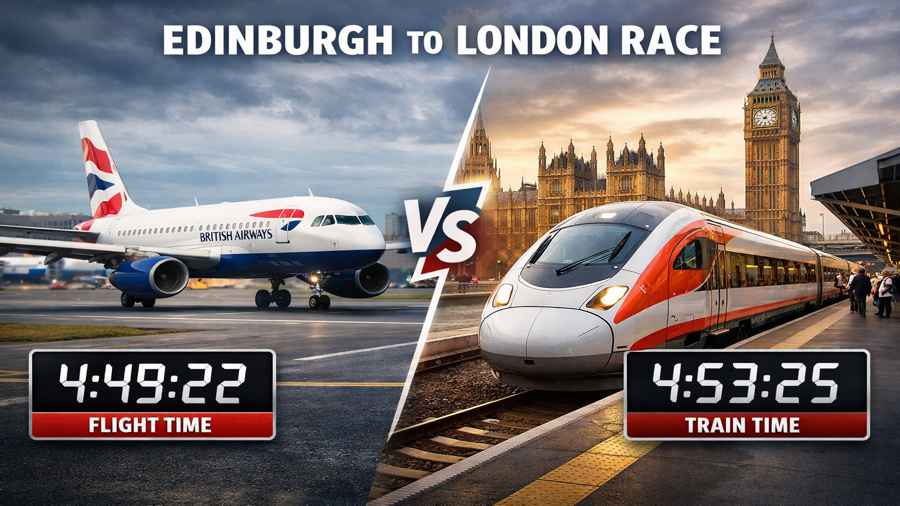
A tightly controlled travel experiment comparing air and rail journeys between Edinburgh and London has produced a narrow and provocative result: flying beat the train by just over four minutes when measured door to door. The outcome, documented by a UK-based YouTuber, underscores how marginal the time difference has become between domestic flights and high-speed rail in the United Kingdom—and highlights the trade-offs travelers face on cost, convenience, and carbon emissions.
The test pitted a domestic flight operated by British Airways against a high-speed rail service, tracking real-world travel rather than scheduled journey times. The findings have renewed debate over whether flying still offers a meaningful speed advantage on one of the UK’s busiest intercity corridors.
A Door-to-Door Approach
The experiment was designed to mirror how passengers actually travel. Rather than comparing airport-to-station times, the challenge began in central Edinburgh and ended in central London, using Princes Street and the Oxford Street area as start and finish points.
Scott Manson, creator of the travel-focused YouTube channel Planes, Trains, Everything, undertook the challenge with a stopwatch, timing every stage of each journey. Transfers, waiting time, boarding procedures, and security checks were all included, aiming to remove the distortions often created by timetable-only comparisons.
The objective, Manson has said, was to test whether aviation’s perceived speed advantage holds up once real-world friction is added to the equation.
Train vs. Plane: The Results
According to reporting by the Daily Record, the rail journey delivered a total travel time of 4 hours, 53 minutes, and 25 seconds—slightly better than the commonly cited five-hour estimate for the route.
The flight recorded a total end-to-end time of 4 hours, 49 minutes, and 22 seconds. That put air travel ahead by just over four minutes, a margin so small that minor disruptions could easily reverse the result.
Manson noted that the outcome relied on smooth airport processing and minimal delays. Longer security queues, gate changes, or transfer hiccups could quickly erase aviation’s slim advantage.
Cost Dynamics Shift the Equation
Beyond time, the comparison highlighted notable differences in pricing. When tickets were booked roughly two months in advance, rail fares came in at £60, while the flight cost £95.
Closer to departure, the gap narrowed in some cases, but overall costs rose for both options. Rail fares increased sharply as availability tightened, while flight prices escalated further once ground transportation to and from airports was factored in.
For business travelers and budget-conscious consumers alike, the results suggest that advance planning remains critical—particularly for rail, where pricing volatility can be pronounced in the weeks before travel.
Comfort and Predictability
The experiment also examined the qualitative aspects of each journey. Manson described the train experience as calmer and more predictable, noting the absence of security screening and the continuity of a single, uninterrupted trip.
By contrast, the airport environment introduced stress points, including security checks and crowding, even at a smaller London airport. While flight time itself was brief, the cumulative burden of pre- and post-flight procedures weighed on the overall experience.
These factors, while subjective, play an increasingly important role for travelers weighing productivity and comfort alongside raw speed.
Carbon Costs Tell a Different Story
Perhaps the most striking contrast emerged in environmental impact. The rail journey produced an estimated 12.5 kilograms of carbon dioxide per passenger. The flight, by comparison, generated approximately 165 kilograms for the same route.
The disparity underscores rail’s environmental advantage and aligns with broader policy discussions in the UK and Europe aimed at shifting short-haul travel from air to rail where viable alternatives exist.
Manson said the emissions gap was the most decisive factor in the comparison, suggesting that sustainability concerns could outweigh marginal time savings for many travelers.
A Narrow Win, No Clear Winner
Despite aviation’s four-minute edge, the experiment revealed no dominant choice in practical terms. Instead, it showed how closely matched the two modes have become when measured realistically.
For travelers moving between city centers, high-speed rail remains a competitive option, offering predictable travel, lower emissions, and, in many cases, lower costs. Flights can still be faster—but only just—and only when everything runs smoothly.
The findings reinforce a broader takeaway for the UK travel market: on short domestic routes, the decision increasingly hinges less on speed and more on values, budgets, and tolerance for friction.
