


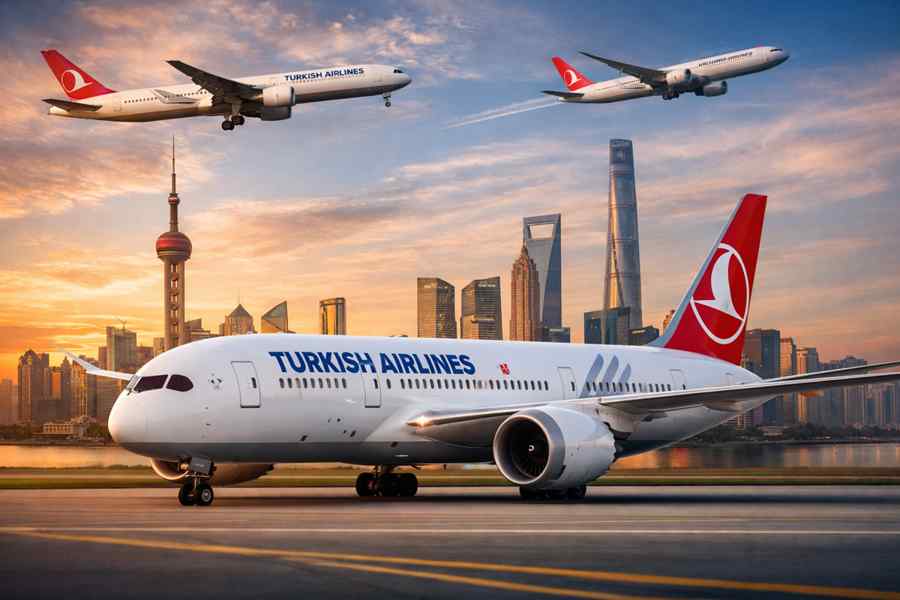
Turkish Airlines has confirmed a substantial expansion of its flight schedule to China for the Northern Summer 2026 season, underscoring continued growth in travel demand between Türkiye and Asia’s largest aviation market. The flag carrier will maintain elevated service levels to Beijing and Guangzhou while significantly increasing frequencies to Shanghai, according to its latest schedule filings.
The expansion reflects a strategic decision to preserve capacity on key long-haul routes at a time when airlines globally are reassessing Asia-Europe connectivity. For Turkish Airlines, China remains a cornerstone of its Asian network, supported by strong passenger demand and improved bilateral air service frameworks.
Beijing Service Maintained at Higher Levels
For the Istanbul–Beijing Capital route, Turkish Airlines will continue operating ten weekly flights beginning 29 March 2026. This marks a departure from earlier plans that would have reduced the route to seven weekly services for the summer season.
Maintaining the higher frequency allows the airline to better serve business, leisure, and connecting traffic flowing through its Istanbul hub. The route will be operated using a mix of Boeing 777-300ER and Boeing 787-9 aircraft, providing both high capacity and fuel efficiency.
Flight schedules are structured to offer flexibility across different travel windows. Flight TK088 departs Istanbul at 0140, arriving in Beijing during daytime hours, while TK196 operates later in the day using the 787-9. Return services TK089 and TK197 provide morning and early-afternoon departures from Beijing, supporting onward connections across Europe, the Middle East, and Africa.
Guangzhou Frequencies Also Preserved
A similar approach is being applied to the Istanbul–Guangzhou Baiyun route. Turkish Airlines will also operate ten weekly flights on this corridor from the end of March 2026, rather than scaling back to seven as initially planned.
The service will again rely on the Boeing 777-300ER and 787-9 fleet, ensuring consistency in product and capacity across its China network. Outbound flight TK072 departs Istanbul in the early morning hours, while return flight TK073 leaves Guangzhou late at night, catering to both point-to-point travelers and long-haul connectors.
By matching the Beijing frequency, the airline is positioning Guangzhou as an equally important gateway in southern China, particularly for trade-related and manufacturing-driven travel demand.
Shanghai Sees the Largest Increase
The most notable growth comes on the Istanbul–Shanghai Pudong route. Turkish Airlines has increased planned service from seven weekly flights to ten weekly flights for much of the Summer 2026 season, with an additional 11th weekly rotation scheduled to resume from 11 May 2026.
Shanghai is one of China’s primary financial and commercial centers, and the added capacity is designed to provide greater scheduling flexibility and improved access for both corporate and leisure passengers. Outbound services will include flights TK026 and TK280, while return operations are handled by TK281 and TK027.
The higher frequency also enhances connectivity for travelers using Istanbul as a transfer point between China and destinations across Europe, Africa, and the Americas.
Bilateral Agreements Support Growth
Turkish Airlines’ China expansion is taking place against a backdrop of broader improvements in air service agreements between Türkiye and China. A bilateral aviation deal finalized in 2024 raised weekly passenger flight entitlements for carriers from both countries, creating room for capacity growth on major international routes.
These regulatory changes have enabled airlines to respond more dynamically to market demand, particularly during peak travel periods such as the Northern summer season.
Outlook for Summer 2026
By sustaining ten weekly flights to both Beijing and Guangzhou and expanding Shanghai services to as many as 11 weekly rotations, Turkish Airlines is signaling confidence in the long-term strength of China-Türkiye travel demand. The expanded schedule supports the airline’s broader strategy of leveraging Istanbul as a global hub linking Asia with multiple regions worldwide.
As Summer 2026 approaches, the enhanced China network positions Turkish Airlines to capture both origin-and-destination traffic and high-yield connecting passengers, reinforcing its role as a major player in intercontinental aviation.
