


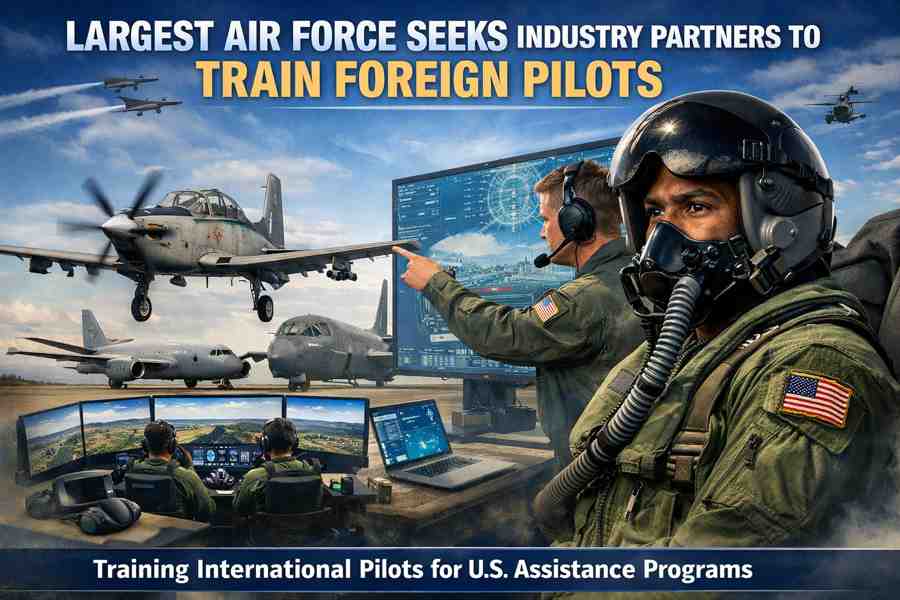
The U.S. Air Force is moving to expand its role as a global aviation training provider, issuing a new Request for Information (RFI) aimed at identifying private-sector companies capable of training foreign military pilots. The initiative is designed to support partner nations that receive American military assistance and reflects growing demand for mission-ready aircrews across a wide range of operational roles.
According to the RFI, the Air Force is seeking insight into industry capabilities that could support pilot, aircrew, and mission-support training using demilitarized military aircraft and commercially derived platforms. Training would be conducted at contractor-operated facilities within the continental United States and structured under established U.S. security assistance frameworks.
Expanding Foreign Military Training Capacity
The effort is led by the Air Force Security Assistance Training Squadron under Air Education and Training Command, which already oversees one of the world’s largest international aviation training pipelines. Through the Foreign Military Sales program, the command trains more than 9,000 international students annually from 142 countries.
Air Force officials say the new RFI is not a contract solicitation but a market research exercise intended to assess how private industry could augment existing government-run training. By leveraging contractor expertise, the service aims to broaden the scope and flexibility of instruction available to allied and partner air forces.
Contractor-Run Programs Under Review
Under the concept outlined in the RFI, selected contractors would be responsible for designing and operating complete training programs tailored to specific aircraft types, mission profiles, and operational environments. Instruction would encompass classroom academics, flight simulation, live-flight training, mission planning, and operational support skills.
The Air Force emphasized that any future program must be capable of supporting both combat and non-combat missions while remaining compliant with U.S. aviation regulations and international flight standards. All flight and ground instruction would be required to meet Federal Aviation Administration rules as well as applicable international safety requirements.
Broad Mission Profiles in Scope
The Air Force identified nine mission categories that industry providers must be prepared to support. These include combat support and light attack operations, reconnaissance and observation, intelligence, surveillance, and reconnaissance missions, and search and rescue. Additional mission sets include maritime patrol, electronic warfare, medical evacuation, transport and airlift, and VIP transport.
Training syllabi would need to cover everything from basic flight skills to advanced maneuvers and full mission execution. Programs would be customized to reflect partner nation requirements, aircraft configurations, and expected operational conditions.
Focus on Older and Commercial Aircraft
Unlike existing Air Force programs that train foreign pilots on front-line fighters such as the F-15, F-16, and F-35, this initiative centers on older military aircraft and commercially derived platforms. These aircraft are more commonly operated by developing air forces and are often better suited to internal security, patrol, transport, and humanitarian missions.
By concentrating on these platforms, the Air Force aims to help partner nations build sustainable airpower capabilities without the cost and complexity associated with advanced fighter fleets.
Emphasis on Modern Training Technologies
The RFI calls for a blended training approach that integrates traditional classroom instruction with modern digital learning tools. Acceptable delivery methods include electronic courseware, interactive simulation, virtual reality systems, and both fixed-base and full-motion simulators.
Simulator training must support emergency procedures and full mission rehearsal, while academic instruction should also address communications, intelligence coordination, and logistics planning. Contractors are encouraged to demonstrate how emerging training technologies could improve learning outcomes and reduce overall training time.
Cultural Awareness and Operational Support
Beyond technical proficiency, the Air Force is placing strong emphasis on cultural readiness and international training experience. Contractors must show they can effectively train students from diverse cultural and operational backgrounds and adapt instruction to differing military doctrines.
Respondents are also asked to outline their approaches to curriculum design, simulator integration, aircraft maintenance and technical training, and broader aircrew and operational support instruction. An understanding of the supplier market and aircraft support ecosystem associated with Foreign Military Sales users is considered essential.
Next Steps in the Acquisition Process
Responses to the Request for Information are due by March 4. The Air Force will use the submissions to map industry capacity, identify potential gaps, and shape future acquisition strategies. While no contracts will be awarded at this stage, the RFI signals a clear intent to deepen collaboration with industry as global demand for pilot training continues to grow.
If implemented, the program would further cement the U.S. Air Force’s role as a central hub for international aviation training, while opening new opportunities for private-sector providers in the defense and aerospace training market.
