


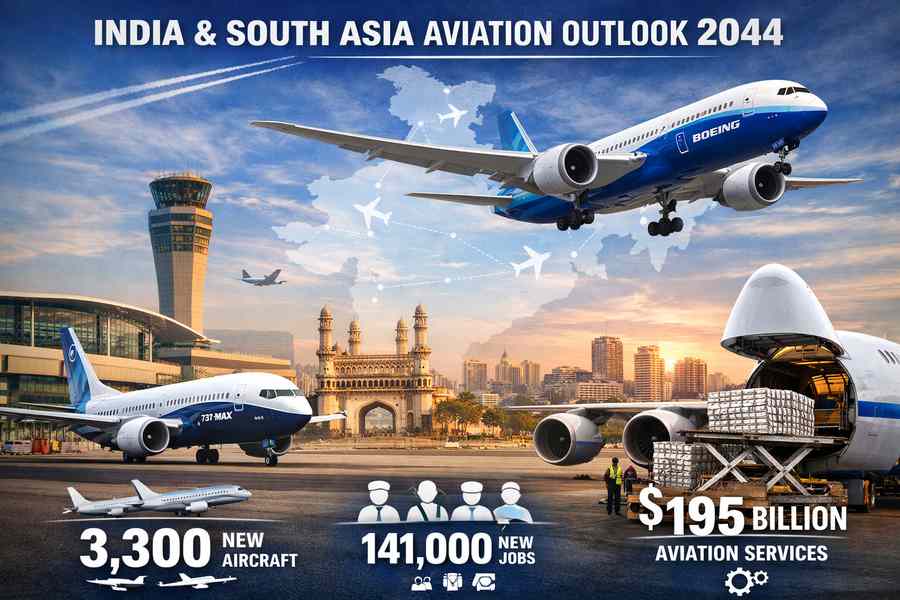
HYDERABAD — Boeing projects that airlines in India and South Asia will require nearly 3,300 new commercial aircraft over the next two decades as passenger traffic accelerates and carriers expand capacity to meet surging demand.
The forecast, released near Rajiv Gandhi International Airport in Hyderabad as part of Boeing’s latest Commercial Market Outlook, underscores the region’s growing importance in the global aviation market. According to the company, air traffic across India and South Asia is expected to grow at an average annual rate of about 7 percent through 2044, driven by rising incomes, expanding route networks, and sustained growth in domestic travel.
Boeing estimates that the region will need approximately 3,290 new airplanes during the period, supporting both fleet expansion and the replacement of aging aircraft. The growth is expected to reshape airline fleet strategies while creating significant demand for aviation-related services and labor.
Fleet Expansion Driven by Domestic Travel
At the center of Boeing’s outlook is the rapid expansion of the region’s commercial aircraft fleet. Boeing expects the Indian and South Asian fleet to grow from about 795 aircraft today to nearly 2,925 by 2044, reflecting one of the fastest growth rates among global aviation markets.
Domestic travel is projected to remain the primary driver of this expansion. Increasing urbanization, improved affordability of air travel, and a shift from rail to air on short- and medium-haul routes are expected to sustain high passenger volumes. Airlines are also benefiting from continued government and private-sector investment in airport infrastructure and regional connectivity programs, which are supporting higher utilization rates and enabling service to secondary and emerging cities.
As airlines modernize fleets, older aircraft are expected to be retired in favor of more fuel-efficient and reliable models, further contributing to delivery demand over the forecast period.
Single-Aisle Aircraft to Dominate Deliveries
Boeing’s outlook shows that single-aisle aircraft will account for nearly 90 percent of the region’s projected airplane deliveries through 2044. Narrowbody jets are increasingly favored by airlines for their operational flexibility, lower operating costs, and ability to support high-frequency service across dense domestic and regional networks.
Airlines are using single-aisle aircraft to expand point-to-point connectivity, increase flight frequencies on high-demand routes, and serve smaller cities that are seeing rising passenger volumes. The dominance of this segment reflects the structure of travel demand in India and South Asia, where short- and medium-haul routes make up the majority of airline operations.
Widebody Fleet Growth and Long-Haul Expansion
While narrowbody aircraft will dominate overall deliveries, Boeing also expects steady growth in widebody demand as carriers expand international operations. The company forecasts that the region’s widebody fleet will more than triple by 2044.
This growth is expected to support expanded long-haul services connecting India and South Asia with markets in the Middle East, Europe, and North America. As international travel demand continues to recover and grow, airlines are positioning themselves to capture traffic flows between major global hubs and emerging long-haul destinations.
Cargo Growth and Workforce Requirements
Beyond passenger travel, Boeing sees strong growth ahead for air cargo operations. The company projects that the South Asia freighter fleet, including both new and converted aircraft, will grow fivefold over the next 20 years. The expansion is being driven by the growth of India’s manufacturing sector, increased participation in global supply chains, and rising e-commerce volumes.
Meeting this growth will require substantial investment across the aviation ecosystem. Boeing estimates that more than $195 billion will be spent on aviation services such as maintenance, digital solutions, training, and aircraft modifications over the forecast period.
In addition, the region’s aviation industry will need approximately 141,000 new professionals, including pilots, technicians, and cabin crew, to support expanding fleets and higher operational activity.
Together, the projections highlight a long-term growth trajectory that positions India and South Asia as one of the most dynamic aviation markets globally through 2044.
