


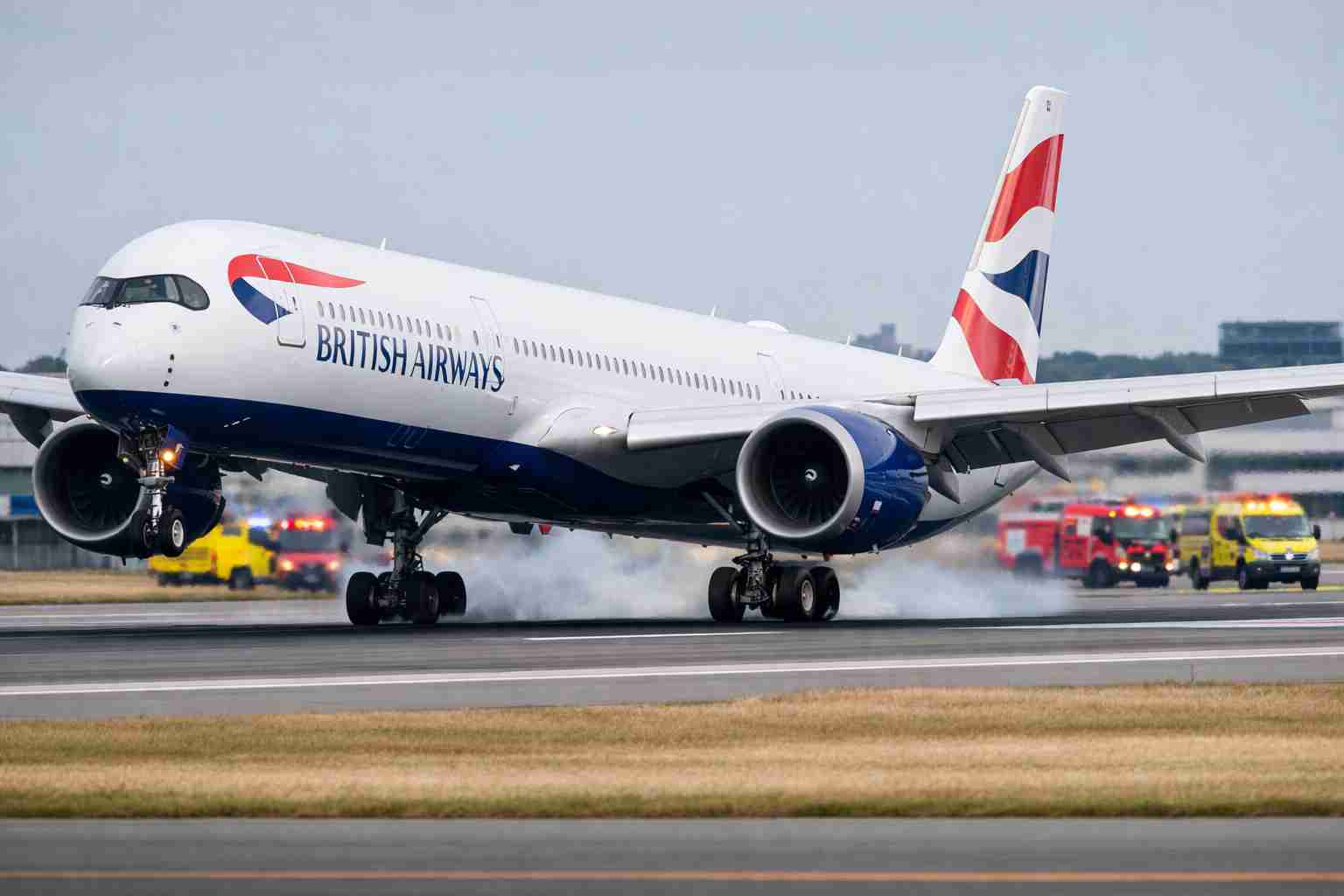
A British Airways long-haul flight operating from Las Vegas to London completed a full transatlantic crossing earlier this week despite losing a wheel shortly after departure, underscoring the resilience of modern aircraft systems and the operational judgment required in managing in-flight mechanical events.
The incident involved a British Airways Airbus A350-1000 operating a scheduled overnight service from Harry Reid International Airport to London Heathrow Airport. Shortly after takeoff, the aircraft experienced a malfunction in its main landing gear, resulting in the detachment of one wheel during the initial climb phase.
Incident Occurs Shortly After Departure
According to information associated with the event, the wheel separated from the right-side main landing gear moments after liftoff from Las Vegas. Video footage captured from the airport perimeter showed sparks near the landing gear as the aircraft rotated for takeoff, followed by the wheel breaking away from the assembly.
Flight crew indications were consistent with a landing gear anomaly, but there was no immediate impact on the aircraft’s controllability or overall performance. The widebody jet continued its climb as planned and stabilized shortly after departure.
The aircraft involved was an Airbus A350-1000, one of the newest-generation long-haul aircraft in commercial service. Designed with multiple redundancies, the A350 family is built to tolerate certain system failures while maintaining safe flight operations.
Decision to Continue the Transatlantic Flight
After assessing the situation, the flight crew elected to continue toward London rather than return to Las Vegas. The aircraft climbed to a cruising altitude of approximately 39,000 feet and proceeded eastbound across the Atlantic Ocean on its scheduled routing.
Operational considerations likely factored into the decision, including aircraft handling characteristics, fuel state, runway performance requirements, and the redundancy built into the landing gear system. Modern widebody aircraft can safely land with missing or damaged wheels under controlled conditions, provided other systems remain fully functional.
Aviation experts note that such decisions are guided by detailed procedures and real-time risk assessments, balancing the safety implications of returning to the departure airport against continuing to a destination with more suitable infrastructure and maintenance capabilities.
Safe Arrival in London
After flying more than 5,200 miles, the aircraft landed safely at London Heathrow. Emergency services were positioned as a precautionary measure, but the landing was completed without further incident.
There were no reported injuries to passengers or crew. Following arrival, inspections confirmed the absence of one main landing gear wheel. The aircraft was subsequently removed from service for detailed maintenance checks and technical evaluation.
British Airways initiated standard internal assessments, while aviation authorities began routine reviews to determine the cause of the wheel separation. Such investigations typically examine maintenance records, component integrity, and inspection procedures.
Implications for the Aviation Industry
While the loss of a landing gear wheel is a rare occurrence, the incident has drawn attention within the aviation sector due to the distance flown and the operational decision-making involved. The successful outcome highlights the robustness of modern aircraft design and the effectiveness of crew training in managing abnormal situations.
Industry analysts note that events like this often contribute to closer scrutiny of maintenance practices, pre-departure inspections, and post-takeoff monitoring systems. Findings from technical reviews may lead to procedural updates or additional inspection requirements across fleets.
Bottom Line
The British Airways Airbus A350-1000 incident demonstrates how advanced engineering, built-in system redundancies, and experienced flight crews can work together to manage unexpected mechanical failures safely.
Despite losing a landing gear wheel shortly after departure, the aircraft completed its transatlantic flight and landed without injury or additional damage, reinforcing confidence in modern commercial aviation operations.
Further updates are expected following the completion of maintenance reviews and regulatory assessments.
