


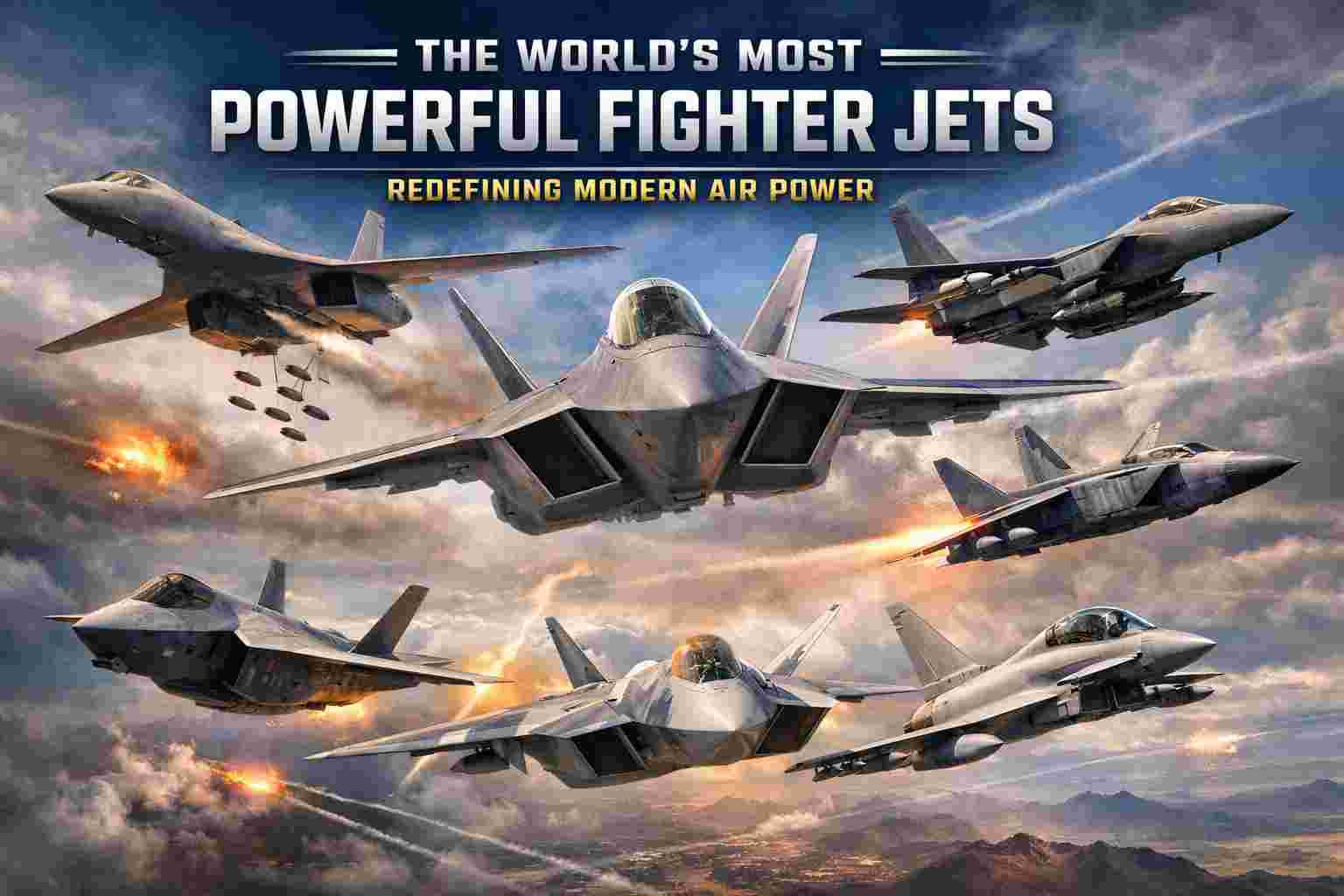
In modern warfare, dominance of the skies is no longer determined by speed or firepower alone. Advances in stealth technology, long-range strike capability, sensor integration, and networking have reshaped how nations project military power from the air. Today’s most formidable combat aircraft influence conflicts long before adversaries ever see them, and in some cases, from thousands of miles away.
Rather than measuring power by a single statistic, defense analysts increasingly assess how aircraft control different dimensions of the battlespace—from information dominance to payload capacity and geographic reach. The following seven aircraft represent the most consequential fighter and combat jets currently in operational service, each excelling in a distinct role that defines modern aerial warfare.
Strategic Striking Power: Boeing B-1B Lancer
Few platforms embody sheer offensive capacity like the B-1B Lancer from Boeing. Powered by four turbofan engines producing more than 120,000 pounds of thrust, the aircraft can carry up to 75,000 pounds of conventional weapons—more than any other operational combat aircraft.
Although it lacks the stealth characteristics of newer bombers, the B-1B compensates with speed and tactics. Its ability to fly at high subsonic speeds while hugging terrain allows it to penetrate defended airspace effectively. With intercontinental range and massive payload capacity, the aircraft remains a central pillar of U.S. long-range strike strategy, capable of reshaping battlefields in a single sortie.
Stealth Air Superiority: Lockheed Martin F-22 Raptor
The F-22 Raptor, developed by Lockheed Martin, represents air dominance at its most asymmetric. Featuring thrust-vectoring engines and a thrust-to-weight ratio greater than 1.25, the aircraft delivers exceptional acceleration, climb rate, and maneuverability.
According to Interesting Engineering, it can sustain supersonic flight without afterburners, giving it a decisive energy advantage in combat. More critically, its low radar cross-section allows it to detect and engage threats long before adversaries are aware of its presence. This combination of stealth, speed, and agility enables the F-22 to dictate the terms of engagement from the outset.
Missile Capacity and Volume: Boeing F-15EX Eagle II
While fifth-generation stealth fighters dominate headlines, the F-15EX Eagle II takes a different approach to power. With nearly 30,000 pounds of payload across 23 hardpoints, the aircraft functions as a flying weapons magazine.
Optimized for scenarios where massed firepower is essential, the F-15EX can carry large numbers of air-to-air and standoff munitions. Its twin engines push the aircraft beyond Mach 2.5, ensuring survivability despite its size. In high-intensity conflicts where missile volume and persistence matter most, the platform offers a decisive operational advantage.
Extreme Maneuverability: Sukhoi Su-57
Russia’s Su-57 reflects a contrasting philosophy centered on aerodynamic performance. Equipped with advanced three-dimensional thrust-vectoring engines, the aircraft can execute extreme high-angle-of-attack maneuvers that few Western fighters can easily replicate.
Although its stealth characteristics are generally considered inferior to U.S. fifth-generation fighters, the Su-57 compensates with exceptional agility. In close-range, high-energy engagements where stealth is less decisive, this emphasis on maneuverability can provide a critical edge.
Information Dominance: Lockheed Martin F-35 Lightning II
The F-35 Lightning II redefines power for the digital era. While its raw speed and payload are modest compared with some peers, its strength lies in sensor fusion and networked warfare.
By integrating radar, infrared, and electronic warfare data into a single operational picture, the aircraft enables pilots to detect and engage threats at extended ranges. Its ability to share that information across allied forces allows a single F-35 to act as an airborne command node, multiplying the effectiveness of surrounding platforms.
Balanced Multirole Performance: Eurofighter Typhoon
The Eurofighter Typhoon occupies a middle ground between raw performance and operational flexibility. Its twin engines deliver strong acceleration and sustained supersonic flight, while its aerodynamic design excels in the transonic regime where many aerial engagements occur.
Designed primarily for air superiority but adaptable for precision strike missions, the Typhoon’s widespread adoption across NATO air forces reflects a balance of performance, reliability, and versatility.
Long-Range Interception: MiG-31 Foxhound
The MiG-31 Foxhound dominates a specialized but vital niche. Capable of approaching Mach 3, it remains the fastest operational combat aircraft in service today.
Its powerful radar and long-range missiles allow it to detect and engage targets hundreds of kilometers away. Built to defend vast airspaces rather than engage in dogfights, the MiG-31’s power lies in reach—neutralizing threats before they penetrate defended territory.
The Bottom Line
There is no single definition of the “most powerful” fighter jet. Modern air power is distributed across stealth, payload, sensors, maneuverability, speed, and strategic reach. Each of these aircraft dominates a different dimension of contemporary warfare, illustrating how power in the skies has become multifaceted.
As military aviation continues to evolve, influence will increasingly shift toward data integration, autonomous systems, and networked operations. For now, these platforms represent the peak of manned air combat—even as the meaning of dominance in the skies continues to be rewritten.
