


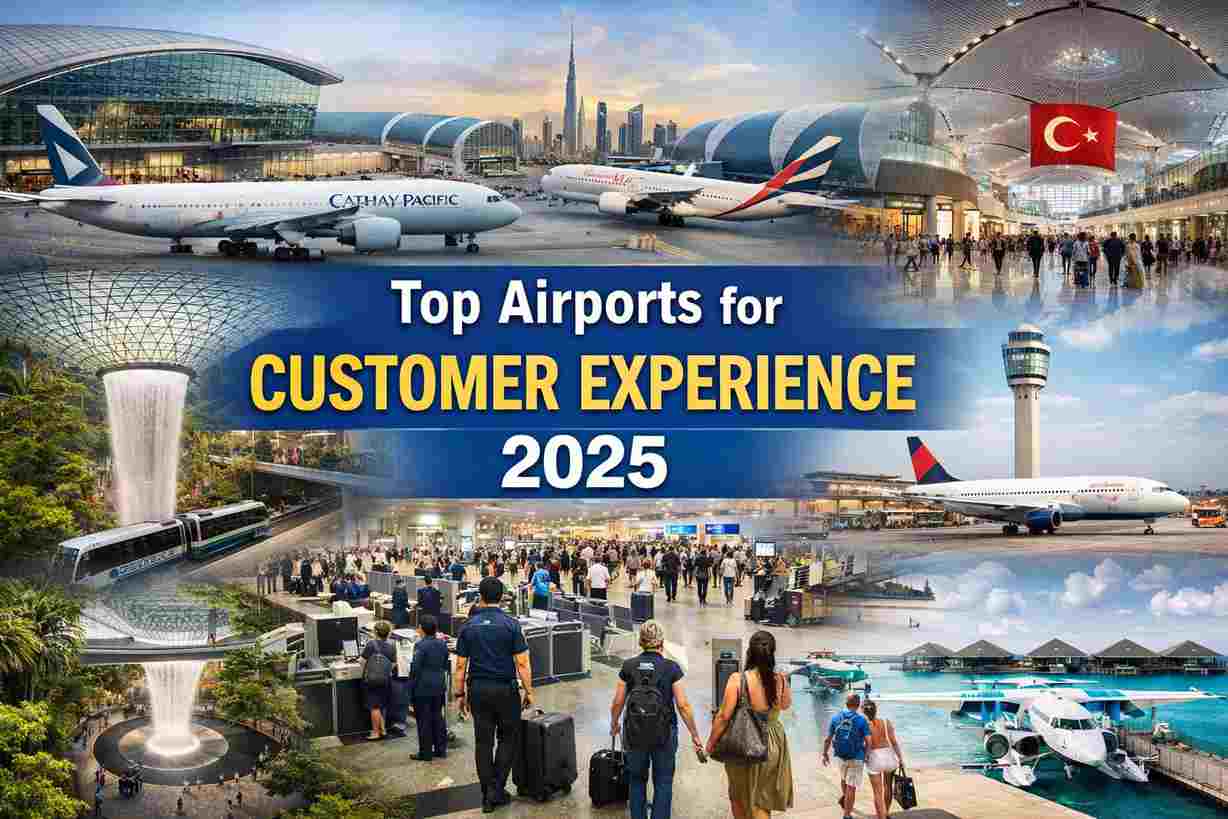
Hong Kong International Airport has been named the world’s leading airport for customer experience in 2025, topping the World Travel Awards’ latest ranking as airports increasingly compete on how smoothly they move passengers from curb to gate.
The annual list highlights 11 airports that the World Travel Awards says are setting the global benchmark for passenger-focused operations, reflecting an industry shift in which customer experience is now judged as much by clarity, comfort, and service as by network size or terminal scale.
“Customer experience has quietly become the defining battleground for the world’s leading airports,” the World Travel Awards ranking noted. “In 2025, excellence is no longer measured purely by size, connectivity, or architectural ambition, but by how smoothly, calmly, and intuitively passengers are guided through every stage of their journey.”
Customer Experience Becomes the New Airport Battleground
Airports recognized this year share a common focus: reducing friction during check-in, security, immigration, transfers, and boarding while offering environments that feel more intuitive and less stressful for travelers.
“From the first kerbside interaction to the final boarding call, airports are expected to reduce friction, anticipate needs, and deliver moments of genuine comfort,” the World Travel Awards ranking said.
The World Travel Awards’ Leading Airports for Customer Experience in 2025, the organization said, are those that “consistently place the passenger at the centre of their operations.” These airports stand out for “their balance of efficiency and warmth, blending smart technology with human service, thoughtful design with cultural character.”
No. 1: Hong Kong International Airport
Hong Kong International Airport ranked first, credited with combining operational performance with a passenger-friendly terminal experience. A major hub for Cathay Pacific, the airport connects Asia with Europe, Oceania, and North America through a broad network of carriers.
The World Travel Awards ranking noted that “check-in, immigration, and security checks are a breeze at this airport,” while its modern design makes “lounges, gates, dining areas, and shops easily accessible from one another.”
The airport is preparing for its next phase of growth, with “its satellite terminal 2 set to open very soon,” which the ranking said will help Hong Kong “enter a new era” and strengthen its position through 2026.
No. 2: Auckland Airport
Auckland Airport placed second, recognized for an experience that “feels calm, personal, and distinctly New Zealand in spirit.” Despite handling growing international demand, the airport was credited with maintaining an “unhurried atmosphere,” supported by clear wayfinding and an intuitive terminal layout.
The ranking also highlighted the airport’s ability to move travelers efficiently without adding pressure. “Security and immigration processes are efficient without feeling rushed,” it said, noting that the airport achieves “a balance that many larger hubs struggle to achieve.”
Retail and dining were cited as key strengths, with options that “lean heavily on local brands,” while “comfortable seating zones, natural light, and thoughtful art installations help ease long layovers.”
No. 3: Cancún International Airport
Cancún International Airport ranked third as the primary gateway to one of the world’s busiest leisure destinations. The World Travel Awards ranking said the airport has continued to refine a passenger experience designed for high-volume holiday travel.
Despite heavy traffic, the ranking said “terminal operations are increasingly streamlined,” with “improved signage and better crowd flow helping reduce stress during peak periods.” Customer service teams were described as “visible and approachable,” especially for international arrivals navigating local procedures for the first time.
The ranking also pointed to recent improvements in comfort, noting that “recent terminal upgrades have improved seating availability and climate comfort,” while ground transportation is “well organised” with clear separation between “tour operators, taxis, and private transfers.”
No. 4: Singapore Changi Airport
Singapore Changi Airport ranked fourth and was described as a continuing global reference point for passenger experience.
“Singapore Changi Airport remains a global reference point for customer experience, and in 2025, it continues to raise expectations rather than rest on its reputation,” the ranking stated.
The airport’s operations were credited with being designed around ease and consistency. “Every interaction, from immigration clearance to gate boarding, feels deliberately designed to minimise effort for passengers,” the ranking said, citing automated systems that work “seamlessly alongside highly attentive staff.”
Changi was also recognized for comfort and amenities, with “abundant seating, quiet rest areas, and a dining selection that rivals city centres,” along with nature and entertainment features that “transform time spent at the airport into an experience rather than a wait.”
No. 5: Dubai International Airport
Dubai International Airport placed fifth, recognized for managing extremely high passenger volumes while maintaining a premium feel.
In 2025, the ranking said the airport’s strength is “efficiency at scale,” supported by “fast-moving security, clear terminal zoning, and extensive staff support across all passenger touchpoints.” The airport’s service model was described as broad-based, with premium travelers benefiting from “world-class lounges,” while economy passengers still have strong access to “retail, dining, and relaxation options.”
No. 6: Hartsfield-Jackson Atlanta International Airport
Hartsfield-Jackson Atlanta International Airport was the only U.S. airport on the list, ranking sixth and earning recognition for operational consistency across one of the world’s busiest hubs.
“Despite its enormous scale, the passenger journey remains remarkably predictable,” the ranking said, calling that predictability “a key component of positive customer experience.” It highlighted “clear signage,” reliable train connections between concourses, and “efficient security operations.”
The ranking also noted that “customer service teams are well-trained and visible,” particularly in helping passengers make tight connections, while dining and retail offerings reflect both “Atlanta’s cultural identity” and national brands.
No. 7: iGA Istanbul Airport
iGA Istanbul Airport ranked seventh, with the World Travel Awards pointing to its combination of large-scale infrastructure and passenger-friendly design.
The airport’s “vast spaces” were described as being supported by “logical layouts, strong wayfinding, and frequent assistance points.” The ranking said Istanbul has continued improving transfers, “making long-haul connections smoother and more intuitive,” while its retail and dining options emphasize “Turkish hospitality and cuisine.”
No. 8: Muscat International Airport
Muscat International Airport placed eighth, recognized for a customer experience defined by calm design and consistent service.
The terminal was described as emphasizing “space, natural light, and uncluttered movement,” creating an environment that feels “composed rather than hectic.” The ranking said immigration and security are handled efficiently, “often with a notably personal touch from staff,” while retail and dining are “curated rather than overwhelming.”
No. 9: Sydney Airport
Sydney Airport ranked ninth, earning recognition for passenger flow and clarity.
The World Travel Awards ranking cited “logical” terminal layouts and “recent improvements to security and immigration processes” that have reduced congestion. It also noted that “customer service teams are proactive,” helping resolve issues before they escalate, and that seating and relaxation zones have expanded.
No. 10: Velana International Airport
Velana International Airport ranked 10th, reflecting its specialized role as the gateway to the Maldives’ resort islands.
In 2025, the ranking said the airport excels at managing complex onward connections, “with staff guiding passengers smoothly through transitions.” While dining and retail options remain limited compared with major hubs, “service levels compensate significantly,” and the airport’s defining strength is “ground and sea transport coordination.”
No. 11: Zayed International Airport, Abu Dhabi
Zayed International Airport rounded out the top 11, recognized for pairing striking architecture with efficient passenger flow.
The World Travel Awards ranking said the terminal “feels spacious without being overwhelming,” and that “passenger flows are carefully managed to avoid bottlenecks.” It highlighted “well-trained staff providing clear guidance at every stage of the journey,” along with premium-leaning retail and dining that remains accessible to a broad range of travelers.
Bottom Line: Consistency, Empathy, and Design Define the Leaders
The World Travel Awards ranking concluded that the leading airports for customer experience in 2025 show how performance is increasingly tied to service quality, terminal design, and operational reliability.
“The Leading Airports for Customer Experience in 2025 demonstrate that true excellence lies in consistency, empathy, and intelligent design,” the ranking said. “Whether operating at a massive global scale or serving niche leisure markets, these airports succeed by understanding passenger needs and reducing friction at every turn. Together, they set the global standard for how airports should feel in an increasingly complex travel environment.”
