


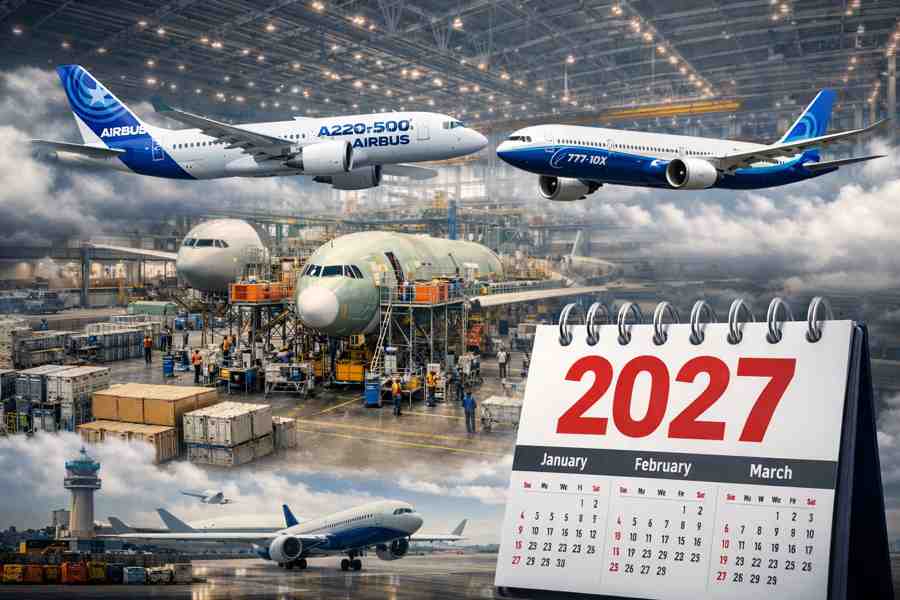
DUBLIN—Global aircraft lessor Avolon is signaling that Airbus and Boeing could move toward launching a new commercial aircraft program in 2027, as airlines remain profitable and demand continues to outstrip the industry’s ability to deliver new jets.
The projection is included in Avolon’s 2026 Up Next report, which points to sustained momentum in the global aviation market even as manufacturers and suppliers struggle to increase production. The report forecasts global airline industry profits reaching $41 billion next year, supported by continued economic expansion, easing fuel costs, and resilient international travel demand.
While airlines have benefited from higher passenger volumes and stronger pricing power, Avolon said the market remains constrained by a structural shortage of aircraft that is limiting growth and forcing carriers to compete for scarce delivery slots.
A Realistic Window for New Aircraft Programs
Avolon expects 2027 to be a plausible timeframe for manufacturers to formally launch a new aircraft program, with both Airbus and Boeing under growing pressure to address gaps across key market segments.
The lessor highlighted three potential candidates as frontrunners: Airbus’s proposed A220-500 and A350-2000, and Boeing’s conceptual 777-10X. These models would target demand in both the single-aisle and widebody categories, where airlines are seeking more efficient aircraft to support network expansion and replace aging fleets.
Avolon said 2026 remains too early for a new launch due to ongoing supply chain constraints and certification pressures, factors that have continued to delay deliveries and limit manufacturers’ flexibility. However, the report suggests that the longer the supply-demand imbalance persists, the more difficult it becomes for Airbus and Boeing to avoid making program decisions.
Single-Aisle Competition Intensifies
The report also drew attention to competitive dynamics in the narrowbody market, where airlines have placed large orders for aircraft designed to serve high-demand routes with improved fuel efficiency.
Avolon noted that Boeing’s 737-10 continues to face significant pressure from the Airbus A321neo, which has outsold the competing Boeing model by a wide margin in recent years. The A321neo has become a key product for airlines seeking higher capacity in a single-aisle aircraft, while Boeing has worked through delays and certification challenges affecting its MAX family.
The ongoing imbalance in orders, Avolon suggested, adds to the urgency for manufacturers to consider new program options that can better match evolving airline requirements.
Backlogs Stretch Beyond 11 Years
Avolon’s report emphasizes that the industry’s aircraft shortage is not a short-term issue but a multi-year constraint that could shape airline growth plans well into the next decade.
Order backlogs at Airbus and Boeing now extend beyond 11 years, effectively meaning that production capacity is largely sold out for years ahead. With airlines unable to secure near-term aircraft directly from manufacturers, lessors are playing an increasingly strategic role by providing access to delivery slots.
This shortage has contributed to higher lease rates and stronger residual values for in-demand aircraft types, according to Avolon, as airlines compete for limited capacity and prioritize fleet modernization.
The report estimates that about $120 billion worth of new aircraft deliveries are expected in 2026, representing a 20% increase year-on-year. Even with that improvement, Avolon’s outlook suggests the supply ramp-up is still not enough to close the gap between demand and available aircraft.
Lessors Gain Influence as Fleet Financing Shifts
Avolon also expects lessors to strengthen their position in the global aviation ecosystem as airlines rely more heavily on leasing to secure aircraft and manage capital requirements.
Lessors are projected to finance nearly half of the global fleet, reinforcing their growing influence in fleet planning decisions and their ability to negotiate strategically with manufacturers and airlines.
In a market where production limitations continue to restrict direct airline access to new aircraft, Avolon said lessor-held delivery positions are becoming more valuable—particularly for carriers seeking next-generation models but facing long wait times.
India, UAE, and Saudi Arabia Lead the Next Growth Cycle
Avolon identified India, the UAE, and Saudi Arabia as the primary drivers of the next wave of aviation growth, reflecting expanding middle-class travel demand, major airline investment, and broader economic diversification initiatives.
The three markets collectively hold an order backlog exceeding 3,000 aircraft, more than double their current in-service fleets. Around 900 aircraft are scheduled for delivery to these regions over the next three years, highlighting the scale of planned expansion.
International markets already accounted for 85% of global capacity growth in 2025 and are expected to dominate again in 2026, according to the report, reinforcing the industry’s reliance on emerging and fast-growing travel corridors.
Avolon also pointed to China’s near-term need for 1,000 additional aircraft, though delivery timelines remain limited by production constraints and the broader manufacturing bottleneck.
Bottom Line: Strong Profits, Limited Planes, Rising Pressure
Avolon’s outlook suggests the aviation industry is entering a prolonged period in which airlines remain financially strong but operationally constrained by aircraft availability.
With profits forecast at $41 billion in 2026 and manufacturer backlogs extending beyond a decade, pressure is building for Airbus and Boeing to pursue new aircraft programs by 2027. For airlines, the next generation of aircraft could offer efficiency gains and added capacity, but access will remain tight.
For well-capitalized lessors, the environment continues to support stronger pricing and strategic leverage as airlines compete for scarce delivery slots in a market still defined by undersupply.
