


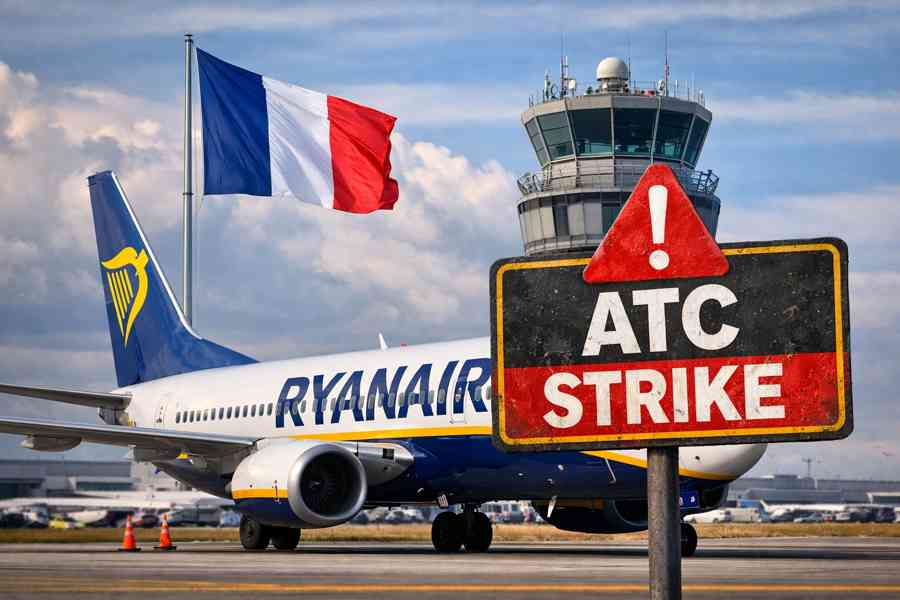
DUBLIN — Ryanair chief executive Michael O’Leary is warning passengers to prepare for renewed travel disruption across Europe if French air traffic controllers return to industrial action from late spring, arguing that staffing shortfalls—not runway or airspace constraints—are the primary driver of delays in France and beyond.
Speaking at the airline’s third-quarter briefing on Jan. 21, O’Leary said recurring shortages in controller availability are creating avoidable bottlenecks, particularly during the busiest travel periods. He pointed to weekend absenteeism as an escalating operational challenge during peak schedules, adding that even limited reductions in French air traffic control capacity can quickly cascade across the wider European aviation network.
France plays a central role in European airspace flows, particularly for aircraft traveling north to south across the continent. As a result, disruptions inside French airspace often affect far more than flights departing from or arriving in the country.
French ATC delays continue to dominate Europe’s summer disruption picture
French air traffic control strikes have repeatedly coincided with high-demand travel periods, amplifying their impact on airlines, airports, and passengers. In early July last year, coordinated walkouts hit the end-of-school holiday rush and forced carriers to cancel hundreds of flights.
Ryanair alone cancelled at least 170 services during the two-day action, affecting more than 30,000 passengers.
According to Eurocontrol data, French air traffic control accounted for 31 percent of all ATC-related delays in Europe during summer 2025, the highest share on the continent. The figure underscores how disruptions in France can dominate the overall European delay landscape, particularly during the summer travel peak when airline schedules are operating at maximum intensity.
The scale of delays has become a growing concern for carriers trying to protect punctuality and manage costs. For low-cost airlines like Ryanair, even small operational disruptions can quickly erode efficiency, forcing aircraft and crews out of position and triggering delays that carry through the rest of the day.
O’Leary blames staffing reliability, not infrastructure limits
At the Jan. 21 briefing, O’Leary said the core issue is not a lack of physical infrastructure, but staffing reliability—particularly during the first wave of morning departures, when airlines depend on a smooth start to the day to keep networks running on time.
According to Connexion France, O’Leary described the resulting restrictions as avoidable, stating that controllers simply failed to report for duty during critical operating windows.
He argued that this creates artificial capacity limits that ripple through airline schedules and ultimately harm passengers through cancellations, missed connections, and extended travel times. Airlines, he said, can plan around predictable limitations, but staffing volatility introduces uncertainty that is difficult to manage without cutting flights.
O’Leary also said the impact is especially severe when disruption occurs over weekends, a period when leisure travel demand is typically highest and aircraft utilization is at its most intense.
Why French airspace disruption hits Europe beyond France
The disruption linked to French strikes often extends well beyond flights that touch French airports. Aircraft transiting French airspace account for a significant share of north-south European traffic, connecting major markets such as the United Kingdom, Spain, and Italy.
When controllers reduce capacity, airlines are frequently forced to reroute flights through Spanish or German airspace. While rerouting can keep flights operating, it comes at a cost: longer flight times, higher fuel burn, and increased operating expenses. Those diversions also create congestion in neighboring airspace, which can produce knock-on delays throughout the network.
For airlines, that means higher costs and reduced operational efficiency. For passengers, it can translate into late arrivals, missed onward travel, and last-minute schedule changes—especially during the peak summer season when spare capacity is limited.
Ryanair urges EU action and penalties for understaffing
O’Leary urged the European Union to take a more aggressive approach to oversight of air traffic control staffing, including financial penalties for providers that fail to adequately staff the first wave of morning departures.
He argued that consistent staffing could significantly reduce disruption without requiring new infrastructure investment, framing the issue as one of operational accountability rather than long-term capital spending.
The call reflects broader airline frustration across Europe, where carriers have repeatedly argued that air traffic control disruptions undermine efforts to improve punctuality and reduce costs, even as airlines face pressure to limit emissions and operate more efficiently.
Ryanair scales back France capacity amid taxes and ATC disruption
Ryanair has already reduced its exposure to the French market in response to what it calls an increasingly uncompetitive operating environment. The airline cut flights to and from France by 13 percent during the winter 2025 schedule, citing higher taxes and persistent ATC disruption.
Further reductions are expected in summer 2026, particularly at regional airports, even as the carrier reports record summer profits and rising passenger volumes.
Still, Ryanair has selectively restored some routes, including services between Tours and London Stansted, along with several U.K. links to Bergerac and Béziers. The airline has signaled that it remains willing to deploy capacity in France where operating conditions support reliability and demand, but insists that predictable air traffic control performance is essential for sustainable growth.
Bottom line: Summer 2026 could bring repeat disruption risk
Ryanair’s warning highlights ongoing structural challenges in European air traffic management, with France at the center of the region’s disruption risk during peak travel months.
Unless staffing reliability improves, airlines and passengers may once again face widespread delays, cancellations, and higher operating costs during the 2026 summer season—particularly if industrial action returns during late spring or early summer.
